
Christians 0, Christians 0
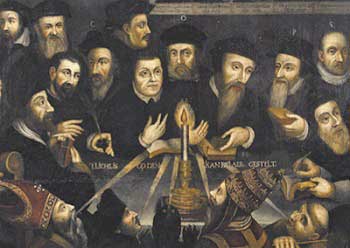
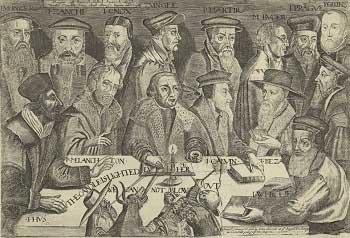
Even during the persecutions of the Romans against the Christians, churches were cleft by rivalry and schism.
- Samuel Laeuchli, The Serpent and the Dove: Five Essays on Early Christianity
The full record shows clearly that the prime object of Christian hatred, at all times, were not pagans but “heretics” who saw themselves in fact as the “real” Christians. Within that conflict lay an unresolved tension between the command to love oneʼs enemies and the equally strong command to reject Satan and all his works. For in any given situation a Christian does not automatically know which of those two commands to follow. By attacking heretics as tools of Satan, Christian militants seized the rhetorical high ground and shifted the focus from loving oneʼs enemies to opposing Satan - using Jesusʼ own words to do so?
Hatred of heresy (setting one Christian against another) was not new in the fourth century. What was new, however, was the option of bringing to bear the coercive power of the state?
Heresy was also the issue that mobilized the monks behind a message of coercion instead of love. Pagan critics provide vivid accounts of rampaging, black-robed mobs, and even the Christian emperor Theodosius is known to have remarked that “the monks commit many crimes.” The potential for organized violence in these spiritual communities - whose inhabitants, by mid-century, are said to have numbered tens of thousands - should not be underestimated. The monks also wielded a spiritual authority that turned what otherwise might have seemed senseless acts of violence into moral crusades.
- H. A. Drake, “Lambs Into Lions: Explaining Early Christian Intolerance,” Past and Present, No. 153, 1996
When the Emperor Constantine repented the murder of his wife, his son, and “some of his nearest relatives,” he was told by a Roman philosopher that such guilt as his could not be eradicated. When some Christian bishops, however, informed him that he could be purified by baptism, he was delighted, and became a Christian. Afterwards, he always carried a priest with him and accepted baptism only on his deathbed so that he might commit sin with impunity to the very end?
Constantine was induced by the bishops to issue a decree outlawing all Christian sects (“the Novatians, Valentinians, Marcionites, Paulians, Montanists,” etc.) other than the one he had converted to. They were “in league with the devil,” and he “commanded all their houses of prayer be made over to the Catholic Church; that no facility whatever be left for any future gathering.”
Ironically, scarcely was the signet dry on this edict when Arianism erupted in the East, Donatism split the northwestern African churches into warring camps, and Manichaeism began to spread throughout Christendom?
There is only one phase of ancient Christian persecution which remains fully recorded: the five decades in which Arian and Athanasian Christians contended for supremacy and in which several hundreds of thousands must have perished while millions suffered distress or exile.
- Martin A. Larson, The Story of Christian Origins
[Murderous riots broke out between Christians over the appointment of Arian or Athanasian bishops.] Probably more Christians were slaughtered by Christians in two years (A.D. 342-343) than by all the persecutions by pagans in the history of Rome.
- Will Durant, The Story of Civilization, Vol. 4, The Age of Faith
From the very first the Church was faced with the task of establishing dogmas. For Christianity abounds in problems more hinted at than answered in the New Testament…
The first ecumenical church council, the Council of Nicea, assembled in the year 325 in the imperial palace of the first Christian emperor, Constantine. Once the discussions started the participants threw their Episcopal dignity to the wind and shouted wildly at each other. They were concerned primarily with improving their positions of power. Diplomacy was wielded as a weapon, and intrigues often replaced intelligence. There were so many ignorant bishops that one participant bluntly called the council “a synod of nothing but blockheads.” Constantine, who treated religious questions solely from a political point of view, assured unanimity by banishing all the bishops who would not sign the new profession of faith hammered out at the council. In this way unity was achieved…
The council also pronounced Arius a heretic. People who owned his writings were ordered to deliver them up on pain of punishment. Arius was banished. And the emperor declared that to side with Arius was a crime. Violent repression of the Arian heresy, however, accomplished the opposite, and served to spread rather than crush the heresy…
Someone close to the emperor intervened on Ariusʼ part and in 330, Arius was reinstated to his priesthood. The hoped for reconciliation between Arius and Athanasius, failed; the factional struggle continued and became intertwined with political disputes. Then, ten years after being condemned, Arianism gained the upper hand, was proclaimed truth, and the opposing party condemned as advocates of error. In 335 it was Bishop Athanasiusʼ turn to go off into exile…
But then, on the eve of his reinstallation to ecclesiastical power, Arius died (or was possibly murdered). History is dumb as to the means of his death, but Athanasius circulated his own version of what happened. He said that Arius fainted in a public privy, and, like Judas Iscariot, his bowels poured out of him, his liver emerged, covered with blood, and then, suffering the most violent pain, he discharged his heart, the seat of all his wickedness. To crown these horrors, Ariusʼ whole body became thinner and thinner until at last the heretic fell through the opening of the privy into the sewer beneath. Which no doubt tells us more about the character of Athanasius, who spread such a repulsive story, than about what really happened to Arius…
At the church council held at Ephesus in 449 the discussion became so inflamed that the delegates went at one another with clubs, until one party held the field and could enforce the decree it desired. Fanatical bands of monks terrorized the assembly of Church notables. Envoys from the church at Rome were set upon and soundly thumped. Leo the Great called it “The Robber Council,” nor was this the only one of its kind. There were other councils at which the Church Fathers became so incensed that they hurled the Bible at each otherʼs heads.
- Walter Nigg, The Heretics
In 380 A.D. the Christian Roman Emperor, Theodosius, passed a decree that read: “We shall believe in the Holy Trinity. We command that those persons who follow this rule shall embrace the name of Catholic Christians. The rest, however, whom We adjudge demented and insane, shall sustain the infamy of heretical dogmas, their meeting places shall not receive the name of churches, and they shall be smitten first by divine vengeance and secondly by the retribution of Our own initiative, which We shall assume in accordance with the divine judgment.”
- J. N. Hillgarth, The Conversion of Western Europe
Christianity created dissension throughout the Roman Empire as Christian fought Christian?After Donatist Christians were persecuted by anti-Donatists of the Empire, leaving their fertile province pillaged with fire and sword, the Donatists welcomed the Vandal invaders of their province with joy, and North Africa was lost to Rome.
Following this, the disputes of the third and fourth general Christian councils alienated Egyptian Christians from the Christians of Asia Minor and Constantinople. The Emperor Justinian enacted measures to win back the Egyptians to orthodoxy. But that only infuriated them more, and, when the Arabs invaded Egypt the Egyptians received them as deliverers, and fell in fury on their Greek defenders, and drove them into the sea. One Egyptian Christian said to Amrou, the Saracen general, “With the Greeks I desire no communion, either in this world or the next, and I adjure forever the Byzantine tyrant, and his Christian synod of Chalcedon.”
Nestorian Christians were forced from the Empire, and went into Asia, establishing what became for a while the largest church in Christendom. “Under the rod of persecution, Nestorian and Monophysite Christians degenerated into rebels and fugitives; and the most ancient and useful allies of Rome were taught to consider the emperor not as the chief, but as the enemy of Christians.” (Gibbon, The Decline and Fall of The Roman Empire)
Differences of opinion regarding the date of Easter grew in intensity over time, and constituted a major factor in bringing about the separation of the churches of Rome (Catholic) and Constantinople (Orthodox) that exists today.
Ebionite Christians and Gnostic Christians were treated poorly, although Ebionites were in all likelihood the truest adherents of primitive Christianity, and the Gnostics were the “Christian humanists” of their day.
The hatred between Christian groups was extraordinary. In the middle of the fifth century they disputed whether the words, “who was crucified for us” should be added to the Trisagion (the “Holy, holy, holy” song sung eternally in heaven according to Isaiah and the book of Revelation). Over this dispute, the city of Constantinople suffered a series of riots, Thrace was depopulated, and as many as tens of thousands of Christians on the wrong side of the argument were slain. The Emperor was forced to go into hiding to beg for mercy.
- Madalyn Murray OʼHair, “Gibbon, the Historian, and Christianity,” An Atheist Speaks
After one “election meeting” in a church, in October 366, the “ushers” picked up from the floor one hundred and sixty Christian corpses! It is sheer affectation of modern Roman Catholic writers to question this, as we learn it from a report to the emperor of two priests of the time. The riots of the Christians which filled the streets of Rome with blood for a week, are, in fact, ironically recorded by the contemporary Roman writer, Ammianus Marcellinus.
In one day the Christians murdered more of their brethren than the pagans can be positively proved to have martyred in three centuries, and the total number of the slain during the fight for the papal chair (in which the supporters of Pope Damasus literally cut his way, with swords and axes, to the papal chair through the supporters of the rival candidate Ursicinus) is probably as great as the total number of actual martyrs. If we add to these the number of the slain in the fights of the Arians and Trinitarians in the east and the fights of Catholics and Donatists in Africa, we get a sum of “martyrs” many times as large as the genuine victims of Roman law; and we should still have to add the massacre by Theodosius at Thessalonica, the massacre of a regiment of Arian soldiers, the lives sacrificed under Constantius, Valentinian, etc.
This frightful and sordid temper of the new Christendom is luridly exhibited in the murder of Hypatia of Alexandria in 415. Under the “great” Father of the Church, Cyril of Alexandria, a Christian mob, led by a minor cleric of the church, stripped Hypatia naked and gashed her with oyster shells until she died (though I have read that she was clubbed to death before her flesh was stripped off her bones - Skip). She was a teacher of mathematics and philosophy, a person of the highest ideals and character. This barbaric fury (of the Christians) raged from Rome to Alexandria and Antioch, and degraded the cities with spectacles that paganism had never witnessed…
Salvianus, a priest of Marseilles of the fifth century, deplores the vanished virtue of the pagan world and declares that “The whole body of Christians is a sink of iniquity.” “Very few,” he says, “avoid evil.” He challenges his readers: “How many in the Church will you find that are not drunkards or adulterers, or fornicators, or gamblers, or robbers, or murderers - or all together?” (De Gubernatione Dei, III, 9) Gregory of Tours, in the next century, gives, incredible as it may seem, an even darker picture of the Christian world, over part of which he presides. You cannot read these truths, unless you can read bad Latin, because they are never translated. It is the flowers, the rare examples of virtue, the untruths of Eusebius and the Martyrologies, that are translated. It is the legends of St. Agnes and St. Catherine, the heroic fictions of St. Lawrence and St. Sebastian that you read. But there were ten vices for every virtue, ten lies for every truth, a hundred murders for every genuine martyrdom.
- Joseph McCabe, “How Christianity Triumphed”
Art, philosophy, literature, the very psychology of Western man, all suffered by the victory of the bishops.
- John Holland Smith, The Death of Classical Paganism
The Christian zealots for conversion took to the streets or criss-crossed the countryside, destroying no doubt more of the architectural and artistic treasure of their world than any passing barbarians thereafter.
- Ramsay MacMullen, Christianizing the Roman Empire
There was a time when religion played an all-powerful role in European politics with Protestants and Catholics organizing themselves into political factions and squandering the wealth of Europe on sectarian wars. English liberalism emerged in direct reaction to the religious fanaticism of the English Civil War. Contrary to those who at the time believed that religion was a necessary and permanent feature of the political landscape, liberalism vanquished religion in Europe. After a centuries-long confrontation with liberalism, religion was taught to be tolerant?
In the sixteenth century, it would have seemed strange to most Europeans not to use political power to enforce belief in their particular sectarian faith. Today, the idea that the practice of religion other than oneʼs own should injure oneʼs own faith seems bizarre, even to the most pious churchmen. Religion has been relegated to the sphere of private life - exiled, it would seem, more or less permanently from European political life except on certain narrow issues like abortion…
Religion per se did not create free societies; Christianity in a certain sense had to abolish itself through a secularization of its goals before liberalism could emerge…
Political liberalism in England ended the religious wars between Protestant and Catholic that had nearly destroyed that country during the seventeenth century: with its advent, religion was defanged by being made tolerant.
- Francis Fukuyama, The End of History and the Last Man
The Thirty Yearsʼ War began in 1618 when Protestant leaders threw two Catholic emissaries out of a Prague window into a dung heap. War flared between Catholic and Protestant princedoms, drawing in supportive religious armies from Germany, Sweden, France, and Italy. Swedenʼs Protestant soldiers sang Martin Lutherʼs “Ein Feste Burg” in battle. Three decades of combat turned central Europe into a wasteland of misery. One estimate stated that due to the war and resulting famine and pestilence, Germanyʼs population dropped from eighteen million to four million. In the end nothing was settled.
- James A. Haught, Holy Horrors: An Illustrated History of Religious Murder and Madness
Herbert Langer in The Thirty Yearsʼ War, says that more than one quarter of Europeʼs population died as a result of those thirty years of slaughter, famine and disease. Ironically, the majority of Europeans who killed each other shared such orthodox religious beliefs as Jesusʼ deity, the Trinity, and even “creationism.” So you canʼt blame the horrific spectacle of the Thirty Yearsʼ War on modern day scapegoats like atheism, humanism or the theory of evolution. Such a war demonstrates that getting nations to agree on major articles of faith does not ensure peace. Far from it. Some of the most intense rivalries exist between groups whose beliefs broadly resemble one another but differ in subtle respects.
- Skip Church
In 1844 Protestants besieged Catholic neighborhoods in Philadelphia with cannon fire, pistols, and by setting houses aflame, because the Catholics had protested the use of the Protestantʼs King James Bible in public schools. Martial law was declared, and it took two thousand federal troops to quell the rioting; eighteen people were killed and scores more were injured.
- Michael Feldberg, The Philadelphia Riots of 1844: A Study of Ethnic Conflicts
Neighbors say the trouble began eight years ago when a second storefront church opened next door to an existing one in Brooklyn. From that time on there were accusations of slashed tires, hung-up phone calls, and parking in each othersʼ driveways. The differences were resolved, however, when the pastor of the Prince of Peace Disciples and his three sons confronted members of the Church of the Lord Jesus Christ and accused them of firing gunshots at their building. The pastorʼs sons then took out their guns and fired away, killing one of the parishioners and wounding the other two.
- J. D. Bell, “Nuts in the News,” The American Rationalist, May/June 1997
A holy war was set off in Brazil when a Pentecostal pastor, opposed to the “image-worship” of the nations 110,000 Catholics, displayed a statue of a black version of the Virgin Mary called Our Lady of Aparecida, and referred to it as “a horrible, disgraceful doll” while kicking and slapping it. Screaming, rock-throwing crowds surrounded the church of the Pentecostal pastor while thousands of Catholics protested by carrying images of the Virgin through the streets.
- J. D. Bell, “Nuts in the News,” The American Rationalist, May/June 1997
A 32-year-old Catholic woman was beaten to death after she refused to enter an evangelical church in northeastern Brazil. She was passing by the Church of the Kingdom of God when two pastors ordered their followers to bring her inside to attend a ceremony. When she refused, the group held her ten-year-old daughter while the pastors dragged her by the hair and beat her in order to “exorcise the devil from her.”
- J. D. Bell, “Nuts in the News,” The American Rationalist, Nov./Dec. 1994
There has never been a kingdom given to so many civil wars as that of Christʼs.
- Charles de Montesquieu
Indians 0, Christians 1
On average two thirds of the native population were killed by colonist-imported smallpox before violence began. This was a great sign of “the marvelous goodness and providence of God” to the Christians of course, e.g. the Governor of the Massachusetts Bay Colony wrote in 1634, as “for the natives, they are near all dead of the smallpox, so as the Lord hath cleared our title to what we possess.”
Although none of the settlers would have survived winter without native help, they soon set out to expel and exterminate the Indians. Warfare among (north American) Indians was rather harmless, in comparison to European standards, and was meant to avenge insults rather than conquer land. In the words of some of the pilgrim fathers: “Their Wars are far less bloody,” so that there usually was “no great slaughter of either side.” Indeed, “They might fight seven years and not kill seven men.” What is more, the Indians usually spared women and children.
In the spring of 1612 some English colonists found life among the (generally friendly and generous) natives attractive enough to leave Jamestown - “being idle … did run away unto the Indians” - to live among them. “Governor Thomas Dale had them hunted down and executed: ‘Some he appointed to be hanged Some burned Some to be broken upon wheels, others to be staked and some shot to death.’” Of course these elegant measures were reserved for fellow Englishmen: “This was the treatment for those who wished to act like Indians. For those who had no choice in the matter, because they were the native people of Virginia” methods were different: “when an Indian was accused by an Englishman of stealing a cup and failing to return it, the English response was to attack the natives in force, burning the entire community” down.
On the territory that is now Massachusetts the founding fathers of the colonies were committing genocide, in what has become known as the Peqout War. The killers were New England Puritan Christians, refugees from persecution in their own home country England. When however, a dead colonist was found, apparently killed by Narragansett Indians, the Puritan colonists wanted revenge. Despite the Indian chiefʼs pledge they attacked. Somehow they seem to have lost the idea of what they were after, because when they were greeted by Pequot Indians (long-time foes of the Narragansetts) the troops nevertheless made war on the Pequots and burned their villages. The puritan commander-in-charge, John Mason, wrote after one massacre: “And indeed such a dreadful Terror did the Almighty let fall upon their Spirits, that they would fly from us and run into the very Flames, where many of them perished… God was above them, who laughed his Enemies and the Enemies of his People to Scorn, making them as a fiery Oven…Thus did the Lord judge among the Heathen, filling the Place with dead Bodies”: men, women, children. So “the Lord was pleased to smite our Enemies in the hinder Parts, and to give us their land for an inheritance.” Because of his readersʼ assumed knowledge of Deuteronomy, there was no need for Mason to quote the words that immediately follow: “Thou shalt save alive nothing that breatheth. But thou shalt utterly destroy them…” (Deut 20) Masonʼs comrade Underhill recalled how “great and doleful was the bloody sight to the view of the young soldiers” yet reassured his readers that “sometimes the Scripture declares women and children must perish with their parents.” Other Indians were killed in successful plots of poisoning. The colonists even had dogs especially trained to kill Indians and to devour children from their mothers breasts, in the colonistsʼ own words: “blood Hounds to draw after them, and Mastiffs to seize them.” In this way they continued until the extermination of the Pequots was near. The surviving handful of Indians “were parceled out to live in servitude. John Endicott and his pastor wrote to the governor asking for ‘a share’ of the captives, specifically ‘a young woman or girl and a boy if you think good.’”
Other tribes were to follow the same path. Comment the Christian exterminators: “Godʼs Will, which will at last give us cause to say: How Great is His Goodness! and How Great is his Beauty!” “Thus doth the Lord Jesus make them to bow before him, and to lick the Dust!” Like today, lying was morally acceptable to Christians then. “Peace treaties were signed with every intention to violate them: when the Indians ‘grow secure upon (sic) the treaty’, advised the Council of State in Virginia, ‘we shall have the better Advantage both to surprise them, & cut down their Corn.’”
In 1624 sixty heavily armed Englishmen cut down 800 defenseless Indian men, women and children. In a single massacre in “King Philipʼs War” of 1675 and 1676 some “600 Indians were destroyed. A delighted Cotton Mather, revered pastor of the Second Church in Boston, later referred to the slaughter as a ‘barbecue.’”
To summarize: Before the arrival of the English, the western Abenaki people in New Hampshire and Vermont had numbered 12,000. Less than half a century later about 250 remained alive - a destruction rate of 98%. The Pocumtuck people had numbered more than 18,000, fifty years later they were down to 920 - 95% destroyed. The Quiripi-Unquachog people had numbered about 30,000, fifty years later they were down to 1500 - 95% destroyed. The Massachusetts people had numbered at least 44,000, fifty years later barely 6000 were alive - 81% destroyed. These are only a few examples of the multitude of tribes living before Christian colonists set their foot on the New World. All this was before the smallpox epidemics of 1677 and 1678 had occurred. And the carnage was not over then. All the above was only the beginning of the European colonization, it was before the frontier age actually had begun. A total of maybe more than 150 million Indians (of both Americas) were destroyed in the period of 1500 to 1900, on average two thirds by smallpox and other epidemics, that leaves some 50 million killed directly by violence, bad treatment and slavery.
Reverend Solomon Stoddard, one of New Englandʼs most esteemed religious leaders, in “1703 formally proposed to the Massachusetts Governor that the colonists be given the financial wherewithal to purchase and train large packs of dogs ‘to hunt Indians as they do bears’.”
Massacre of Sand Creek, Colorado 11/29/1864. Colonel John Chivington, a former Methodist minister and still elder in the church (“I long to be wading in gore”) had a Cheyenne village of about 600, mostly women and children, gunned down despite the chiefsʼ waving with a white flag: 400-500 killed. From an eye-witness account: “There were some thirty or forty squaws collected in a hole for protection; they sent out a little girl about six years old with a white flag on a stick; she had not proceeded but a few steps when she was shot and killed. All the squaws in that hole were afterwards killed …”
By the 1860s “in Hawaii the Reverend Rufus Anderson surveyed the carnage that by then had reduced those islandsʼ native population by 90 percent or more, and he declined to see it as tragedy; the expected total die-off of the Hawaiian population was only natural, this missionary said, somewhat equivalent to ‘the amputation of diseased members of the body’.”
- Kelsos, “Victims of the Christian Faith”
(Most of the above information derived from D. Stannard, American Holocaust, Oxford University Press 1992)
Slaves 0, Christians 1
The Christian church became the biggest slave owner in the Roman Empire. Popes kept slaves until the eighteenth century. Ignatius of Antioch (c. 107-117) refused the request of Christian slaves to have their freedom purchased out of the common fund. Augustine (c. 354-430) taught that slavery was Godʼs will and that Christianity did not make slaves free but made good slaves out of bad ones. (The City of God 19.5)
Early in the 11th century Pope Benedict VIII condemned the children of priests to be slaves and Pope Clement did likewise to the whole population of Venice in 1309. Pope Paul III decreed slavery for all Englishmen who supported Henry VIII of England. Papal licenses were granted to the Kings of Portugal in the fifteenth century to conquer “heathen” countries and reduce their inhabitants to “everlasting slavery.” As it says in Psalm 2: “Ask of me, and I shall give thee the heathen for thine inheritance (as slaves), and the uttermost parts of the earth for thy possession. Thou shalt break them with a rod of iron.” Altogether, more than eighteen hundred years of Christianity supported the notion of slavery.
- The Humanist (Great Britain), October 1959
The “Word of God” tells us that a master may beat his slave within an inch of the slaveʼs life, or within “a day or two” of their life: “If a man strikes his male or female slave with a rod and he dies at his hand, he shall be punished. If, however, the slave survives a day or two (before dying), no vengeance shall be taken; for the slave is his masterʼs money.”
(Ex. 21:20-21)
In line with such pearls of wisdom an early Christian Council, The Council of Elvira (c. 305), prescribed that any Christian mistress who beat her slave to death without premeditation was merely to be punished with five years of penance. 1 Peter 2:18-20 teaches that the Christian who is a slave should “patiently endure” even harsh unjust punishments in order to “find favor with God.”
So, according to the “Word of God,” any man who happens to have enough money to buy another man is automatically “worthy of all honor,” (1 Tim. 6:1); slaves should seek to fulfill “the will of God” by obediently serving their masters (Eph. 6:5-6); and slaves who endured “suffering” were “acceptable of God” (1 Peter 2:18-20). Therefore, if slaves did not find their masters “worthy of all honor,” disobeyed their masters, and refused to endure suffering imposed on them by their masters, this displeased not only man, but God.
- Skip Church
English North Americans embraced slavery because they were Christians, not in spite of it.
- Forrest G. Wood, The Arrogance of Faith: Christianity and Race in America from the Colonial Era to the Twentieth
We have men sold to build churches, women sold to support the gospel, and babes sold to purchase Bibles for the poor heathen, all for the glory of God and the good of souls. The slave auctioneerʼs bell and the church-going bell chime in with each other, and the bitter cries of the heart-broken slave are drowned in the religious shouts of his pious master. Revivals of religion and revivals of the slave trade go hand in hand…
Were I to be again reduced to the chains of slavery, next to the enslavement, I should regard being the slave of a religious master the greatest calamity that could befall me. For of all slaveholders with whom I have ever met, religious slaveholders are the worst. I have ever found them the meanest and basest, the most cruel and cowardly, of all others? It was my unhappy lot to belong to a religious slaveholder. He always managed to have one or more of his slaves to whip every Monday morning?
In August, 1832, my master attended a Methodist camp-meeting and there experienced religion. He prayed morning, noon, and night. He very soon distinguished himself among his brethren, and was made a class leader and exhorter…
I have seen him tie up a lame young woman, and whip her with a heavy cowskin whip upon her naked shoulders, causing the warm red blood to drip; and, in justification of the bloody deed, he would quote the passage of Scripture, “He who knoweth the masterʼs will, and doeth it not, shall be beaten with many stripes.” (Luke 12:47)?
I prayed for freedom twenty years, but received no answer until I prayed with my legs.
- Frederick Douglass, Narrative of the Life of Frederick Douglass: An American Slave
Frederick Douglass Was Not The Only Witness To Testify That Christians Were The Cruelest Slaveholders
Henry Bibb…lists six “professors of religion” who sold him to other “professors of religion.” (One of Bibbʼs owners was a deacon in the Baptist church, who employed whips, chains, stocks, and thumbscrews to “discipline” his slaves.) Harriet Jacobs, in her narrative, informs us that her tormenting owner was the worse for being converted. Mrs. Joseph Smith, testifying before the American Freedmenʼs Inquiry Commission in 1863 tells why Christian slaveholders were the worst owners: “Well, it is something like this - the Christians will oppress you more.”
- Donald B. Gibson, “Faith, Doubt and Apostasy,” Frederick Douglass: New Literary and Historical Essays, ed. Eric J. Sundquist Gibson
Letter Written By A Slave To A White Minister Of North Carolina Who Had Recently Preached At That Slaveʼs Plantation
I want you to tell me the reason you always preach to the white folks and keep your back to us. If God sent you to preach to sinners did He direct you to keep your face to the white folks constantly? Or is it because they give you money? If this is the cause we are the very persons who labor for this money but it is handed to you by our masters. Did God tell you to make your meeting houses just large enough to hold the white folks and let the Black people stand in the sun and rain as the brooks in the field? We are charged with inattention. It is impossible for us to pay good attention with this chance. In fact, some of us scarcely think we are preached to at all. Money appears to be the object. We are carried to market and sold to the highest bidder never once inquiring whether sold to a heathen or Christian. If the question was put, ‘Did you sell to a Christian?” what would be the answer, ‘I canʼt tell what he was, he gave me my price, thatʼs all I was interested in?’ Is that the way to heaven? If it is, there will be a good many who go there. If not, their chance of getting there will be bad for there can be many witnesses against them.
- Blacks in Bondage: Letters of American Slaves, ed., Robert S. Starobin
Before the South seceded politically from the North, she seceded religiously. The three largest Christian denominations in the South, the Methodists, Baptists and Presbyterians, seceded from their northern brethren to form separate “Southern” denominations, each founded on the Biblical right (of laymen and ministers) to own slaves.
- Skip Church
The Old School (Presbyterian) General Assembly report of 1845 concluded that slavery was based on “some of the plainest declarations of the Word of God.” Those who took this position were conservative evangelicals. Among their number were the best conservative theologians and exegetes of their day, including, Robert Dabney, James Thornwell and the great Charles Hodge of Princeton - fathers of twentieth century evangelicalism and of the modern expression of the doctrine of biblical inerrancy. No one can really appreciate how certain these evangelicals were that the Bible endorsed slavery, or of the vehemence of their argumentation unless something from their writings is read.
- Kevin Giles, “The Biblical Argument for Slavery,” The Evangelical Quarterly, Vol. 66, No. 1, 1994
Southern Denominations Played A Pivotal Role In Promoting Secession
Southern clergymen spoke openly and enthusiastically on behalf of disunion… Denominational groups across the South officially endorsed secession and conferred blessings on the new Southern nation. Influential denominational papers from the Mississippi Baptist to the Southern Episcopalian, the Southern Presbyterian and the South Western Baptist, agreed that secession “must be effected at any cost, regardless of consequences,” and “secession was the only consistent position that Southern freemen or Christians could occupy.” (One amusing anecdote tells how a prominent member of a Southern Presbyterian church told his pastor that he would quit the church if the pastor did not pray for the Union. Unmoved by this threat, the pastor replied that “our church does not believe in praying for the dead!”)
Meanwhile, Northern clergymen blamed their Southern counterparts for “inflaming passions,” “adding a feeling of religious fanaticism” to the secessionist controversy, and also blamed them for being “the strongest obstacle in the way of preserving the Union.” “In this way, the Northern clergy contributed to the belief in an irrepressible conflict, and aroused the same kind of political passions they were condemning in their Southern brethren.”
One Southern sermon that had “a powerful influence in converting Southern sentiments to secession,” and which was republished in several Southern newspapers and distributed in tens of thousands of individual copies, was Reverend Benjamin B. Palmerʼs sermon, “Slavery a Divine Trust: Duty of the South to Preserve and Perpetuate It,” delivered soon after Lincolnʼs election in 1860. According to Palmer that election had brought “one issue before us” which had created a crisis that called forth the guidance of the clergy. That issue was “slavery.” Palmer insisted that “the South defended the cause of all religion and truth…We defend the cause of God and religion,” while abolitionism was “undeniably atheistic.” Palmer was incensed at the platform of Lincolnʼs political party which promised to constrain the practice of slavery within certain geographical limits instead of allowing it to expand into Americaʼs Western territories. Therefore, the South had to secede in order to protect its providential trust of slavery.
When Union armies reached Reverend Palmerʼs home state, a Union general placed a price on his head, because as some said, the Reverend had done more than “any other non-combatant in the South to promote rebellion.” Thomas R. R. Cobb, an official of the Confederate government, summed up religionʼs contribution to the fervor and ferment of those times with these words, “This revolution (the secessionist cause) has been accomplished mainly by the Churches.”
- Mitchell Snay, Gospel of Disunion
The Southern Presbyterian Church resolved in 1864 (the year after Lincoln issued his Emancipation Proclamation and while the Civil War was still raging): “We hesitate not to affirm that it is the peculiar mission of the Southern Church to conserve the institution of slavery, and to make it a blessing both to master and slave.“ The Church also insisted that it was “unscriptural and fanatical” to accept the dogma that slavery was inherently sinful: it was “one of the most pernicious heresies of modern times” - to which one slaveʼs response was, “If slavery ainʼt a sin, then nothing is.”
- Skip Church
To judge by the hundreds of sermons and specially composed church prayers which have survived on both sides, ministers were among the most fanatical of the combatants from beginning to end. The churches played a major role in dividing the nation, and it may be that the splits in the churches made a final split in the nation possible. In the North, such a charge was often willingly accepted. Granville Moddy, a Northern Methodist, boasted in 1861, “We are charged with having brought about the present contest. I believe it is true we did bring it about, and I glory in it, for it is a wreath of glory round our brow.” Southern clergymen did not make the same boast but of all the various elements in the South they did the most to make a secessionist state of mind possible. Southern clergymen were particularly responsible for prolonging the increasingly futile struggle. Both sides claimed vast numbers of “conversions” among their troops and a tremendous increase in churchgoing and “prayerfulness” as a result of the fighting.
- Paul Johnson, A History of the American People
(Other “results of the fighting” that clergymen were not as boastful about included tremendous outbreaks of syphilis and gonorrhea among Northern and Southern troops, as well as diarrhea, the latter of which killed more soldiers than were killed in battle. - Skip)
By their fruits ye shall know them.
- Jesus Christ (Mat. 7:20)
The fruits of Christianity were religious wars, butcheries, crusades, inquisitions, extermination of the natives of America, and the introduction of African slaves in their place.
- Arthur Schopenhauer