
Showing posts with label problem of pain. Show all posts

Non-Exclusivism, Universalism, Evil, and, Philosophy As One Big “IF”

Non-Exclusivism, Universalism, Evil, and, Philosophy As One Big “IF”

by Edward T. Babinski

Americaʼs leading Evangelical Christian philosophers (influenced perhaps by the struggle to find a way to justify the devilish amount of sheer ignorance in the world) are more attracted to ideas of “non-exclusivism” (i.e., people who are not born-again nor confessing Christians can still be “saved”), including even universalism (i.e., everyone will one day be “saved”), than are Americaʼs leading Evangelical Christian theologians, the latter of whom spout relatively more exclusivistic views based on a stricter linguistic interpretation of the Scriptures.

Though Alvin Plantinga is not a universalist, he is apparently a non-exclusivist who is attracted to the idea that more than just born-again or confessing Christians will be “saved.”

Evangelical Christian philosopher, Vic Reppert [who argues on a philosophical basis that there is a likelihood of a “second chance” after death] adds, “There really isnʼt a firm quotable statement [regarding exactly what Plantingaʼs views are]. However, when I used to attend SCP meeting on a regular basis, I would have to say that exclusivism was very much a minority position. The philosophers, Robert Merrihew Adams and his wife Marilyn McCord Adams, are both Universalists, and next to Plantinga, they are the best-regarded [Evangelical] Christian philosophers.” [email from Reppert to Babinski, Tuesday, October 24, 2006]

Victor Reppert at his blogsite also recently posted an entry debating questions concerning Godʼs “middle knowledge,” titled, Gale, Adams, and universal salvation, that ended with Vicʼs observation that “since Adams [mentioned above] is a card-carrying universalist, it looks like he can dodge this objection. Everyone gets saving grace.”

Philosophy As One Big “If”, Part 1

I suspect there are even more “ifs” if everyone looked harder at every argument—from eternal damnationism to universalism to simply death and rotting. I think it would demonstrate that philosophy is one big “if” when it comes to such questions.

Such “ifs” must also include the fact that the Bible is a book of words written by human beings, and such words are not equivalent to visibly seeing God, Jesus, the afterlife. Furthermore, people who claim to have seen God and/or the afterlife are also FEW in number. And many such “sights” are brief at best, or hazy (and they grow either “hazier” or “clearer” with the passage of time, depending on whether one is relying strictly on oneʼs memory, or continually redefining oneʼs memory of oneʼs vision in verbal terms linked to increasingly dogmatic influences and interpretations applied from outside). Even of those few visions that some claim to have seen clearly, thereʼs a wide variety of things seen, not simply Christian ones. So there is no coherent interpretation that includes and explains all such visions, let alone a “theologically systematic” whole, and as I said, FEW have ever seen such things.

Philosophy As One Big “If”, Part 2, Points For Plantinga And Vic To Ponder Concerning Evil And Freewill

1) If freewill was truly free than maybe itʼs logically impossible to assert that a God with “freewill” can also be defined as “good,” because a God with “freewill” could also act “evil” by definition of having “freewill.” Such a “God” would then have to be defined first and foremost as “free” and His actions defined as “indeterminate” or “vacillating based on choice.”

2) Even if someone tries to argue that the definition of “freewill” (i.e., “always being able to choose either good or evil”) applies to “God,” then thereʼs yet another question.

Letʼs accept a tri-omni good God exists. The “defense” offered for evil in that case is that anything God creates would be inherently less than God and more subject to temptations toward evil. But such an argument simply redefines the words “less than God,” as “evil,” but there is no proof that such a redefinition is necessarily true. Being “less” than “God” does not necessarily entail a creature becoming “evil,” not anymore than Godʼs own “freewill” might leave God in the exact same situation of always having to choose between two options. And Whatever May Be Said In The One Case Applies To Both. Whatever keeps a tri-omni good God from never using His freewill to choose evil, could just as well apply to a less than tri-omni creation that came directly out of that same God. I stick by that statement, but Plantinga and Vic deny it on no provable basis that I have yet seen.

Conclusion

So there is no way for theistic philosophy to prove it has argued its was to reality or THE truth, because it just tries to redefine “freewill” in different terms for God and man, (or, it tries to equate the phrase “less than God” with “evil,” again without proving that it is necessarily so), just based on Presuppositions That It Must Be So. And such presuppositions remain as Questionable as any other view.

In the end the idea of evil coming out of perfect goodness remains an unproven proposition.


All such philosophical arguments also flounder on the fact that we grow up via experiences of this cosmos. We learn about “‘good’ and ‘evil’ and the spectrum of actions lying in the grey area” in this cosmos before we ever learn how to separate those examples and concepts fully from one another in the form of “words,” and claim they are fully and absolutely separate from one another. So the separation takes place afterwards (after oneʼs mental development and contact with the world), and only after such a separation do philosophers take one of those abstracted concepts and try to build a bridge over to the opposite word and concept:

Perfect goodness➜ Evil

When I read about arguments that try to create such a bridge I canʼt help noting all of the sheer ingenuity and guess work employed in the process of trying to find a way to bridge those two things that We as human beings experienced and learned about as they already co-existed together, a world with both good evil and many grey areas of various shades as well. People living in this cosmos in which all those things co-existed, have learned how to pull such things apart mentally, and imagine only one of them existing alone in the beginning, then philosophers try to mentally derive one FROM the other. But that proves nothing about reality itself, the one in which we were raised and in which such things co-existed already.

Itʼs like beginning with

Perfect Cold➜ Hotness

Perfect Darkness➜ Luminosity

A philosopher can of course argue based on scientific knowledge that the answer in the above cases is that molecules start to move faster, generating more heat and even light. But then the philosopher must also recognize that “perfect coldness” has no molecules that move faster than “perfect coldness” allows. Not if you begin with Nothing But “perfect coldness.” So you can Never get to the opposite side or cross the bridge from the initial defining point—you canʼt cross the bridge from one word to the other if both are already so well defined to the complete exclusion of the opposite word. (*Donʼt misunderstand me, I am speaking in terms of the limitation of going from one abstract word or concept to another, which by definition excludes the former word or concept. I am not speaking in terms of a creationist argument in which the cosmos began in perfect darkness and coldness—and even that argument is fallacious because scientists admit many possibilities not simply the one that the cosmos was created out of an inert cold and dark mass. They admit cosmoses might oscillate, give birth to other cosmoses, there might be an infinity of cosmoses and super-cosmoses throughout infinite time and space. And using “God” to explain the existence of the cosmos is simply to employ an even greater mystery (“God”) to explain a lesser one, a more immediate and universally recognizable one.)

Now consider these questions and how they might be bridged:

Perfect Cold➜ Hotness

Perfect Darkness➜ Luminosity

In nature, coldness can and does sometimes warm up and/or cool down again; and darkness can and does grow brighter, and/or dimmer again. We observe such things happening on earth and via telescopes. So in nature Changes Occur, including oscillating ones. We observe that to be a fact of which there is no facter. Because thereʼs a variety and mix of forces and co-existence of forces in the cosmos, all of which exist Together, side by side, rather than there being “Perfect cold” or “Perfect darkness.” Nature, isnʼt “perfect” in either respect, and unlike philosophy, nature appears to be multi-sided, changeable and filled with the co-existence of things philosphers simply want to purify down into “perfect” words of which there is no worder.

Therefore, philosophy invents and relies on abstractions from nature that philosophers then further elevate to “perfections” or “absolutes,” but they are picked a bit here and there from nature, like gnats from natureʼs hair, and philosophers claim that each particular thing they plucked from nature mentally is the “IT” that began it all.

Thatʼs probably why philosophers continues running into the same debates and obstacles to agreement since the pre-Socratics, because philosophy begins with fragments of the whole natural world of experience and then after fragmenting nature has to try and reunite the fragments back together to get This whole cosmos. Philosophy is the Humpty Dumpty rhyme writ large.

Thus the Big Questions appear to lay beyond the ability of philosophers to get people to agree upon their answers. Philosophy cannot prove itʼs various conflicting explanations for reality, for this cosmos in which things co-exist, mix, and change. Philosophy has so far proven nothing. It is a mere wax nose on the faces of all philosophers, as flexible as their brains that keep alive all sorts of opposing views and viewpoints concerning the Big questions.


Back To The Question Of “Eternal Separation”

Why speak about “eternal separation” as if change is no longer possible after some point? If there is “freewill” and if “freewill” is so vitally important, then why not retain freewill and that means retaining possibilities of change throughout eternity? Maybe people have their “up” and “down” periods throughout eternity? If youʼre looking at options Purely Philosophically then eternal oscillation with no point of “no return,” remains as good a purely mental option as any. But most people simply want the game of philosophy to end in some definitive way. They donʼt even begin to think in terms of life the universe and everything as an Infinite game (rather than a finite one). I suppose thatʼs partly because philosophers are lazy like the rest of the primates on this planet. Finish the job, reach the point of no return and get some sleep. (But read James Carseʼs Finite And Infinite Games too, as well as Alan Wattsʼs The Book Of The Taboo: Against Knowing Who You Really Are.)

- Edward T. Babinski

Question of Evil

Victor Reppert wrote at my blog

I asked you [Ed] a yes or no question. Do you believe that the argument from evil proves that God does not exist. If you are consistent in maintaining that philosophy is all a game and proves nothing, then the answer has to be no.

Donʼt you see that the atheist is trying to disprove the existence of God by appealing to the argument from evil? I am asking you whether you think they succeed in doing so.

If I ask you whether or you think an argument proves something, you can answer “yes,” “no,” or I donʼt know. Given the fact that the terms in this discussion are clear, the choices are stark. Stop BSing and make a clear statement.


Question of Evil

Dear Vic,

  1. Itʼs moot who is “BSing” whom. (See my original article and comments to Vic here.) Not being an atheist nor a classical theist, my point was that none of us appear to know all we need to know in order to construct convincing (purely philosophical) proofs of things like a “tri-omni God” of classical theism; or prove purely philosophically that we all shall live eternally; or prove what the afterlife will be like; or prove that we know for sure (or even that people believing in the same holy books agree) on all the things we must believe (or do) in order to ensure a positive eternity.

  2. Concerning your second question, on “the argument from evil,” it does not appear to be a matter of denying its validity or asserting it, because one does not even need to construct “philosophical proofs” in order to entertain basic questions concerning “why” the cosmos is the way it is. I personally hope there is more than just mortal life with its pains and then death. Having the brain/mind to be able to foresee my own eventual death, I simply donʼt find the prospect inviting. Neither am I a big fan of sickness, natural disasters, poverty, ignorance, nor the confusion and problems inherent in the very act of attempting to communicate with one another (across boundaries of language, place or culture), as well as across boundaries in communication that arise simply by virtue of not having read the same books, nor met the same people, all of which affect our beliefs.

    Neither does it require philosophical “proofs” to express the desire for a life that does not end but continues to grow and flourish, or a desire not to have to struggle so greatly against ignorance, poverty, illness, and acts of nature that destroy, cripple or kill. (Moreover, if the ancient Hebrews, a religious people, could conceive and desire a mythical “Eden” in which people were fed without having to sweat over thorns and thistles, where there was no danger in giving birth, no animals with poisonous bites, no illness, and where everyone spoke the same language, then questions concerning why a physical cosmos more desirous than our own could not have been created “in the beginning,” are not simply the result of atheistic doubts, but remain valid questions humanity has pondered for quite some time.)

  3. A further word on the tri-omni God idea and all the assumptions that lay behind it. I donʼt begin my own search for truth with the notion of a tri-omni God, but simply with an admission of lack of knowledge. But concerning such a God one should note there are “open” theologians who cite the Bible to argue that God is not necessarily revealed as being tri-omni, but who consider that God might not know everything. If so that might make the problem of evil less of a problem.

    The “free will” defense seems less convincing as a possible solution, because nature presumably got along without human “free will” for hundreds of millions of years, i.e., long before humanity showed up, God was perfecting the ways and means of nature, including carnivorism, diseases, natural disasters, along with the inevitability of death of every individual living thing. Moreover, the presumed attributes/definitions of a tri-omni God that combine “absolute freewill” with “absolute goodness” is a mind boggler. (Doesnʼt sound like any definition of “freewill” that human beings know about, since for us it is defined as involving a genuine choice between “good” and “evil.” Neither has anyone proven that the “will” of human beings is “free” in a libertarian philosophical sense, but the tri-omni God philosophers have zipped past that unanswered question and already claim to be devising “proofs” regarding matters pertaining to things about “Godʼs will.” How imaginative of them!)

    It also remains questionable just what the “good” is in various cases—because a theologian can simply pluck imaginatively from various dogmas, even competing dogmas about “God,” and claim in each case that such dogmas illustrate what is “good” about God. For instance, Godʼs commanding of the slaying of the Canaanite children has been interpreted by some theologians as “good” in the sense that God was sparing those childrenʼs souls from growing up, falling into sin and going to hell, by instead sending them to eternal bliss via the blessing of a bloody sword, and thus Godʼs character as “love” was demonstrated. But Calvinists and other teachers of the classical Augustinian doctrine of “infant damnation,” interpret the slaying of the Canaanite children as being “good” because God wished to demonstrate his character as “judge,“ including children, including sending them forthwith to eternal damnation. Itʼs all “good” depending on oneʼs interpretive theology!

Talk about theology being a wax nose!

I didnʼt even mention the third alternative according to the Catholic tradition of “limbo“ for dead unbaptized children, which was viewed as “good” by Catholics for over a thousand years (though I read about “limbo” being abolished just this year at a recent church council, or close to being abolished?). Limbo kept the unbaptized infants at a distance from Godʼs holiness, but not deserving of eternal hellfire.

So weʼve got three definitions of what was “good” about God commanding the killing of everything alive in cities that refused to submit and become Israelite slaves. And different Christians seem quite content to always come up with their own excuse (read, “guess”) for why they believe such commands and actions were “good.“

Itʼs also “good” no doubt for a tri-omni God to ensure that a high percentage of the young of every species on earth provide food for viruses and bacteria—as they have for hundreds of millions of years right up to the present.

In short what I am saying is that I begin with features in the cosmos that we all know and can agree upon relatively well, and also begin with some “good” desires that many share, rather than seek to justify every last command and activity of “God” as described in various “holy books.” I also share many basic hopes and fears that both atheists and religionists share. So I think I am asking some plain questions.

I reiterate, we live in a cosmos that already has “good” and “evil” as well as plenty of grey areas in-between. Philosophy (especially philosophy of religion) seems to want to take these notions that we have gained from living in this cosmos of mixed blessings and death of all living things, and strain out everything in this cosmos that we donʼt like, and try to begin with assumptions that are all “good” (again, depending on what definition of “good” you are using vis a vis “God”). But that means that “philosophy” (especially philosophy of religion) then has the unenviable task of explaining how everything began “perfect good,” but led to the cosmos we all know where everything dies and even the things we desire most seem mixed blessings (including the hope of converting everyone else to our own view).

— Edward T. Babinski

Problem of Evil

Problem of Evil

by Edward T. Babinski

  1. Theistic philosophers who discuss the problem of pain/evil without acquainting themselves with specific cases in detail from nature are like Kant who apparently avoided the museum of art that he walked past each day on his way to write a book on the “philosophy of art/aesthetics.” (A philosophy professor even shared with me that Kant boasted something to the effect that it wasnʼt even necessary to look at art in order to write his treatise).

    Unlike Kant I prefer to begin all investigations, philosophical or otherwise, by pondering specific instances. And since the topic is suffering (including suffering unto madness) please see the collection of instances found HERE. The effect of reading and pondering those examples is a bit different from reading a philosophical treatise on “suffering” that spends the majority of its time juggling-stretching-and-playing with huge generalizations such as “good,” “evil,” “pain,” “suffering,” “God,” “perfection,” “omnipotence,“ and “freewill,” etc.)

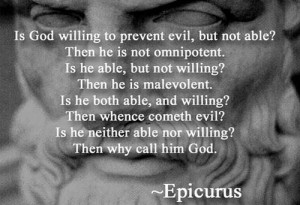
  2. Has any philosopher yet explained (except via verbal alchemy) how something can start out perfectly good and yet evil can come out of it? If God is defined as the perfectly good and only source of everything, then whence comes evil? Endless ages of verbal alchemy attached to this question explain nothing, the question remains.

    Note that if God is perfectly good and has freewill then a freewilled being can exist in a state of perfect goodness. But if God has freewill then wouldnʼt it be possible for God Himself to commit evil, or become evil? (Or do Christian apologists employ a different definition of “freewill” when it comes to “God?”) Conversely, if God does not have freewill then doesnʼt that imply that freewill is not necessarily of ultimate value and that humanity has something even God lacks?

  3. Is there something, ANYTHING, that a Christian apologist might consider to be “unjustifiable suffering?”

    For instance, what types of horrendous suffering (or chronic forms of soul-grinding suffering, or physically or psychologically crippling forms of suffering, even mentally maddening forms of suffering) have NOT happened to someone somewhere on this planet, or may not happen say, to someone throughout eternity? And is not ALL of that suffering “justifiable” according to Christian apologists? Judaism claims that even the righteous suffer like Job. While Christianity claims that an infinite eternal and guiltless Being (AKA Jesus-God) has “suffered” and even spent time in “hell,” though everyone still continues to suffer here on earth, including for the past two thousand years since that Being suffered. So there does not appear to be any form of suffering thatʼs not justifiable to the Christian apologist, is there, including Jews suffering in concentration camps simply for being Jewish in some way—and then they die in such a camp and may will awaken on judgment day to find their new bodies (and old souls) in eternal hell, right? (For centuries both devout Calvinists and Catholics even spoke about seeing the damned suffer for eternity and not only finding the eternal suffering of the damned something justifiable, but also something worth REJOICING over.) I ask again, is there any form of suffering that a Christian apologist might consider to be “unjustifiable suffering?”

    And why must people believe that the only way God can “accept” a person is if that person believes God has wrath (or a need to punish), and cannot simply forgive, nor punch a super pillow till His wrath abates, nor calmly instruct with minimal pain, and give people more than one chance, but instead God must take the sum total of His wrath out on the most unworthy recipient, a wholly guiltless individual, who also happens to be Himself? Why is such a belief necessary? And why do Christian creeds insist on the necessity of such a belief, when it obviously does not appeal to all, nor even make sense to all? All people donʼt even find the same stories (whether they involve “God” or not) as equally appealing or believable.

    At present about a third of the world is nominally speaking, “Christian.” No doubt the Bible is constantly being published and republished, even Uber-published if I may coin the phrase, and passed out round the world, making it the “worldʼs biggest best seller,” though a more truthful accolade might be the “worldʼs most handed out book,” or the “worldʼs most common gift book,” or the “most commonly suggested book that Christian men and women and pastors tell others that they should or must get a copy of and read.”

  4. I wonder whether Christian apologists have ever come to grips in a truly convincing fashion with the ways their God is portrayed (either in reality or metaphorically) in the book that they claim “reveals” the truth of their beliefs to humanity? For instance does the DEVIL threaten to cast people body and soul into hell? No. That type of imposed suffering is Godʼs design. Does the Devil get portrayed as wiping out every breathing thing on the planet except some ark survivors? Nope. Thatʼs God again. Does the Devil command the destruction of everything that breathes in certain cities? Does the Devil send plagues, famines, poisonous snakes, and opposing armies to teach people lessons like the God of the Bible is portrayed as doing? Does the Devil strike husband and wife both dead if they lie about giving all of their earthly possessions to the church?

Have Christian philosophers really dealt with questions like those above and below, or do they tend to flee them till they reach a nice quiet corner of huge generalizations resembling nothing so much as pious platitudes? But think for just a moment longer about this…

God is portrayed as acting thusly toward the “apple of His eye,” the “children of Israel”: The God of Israel tried to kill Moses (and failed); struck dead two sons of Aaron; commanded “brother to kill brother” leading to the deaths of 3,000 Israelites (right after He gave them the commandment, “Do not kill”); opened up the earth and buried alive “wives, sons and little children;” sent a fire that consumed 148 Levite princes; cursed his people to wander in the desert for forty years and eat 40,000 meals of quail and “manna” (talk about a monotonously torturous diet—and when they complained about it, God killed 3,000 Israelites with a plague); had a man put to death for picking up sticks on the Sabbath; denied Moses and Aaron entrance into the “promised land” because Moses struck a rock twice with his staff instead of talking to the rock; delivered to his people a “promised land” that was parched, bordered by desert, and a corridor for passing conquering armies; sent fiery serpents among Israel, killing many; wanted to kill every Israelite and start over with Moses and his family (but Moses talked God out of that plan); drove the first king of Israel to suicide; killed someone who tried to steady a teetering ark of the covenant; murdered king Davidʼs innocent child; sent plagues and famines upon his people that killed men, women and children; ordered the execution of 42 children of the king of Judah; “smote all Israel” killing half a million men of Israel in a civil war between Israel and Judah; “delivered into the hand of the king of Israel” 120,000 Judeans massacred in one day along with 200,000 Jewish women and children; gave Satan the power to kill Jobʼs children and servants (in order to win a bet); let the Babylonians conquer the holy city of Jerusalem, and then the Greek forces of Alexander the Great, followed by the Romans; and finally left the Jews homeless and persecuted by Christians and Moslems for nearly 2000 years. Furthermore, the large number of laws in the Hebrew Bible concerning the treatment of lepers and those with sores demonstrates that the Israelites were far from being blessed with unparalleled good health. And archeological evidence indicates that in ancient Israel the infant mortality rate was as high as fifty percent.

Edward T. Babinski [See the Bible for all of the cases mentioned above, except for the archeological evidence concerning ancient Israelʼs infant mortality rate. For the latter see, Drorah OʼDonnell Setel, “Abortion,” The Oxford Guide to Ideas & Issues of the Bible, ed. by Bruce Metzger and Michael D. Coogan (Oxford University Press, 2001)]

The Problem of Evil, Alvin Plantinga & Victor Reppert

by Edward T. Babinski

I saw through Plantingaʼs initial assumptions regarding his “solution” to the problem of evil twenty years ago while reading Plantingaʼs book that a Calvinist friend loaned me. I phoned Plantinga years later. He didnʼt answer my question.

Problem of Evil

Hereʼs my question…

A free-willed
All powerful
All knowing
All good
All perfect
All blissful God

creates something SOLELY out of His own will, power, knowledge, goodness, perfection, and bliss…so what room is there for anything less?

…but out of infinite perfection comes a cosmos where everything dies, where bliss is fleeting, where minds and hearts grow confused, damaged, sometimes even shattered via the process of struggling to earn a living and/or raise a family, or whittled down via repressive labor, or bored to death. Where human development is difficult and perilous, where communication is difficult, even perilous, for both people and nations, where ignorance (inherent in each culture, family and individual) and stubbornness about oneʼs ignorance is rife (the latter perhaps due to increasing inflexibility of the brain/mind once it has assumed a “system”—or been “assumed by” a system—because we not only “have beliefs,” but there is also evidence that “beliefs have us” as well). A cosmos where we cannot “see” whatʼs “behind it,” where “God” and “heaven” and the “afterlife” (or even the “before birth”) remains “hidden” to the vast majority of the earthʼs inhabitants throughout time. A cosmos where consciousness does not appear to pop out fully grown all at once, but has to develop just as the brain/mind develops in the womb and during the time of infancy, childhood, adolescent impulsiveness and finally adulthood. A cosmos where we continue to struggled against a world of nature that kills with cold, wind, fire, water, earth, desert heat, lava, predators, poisons, diseases, parasites. A cosmos where we strive to lessen the painful effects of, or eliminate, natureʼs dangers and pains that haunt not only us, but every other living organism on this planet. So we fighting the cold weather that kills to the desert heat that withers, and we strive to discern early warning signs of natural disasters and epidemics. A cosmos where we also strive to eliminate barriers of communication, or blow each other up trying.

Christian apologists like Plantinga ADD to the above mix of confusion and dangers their PRESUMPTION that this cosmos is all for the greater good, and PRESUME that besides all of the above confusion imperfection and dangers—from the death of everything we see—to insufferable boredom—to daily pains—passions—miscommunications—the ignorance inherent in each culture, family and individual—the inflexibility and inertia inherent in each brain/mind as it develops from youth—or degenerates with age—besides all that—Christian apologists insist everyone MUST believe in a particular holy book written by true believers (even in a particular INTERPRETATION of that holy book), or we will not only continue to suffer as on earth, but suffer relentlessly for eternity, without mercy.

And Plantinga presents it all like itʼs the most “rational” view possible.

Christian philosopher Victor Reppert at his blog, “C. S. Lewisʼs Dangerous Idea,” seems at least doubtful that Plantingaʼs view is the most rational and suggests that it might made a bit more sense if people received “another chance” after they had died to “convert.” I assume Vic believes that the ignorant limited brain/minds, and confused or debilitated characteristics of peopleʼs brain/minds from living in this imperfect cosmos will be healed following death (otherwise they might misperceive even the afterlife based on past limited experiences or imperfect brain/mind constitutions). So Vic suggests non-Christians will all be given another chance to “believe” after they have seen God and heaven and had time to investigate and ponder matters on the “other” side of this cosmos. But Vic also realizes I suppose that this is a rationalization on Vicʼs part. (What other of Vicʼs beliefs might not also be “rationalizations to believe” as he does, i.e., rather than “reasons to believe?”) At the very least Vic does not appear to think that Plantinga has “solved” all the problems regarding this cosmos and the Christian view of salvation, since Vic recognizes the need to try and go “further” than Plantinga via Vicʼs “second chance” scenario/rationalization.

Victor Reppert remains uncomfortable, has more questions than most orthodox Christian apologists on the internet. (Welcome to my mind/brain world, Vic, filled with more questions than answers.)

I have rational difficulties conceiving of a perfectly good and perfectly powerful being squeezing out a cosmos such as this. Furthermore, the experience of this cosmos in which all things die (and struggle not to) with such daily persistence is a shared experience of everyone on the planet.

I have even GREATER difficulty imagining that humanity (and every other organism on earth) have been placed in such a universally deadly situation in order that human beings might “hear the Word of the Christian God” and either choose to believe a book written by true believers, or die an everlasting death.

P.S., Since Iʼm agnostic, let me play around with a philosophical suggestion or two, a rationalization here, a guess there, concerning God. What if “God,” being a perfect eternal being, got omni-bored and tried to surprise Himself/Herself/They/Itself by playing “hide and seek” with Him/Her/They/Itself in a panentheistic fashion? Not that I even know what “panentheism” is, except to say that some say it refers to a view of “God” as the flame of all reality with everything else being flamelets proceedings from the one great flame, a lot like pantheism, but with each flamelet having a slightly greater degree of individuality. (I wonʼt argue whether such a conception of “degrees of individuality” is “true or not” in a philosophical sense, which will obviously get us no where, since how could one prove any of my assumptions above at all)? At any rate the “Hide and Seek” playing panentheistic God who gets omnibored and then tries to generate “Surprise,” might help explain a cosmos in which life arises yet everything dies, and it might help explain humanity as well, including the “hiddenness” of God. But again, I admit Iʼm only dealing with analogies from “fire,” or from basic human emotions such as “boredom” and “surprise,” and ways in which we understand such matters, and thus I am bending the wax nose of philosophical ideas and words in ways I cannot prove and that prove nothing. Though if someone wished to follow up on this little suggestion they could do worse than read Alan Wattsʼs BOOK OF THE TABOO (Against Knowing Who You Really Are); or his Christian version of the same view in an earlier work he wrote while still an Anglican priest, BEHOLD THE SPIRIT. I am not however suggesting one must read anything of the sort.

Another guess concerns the views of universalist Christians who believe that God and time are the best teachers, hence they donʼt fear what comes next for anyone, and merely seek to blow on the spark of eternal salvation already lying inside us all, to inspire and uplift.

Iʼm not saying any philosophical suggestion of mine, or Plantingaʼs, or Reppertʼs, is easy to maintain however, not if pains or diseases of body and/or mind grow excruciating. People suffering a “ringing in the ears” have been known to leap to their deaths because the ringing kept them up till they had gone nearly mad. Sleep deprivation, even just dream deprivation (waking up a person whenever they go into rapid eye movement (or REM) mode to prevent them from dreaming) can apparently kill a person faster than depriving them of food. During times of intense pain, disease, or deprivation neither philosophy nor theology seem to help the person who is being forced to suffer greatly. Even in the Bible, though Job didnʼt curse God, he sought answers. “WHY?” Even Jesus is portrayed as shouting out “WHY” in a despairing line from a psalm before his death, “My God, My God WHY have you forsaken me?” C.S.Lewis admitted a year before he died that he “dreaded most” the thought that he may have been “deceiving himself” concerning the kind of “God” who would give his wife cancer and then himself cancer. Or as in the case of a conversation Mother Teresa had (she didnʼt believe in pain killers) with a man suffering intense pain from cancer, “Jesus is kissing you,” to which the man replied, “Then I wish heʼd stop.” Thatʼs the problem of pain in a nutshell. The “dread” of C.S. Lewis. The “Whys” of Job and Jesus. Not to mention Victor Reppertʼs “second chance.”