Showing posts with label god. Show all posts

Non-Exclusivism, Universalism, Evil, and, Philosophy As One Big “IF”

Non-Exclusivism, Universalism, Evil, and, Philosophy As One Big “IF”

by Edward T. Babinski

Americaʼs leading Evangelical Christian philosophers (influenced perhaps by the struggle to find a way to justify the devilish amount of sheer ignorance in the world) are more attracted to ideas of “non-exclusivism” (i.e., people who are not born-again nor confessing Christians can still be “saved”), including even universalism (i.e., everyone will one day be “saved”), than are Americaʼs leading Evangelical Christian theologians, the latter of whom spout relatively more exclusivistic views based on a stricter linguistic interpretation of the Scriptures.

Though Alvin Plantinga is not a universalist, he is apparently a non-exclusivist who is attracted to the idea that more than just born-again or confessing Christians will be “saved.”

Evangelical Christian philosopher, Vic Reppert [who argues on a philosophical basis that there is a likelihood of a “second chance” after death] adds, “There really isnʼt a firm quotable statement [regarding exactly what Plantingaʼs views are]. However, when I used to attend SCP meeting on a regular basis, I would have to say that exclusivism was very much a minority position. The philosophers, Robert Merrihew Adams and his wife Marilyn McCord Adams, are both Universalists, and next to Plantinga, they are the best-regarded [Evangelical] Christian philosophers.” [email from Reppert to Babinski, Tuesday, October 24, 2006]

Victor Reppert at his blogsite also recently posted an entry debating questions concerning Godʼs “middle knowledge,” titled, Gale, Adams, and universal salvation, that ended with Vicʼs observation that “since Adams [mentioned above] is a card-carrying universalist, it looks like he can dodge this objection. Everyone gets saving grace.”

Philosophy As One Big “If”, Part 1

I suspect there are even more “ifs” if everyone looked harder at every argument—from eternal damnationism to universalism to simply death and rotting. I think it would demonstrate that philosophy is one big “if” when it comes to such questions.

Such “ifs” must also include the fact that the Bible is a book of words written by human beings, and such words are not equivalent to visibly seeing God, Jesus, the afterlife. Furthermore, people who claim to have seen God and/or the afterlife are also FEW in number. And many such “sights” are brief at best, or hazy (and they grow either “hazier” or “clearer” with the passage of time, depending on whether one is relying strictly on oneʼs memory, or continually redefining oneʼs memory of oneʼs vision in verbal terms linked to increasingly dogmatic influences and interpretations applied from outside). Even of those few visions that some claim to have seen clearly, thereʼs a wide variety of things seen, not simply Christian ones. So there is no coherent interpretation that includes and explains all such visions, let alone a “theologically systematic” whole, and as I said, FEW have ever seen such things.

Philosophy As One Big “If”, Part 2, Points For Plantinga And Vic To Ponder Concerning Evil And Freewill

1) If freewill was truly free than maybe itʼs logically impossible to assert that a God with “freewill” can also be defined as “good,” because a God with “freewill” could also act “evil” by definition of having “freewill.” Such a “God” would then have to be defined first and foremost as “free” and His actions defined as “indeterminate” or “vacillating based on choice.”

2) Even if someone tries to argue that the definition of “freewill” (i.e., “always being able to choose either good or evil”) applies to “God,” then thereʼs yet another question.

Letʼs accept a tri-omni good God exists. The “defense” offered for evil in that case is that anything God creates would be inherently less than God and more subject to temptations toward evil. But such an argument simply redefines the words “less than God,” as “evil,” but there is no proof that such a redefinition is necessarily true. Being “less” than “God” does not necessarily entail a creature becoming “evil,” not anymore than Godʼs own “freewill” might leave God in the exact same situation of always having to choose between two options. And Whatever May Be Said In The One Case Applies To Both. Whatever keeps a tri-omni good God from never using His freewill to choose evil, could just as well apply to a less than tri-omni creation that came directly out of that same God. I stick by that statement, but Plantinga and Vic deny it on no provable basis that I have yet seen.

Conclusion

So there is no way for theistic philosophy to prove it has argued its was to reality or THE truth, because it just tries to redefine “freewill” in different terms for God and man, (or, it tries to equate the phrase “less than God” with “evil,” again without proving that it is necessarily so), just based on Presuppositions That It Must Be So. And such presuppositions remain as Questionable as any other view.

In the end the idea of evil coming out of perfect goodness remains an unproven proposition.


All such philosophical arguments also flounder on the fact that we grow up via experiences of this cosmos. We learn about “‘good’ and ‘evil’ and the spectrum of actions lying in the grey area” in this cosmos before we ever learn how to separate those examples and concepts fully from one another in the form of “words,” and claim they are fully and absolutely separate from one another. So the separation takes place afterwards (after oneʼs mental development and contact with the world), and only after such a separation do philosophers take one of those abstracted concepts and try to build a bridge over to the opposite word and concept:

Perfect goodness➜ Evil

When I read about arguments that try to create such a bridge I canʼt help noting all of the sheer ingenuity and guess work employed in the process of trying to find a way to bridge those two things that We as human beings experienced and learned about as they already co-existed together, a world with both good evil and many grey areas of various shades as well. People living in this cosmos in which all those things co-existed, have learned how to pull such things apart mentally, and imagine only one of them existing alone in the beginning, then philosophers try to mentally derive one FROM the other. But that proves nothing about reality itself, the one in which we were raised and in which such things co-existed already.

Itʼs like beginning with

Perfect Cold➜ Hotness

Perfect Darkness➜ Luminosity

A philosopher can of course argue based on scientific knowledge that the answer in the above cases is that molecules start to move faster, generating more heat and even light. But then the philosopher must also recognize that “perfect coldness” has no molecules that move faster than “perfect coldness” allows. Not if you begin with Nothing But “perfect coldness.” So you can Never get to the opposite side or cross the bridge from the initial defining point—you canʼt cross the bridge from one word to the other if both are already so well defined to the complete exclusion of the opposite word. (*Donʼt misunderstand me, I am speaking in terms of the limitation of going from one abstract word or concept to another, which by definition excludes the former word or concept. I am not speaking in terms of a creationist argument in which the cosmos began in perfect darkness and coldness—and even that argument is fallacious because scientists admit many possibilities not simply the one that the cosmos was created out of an inert cold and dark mass. They admit cosmoses might oscillate, give birth to other cosmoses, there might be an infinity of cosmoses and super-cosmoses throughout infinite time and space. And using “God” to explain the existence of the cosmos is simply to employ an even greater mystery (“God”) to explain a lesser one, a more immediate and universally recognizable one.)

Now consider these questions and how they might be bridged:

Perfect Cold➜ Hotness

Perfect Darkness➜ Luminosity

In nature, coldness can and does sometimes warm up and/or cool down again; and darkness can and does grow brighter, and/or dimmer again. We observe such things happening on earth and via telescopes. So in nature Changes Occur, including oscillating ones. We observe that to be a fact of which there is no facter. Because thereʼs a variety and mix of forces and co-existence of forces in the cosmos, all of which exist Together, side by side, rather than there being “Perfect cold” or “Perfect darkness.” Nature, isnʼt “perfect” in either respect, and unlike philosophy, nature appears to be multi-sided, changeable and filled with the co-existence of things philosphers simply want to purify down into “perfect” words of which there is no worder.

Therefore, philosophy invents and relies on abstractions from nature that philosophers then further elevate to “perfections” or “absolutes,” but they are picked a bit here and there from nature, like gnats from natureʼs hair, and philosophers claim that each particular thing they plucked from nature mentally is the “IT” that began it all.

Thatʼs probably why philosophers continues running into the same debates and obstacles to agreement since the pre-Socratics, because philosophy begins with fragments of the whole natural world of experience and then after fragmenting nature has to try and reunite the fragments back together to get This whole cosmos. Philosophy is the Humpty Dumpty rhyme writ large.

Thus the Big Questions appear to lay beyond the ability of philosophers to get people to agree upon their answers. Philosophy cannot prove itʼs various conflicting explanations for reality, for this cosmos in which things co-exist, mix, and change. Philosophy has so far proven nothing. It is a mere wax nose on the faces of all philosophers, as flexible as their brains that keep alive all sorts of opposing views and viewpoints concerning the Big questions.


Back To The Question Of “Eternal Separation”

Why speak about “eternal separation” as if change is no longer possible after some point? If there is “freewill” and if “freewill” is so vitally important, then why not retain freewill and that means retaining possibilities of change throughout eternity? Maybe people have their “up” and “down” periods throughout eternity? If youʼre looking at options Purely Philosophically then eternal oscillation with no point of “no return,” remains as good a purely mental option as any. But most people simply want the game of philosophy to end in some definitive way. They donʼt even begin to think in terms of life the universe and everything as an Infinite game (rather than a finite one). I suppose thatʼs partly because philosophers are lazy like the rest of the primates on this planet. Finish the job, reach the point of no return and get some sleep. (But read James Carseʼs Finite And Infinite Games too, as well as Alan Wattsʼs The Book Of The Taboo: Against Knowing Who You Really Are.)

- Edward T. Babinski

Question of Evil

Victor Reppert wrote at my blog

I asked you [Ed] a yes or no question. Do you believe that the argument from evil proves that God does not exist. If you are consistent in maintaining that philosophy is all a game and proves nothing, then the answer has to be no.

Donʼt you see that the atheist is trying to disprove the existence of God by appealing to the argument from evil? I am asking you whether you think they succeed in doing so.

If I ask you whether or you think an argument proves something, you can answer “yes,” “no,” or I donʼt know. Given the fact that the terms in this discussion are clear, the choices are stark. Stop BSing and make a clear statement.


Question of Evil

Dear Vic,

  1. Itʼs moot who is “BSing” whom. (See my original article and comments to Vic here.) Not being an atheist nor a classical theist, my point was that none of us appear to know all we need to know in order to construct convincing (purely philosophical) proofs of things like a “tri-omni God” of classical theism; or prove purely philosophically that we all shall live eternally; or prove what the afterlife will be like; or prove that we know for sure (or even that people believing in the same holy books agree) on all the things we must believe (or do) in order to ensure a positive eternity.

  2. Concerning your second question, on “the argument from evil,” it does not appear to be a matter of denying its validity or asserting it, because one does not even need to construct “philosophical proofs” in order to entertain basic questions concerning “why” the cosmos is the way it is. I personally hope there is more than just mortal life with its pains and then death. Having the brain/mind to be able to foresee my own eventual death, I simply donʼt find the prospect inviting. Neither am I a big fan of sickness, natural disasters, poverty, ignorance, nor the confusion and problems inherent in the very act of attempting to communicate with one another (across boundaries of language, place or culture), as well as across boundaries in communication that arise simply by virtue of not having read the same books, nor met the same people, all of which affect our beliefs.

    Neither does it require philosophical “proofs” to express the desire for a life that does not end but continues to grow and flourish, or a desire not to have to struggle so greatly against ignorance, poverty, illness, and acts of nature that destroy, cripple or kill. (Moreover, if the ancient Hebrews, a religious people, could conceive and desire a mythical “Eden” in which people were fed without having to sweat over thorns and thistles, where there was no danger in giving birth, no animals with poisonous bites, no illness, and where everyone spoke the same language, then questions concerning why a physical cosmos more desirous than our own could not have been created “in the beginning,” are not simply the result of atheistic doubts, but remain valid questions humanity has pondered for quite some time.)

  3. A further word on the tri-omni God idea and all the assumptions that lay behind it. I donʼt begin my own search for truth with the notion of a tri-omni God, but simply with an admission of lack of knowledge. But concerning such a God one should note there are “open” theologians who cite the Bible to argue that God is not necessarily revealed as being tri-omni, but who consider that God might not know everything. If so that might make the problem of evil less of a problem.

    The “free will” defense seems less convincing as a possible solution, because nature presumably got along without human “free will” for hundreds of millions of years, i.e., long before humanity showed up, God was perfecting the ways and means of nature, including carnivorism, diseases, natural disasters, along with the inevitability of death of every individual living thing. Moreover, the presumed attributes/definitions of a tri-omni God that combine “absolute freewill” with “absolute goodness” is a mind boggler. (Doesnʼt sound like any definition of “freewill” that human beings know about, since for us it is defined as involving a genuine choice between “good” and “evil.” Neither has anyone proven that the “will” of human beings is “free” in a libertarian philosophical sense, but the tri-omni God philosophers have zipped past that unanswered question and already claim to be devising “proofs” regarding matters pertaining to things about “Godʼs will.” How imaginative of them!)

    It also remains questionable just what the “good” is in various cases—because a theologian can simply pluck imaginatively from various dogmas, even competing dogmas about “God,” and claim in each case that such dogmas illustrate what is “good” about God. For instance, Godʼs commanding of the slaying of the Canaanite children has been interpreted by some theologians as “good” in the sense that God was sparing those childrenʼs souls from growing up, falling into sin and going to hell, by instead sending them to eternal bliss via the blessing of a bloody sword, and thus Godʼs character as “love” was demonstrated. But Calvinists and other teachers of the classical Augustinian doctrine of “infant damnation,” interpret the slaying of the Canaanite children as being “good” because God wished to demonstrate his character as “judge,“ including children, including sending them forthwith to eternal damnation. Itʼs all “good” depending on oneʼs interpretive theology!

Talk about theology being a wax nose!

I didnʼt even mention the third alternative according to the Catholic tradition of “limbo“ for dead unbaptized children, which was viewed as “good” by Catholics for over a thousand years (though I read about “limbo” being abolished just this year at a recent church council, or close to being abolished?). Limbo kept the unbaptized infants at a distance from Godʼs holiness, but not deserving of eternal hellfire.

So weʼve got three definitions of what was “good” about God commanding the killing of everything alive in cities that refused to submit and become Israelite slaves. And different Christians seem quite content to always come up with their own excuse (read, “guess”) for why they believe such commands and actions were “good.“

Itʼs also “good” no doubt for a tri-omni God to ensure that a high percentage of the young of every species on earth provide food for viruses and bacteria—as they have for hundreds of millions of years right up to the present.

In short what I am saying is that I begin with features in the cosmos that we all know and can agree upon relatively well, and also begin with some “good” desires that many share, rather than seek to justify every last command and activity of “God” as described in various “holy books.” I also share many basic hopes and fears that both atheists and religionists share. So I think I am asking some plain questions.

I reiterate, we live in a cosmos that already has “good” and “evil” as well as plenty of grey areas in-between. Philosophy (especially philosophy of religion) seems to want to take these notions that we have gained from living in this cosmos of mixed blessings and death of all living things, and strain out everything in this cosmos that we donʼt like, and try to begin with assumptions that are all “good” (again, depending on what definition of “good” you are using vis a vis “God”). But that means that “philosophy” (especially philosophy of religion) then has the unenviable task of explaining how everything began “perfect good,” but led to the cosmos we all know where everything dies and even the things we desire most seem mixed blessings (including the hope of converting everyone else to our own view).

— Edward T. Babinski

Problem of Evil

Problem of Evil

by Edward T. Babinski

  1. Theistic philosophers who discuss the problem of pain/evil without acquainting themselves with specific cases in detail from nature are like Kant who apparently avoided the museum of art that he walked past each day on his way to write a book on the “philosophy of art/aesthetics.” (A philosophy professor even shared with me that Kant boasted something to the effect that it wasnʼt even necessary to look at art in order to write his treatise).

    Unlike Kant I prefer to begin all investigations, philosophical or otherwise, by pondering specific instances. And since the topic is suffering (including suffering unto madness) please see the collection of instances found HERE. The effect of reading and pondering those examples is a bit different from reading a philosophical treatise on “suffering” that spends the majority of its time juggling-stretching-and-playing with huge generalizations such as “good,” “evil,” “pain,” “suffering,” “God,” “perfection,” “omnipotence,“ and “freewill,” etc.)

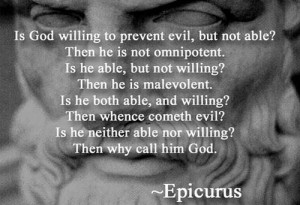
  2. Has any philosopher yet explained (except via verbal alchemy) how something can start out perfectly good and yet evil can come out of it? If God is defined as the perfectly good and only source of everything, then whence comes evil? Endless ages of verbal alchemy attached to this question explain nothing, the question remains.

    Note that if God is perfectly good and has freewill then a freewilled being can exist in a state of perfect goodness. But if God has freewill then wouldnʼt it be possible for God Himself to commit evil, or become evil? (Or do Christian apologists employ a different definition of “freewill” when it comes to “God?”) Conversely, if God does not have freewill then doesnʼt that imply that freewill is not necessarily of ultimate value and that humanity has something even God lacks?

  3. Is there something, ANYTHING, that a Christian apologist might consider to be “unjustifiable suffering?”

    For instance, what types of horrendous suffering (or chronic forms of soul-grinding suffering, or physically or psychologically crippling forms of suffering, even mentally maddening forms of suffering) have NOT happened to someone somewhere on this planet, or may not happen say, to someone throughout eternity? And is not ALL of that suffering “justifiable” according to Christian apologists? Judaism claims that even the righteous suffer like Job. While Christianity claims that an infinite eternal and guiltless Being (AKA Jesus-God) has “suffered” and even spent time in “hell,” though everyone still continues to suffer here on earth, including for the past two thousand years since that Being suffered. So there does not appear to be any form of suffering thatʼs not justifiable to the Christian apologist, is there, including Jews suffering in concentration camps simply for being Jewish in some way—and then they die in such a camp and may will awaken on judgment day to find their new bodies (and old souls) in eternal hell, right? (For centuries both devout Calvinists and Catholics even spoke about seeing the damned suffer for eternity and not only finding the eternal suffering of the damned something justifiable, but also something worth REJOICING over.) I ask again, is there any form of suffering that a Christian apologist might consider to be “unjustifiable suffering?”

    And why must people believe that the only way God can “accept” a person is if that person believes God has wrath (or a need to punish), and cannot simply forgive, nor punch a super pillow till His wrath abates, nor calmly instruct with minimal pain, and give people more than one chance, but instead God must take the sum total of His wrath out on the most unworthy recipient, a wholly guiltless individual, who also happens to be Himself? Why is such a belief necessary? And why do Christian creeds insist on the necessity of such a belief, when it obviously does not appeal to all, nor even make sense to all? All people donʼt even find the same stories (whether they involve “God” or not) as equally appealing or believable.

    At present about a third of the world is nominally speaking, “Christian.” No doubt the Bible is constantly being published and republished, even Uber-published if I may coin the phrase, and passed out round the world, making it the “worldʼs biggest best seller,” though a more truthful accolade might be the “worldʼs most handed out book,” or the “worldʼs most common gift book,” or the “most commonly suggested book that Christian men and women and pastors tell others that they should or must get a copy of and read.”

  4. I wonder whether Christian apologists have ever come to grips in a truly convincing fashion with the ways their God is portrayed (either in reality or metaphorically) in the book that they claim “reveals” the truth of their beliefs to humanity? For instance does the DEVIL threaten to cast people body and soul into hell? No. That type of imposed suffering is Godʼs design. Does the Devil get portrayed as wiping out every breathing thing on the planet except some ark survivors? Nope. Thatʼs God again. Does the Devil command the destruction of everything that breathes in certain cities? Does the Devil send plagues, famines, poisonous snakes, and opposing armies to teach people lessons like the God of the Bible is portrayed as doing? Does the Devil strike husband and wife both dead if they lie about giving all of their earthly possessions to the church?

Have Christian philosophers really dealt with questions like those above and below, or do they tend to flee them till they reach a nice quiet corner of huge generalizations resembling nothing so much as pious platitudes? But think for just a moment longer about this…

God is portrayed as acting thusly toward the “apple of His eye,” the “children of Israel”: The God of Israel tried to kill Moses (and failed); struck dead two sons of Aaron; commanded “brother to kill brother” leading to the deaths of 3,000 Israelites (right after He gave them the commandment, “Do not kill”); opened up the earth and buried alive “wives, sons and little children;” sent a fire that consumed 148 Levite princes; cursed his people to wander in the desert for forty years and eat 40,000 meals of quail and “manna” (talk about a monotonously torturous diet—and when they complained about it, God killed 3,000 Israelites with a plague); had a man put to death for picking up sticks on the Sabbath; denied Moses and Aaron entrance into the “promised land” because Moses struck a rock twice with his staff instead of talking to the rock; delivered to his people a “promised land” that was parched, bordered by desert, and a corridor for passing conquering armies; sent fiery serpents among Israel, killing many; wanted to kill every Israelite and start over with Moses and his family (but Moses talked God out of that plan); drove the first king of Israel to suicide; killed someone who tried to steady a teetering ark of the covenant; murdered king Davidʼs innocent child; sent plagues and famines upon his people that killed men, women and children; ordered the execution of 42 children of the king of Judah; “smote all Israel” killing half a million men of Israel in a civil war between Israel and Judah; “delivered into the hand of the king of Israel” 120,000 Judeans massacred in one day along with 200,000 Jewish women and children; gave Satan the power to kill Jobʼs children and servants (in order to win a bet); let the Babylonians conquer the holy city of Jerusalem, and then the Greek forces of Alexander the Great, followed by the Romans; and finally left the Jews homeless and persecuted by Christians and Moslems for nearly 2000 years. Furthermore, the large number of laws in the Hebrew Bible concerning the treatment of lepers and those with sores demonstrates that the Israelites were far from being blessed with unparalleled good health. And archeological evidence indicates that in ancient Israel the infant mortality rate was as high as fifty percent.

Edward T. Babinski [See the Bible for all of the cases mentioned above, except for the archeological evidence concerning ancient Israelʼs infant mortality rate. For the latter see, Drorah OʼDonnell Setel, “Abortion,” The Oxford Guide to Ideas & Issues of the Bible, ed. by Bruce Metzger and Michael D. Coogan (Oxford University Press, 2001)]

The Problem of Evil, Alvin Plantinga & Victor Reppert

by Edward T. Babinski

I saw through Plantingaʼs initial assumptions regarding his “solution” to the problem of evil twenty years ago while reading Plantingaʼs book that a Calvinist friend loaned me. I phoned Plantinga years later. He didnʼt answer my question.

Problem of Evil

Hereʼs my question…

A free-willed
All powerful
All knowing
All good
All perfect
All blissful God

creates something SOLELY out of His own will, power, knowledge, goodness, perfection, and bliss…so what room is there for anything less?

…but out of infinite perfection comes a cosmos where everything dies, where bliss is fleeting, where minds and hearts grow confused, damaged, sometimes even shattered via the process of struggling to earn a living and/or raise a family, or whittled down via repressive labor, or bored to death. Where human development is difficult and perilous, where communication is difficult, even perilous, for both people and nations, where ignorance (inherent in each culture, family and individual) and stubbornness about oneʼs ignorance is rife (the latter perhaps due to increasing inflexibility of the brain/mind once it has assumed a “system”—or been “assumed by” a system—because we not only “have beliefs,” but there is also evidence that “beliefs have us” as well). A cosmos where we cannot “see” whatʼs “behind it,” where “God” and “heaven” and the “afterlife” (or even the “before birth”) remains “hidden” to the vast majority of the earthʼs inhabitants throughout time. A cosmos where consciousness does not appear to pop out fully grown all at once, but has to develop just as the brain/mind develops in the womb and during the time of infancy, childhood, adolescent impulsiveness and finally adulthood. A cosmos where we continue to struggled against a world of nature that kills with cold, wind, fire, water, earth, desert heat, lava, predators, poisons, diseases, parasites. A cosmos where we strive to lessen the painful effects of, or eliminate, natureʼs dangers and pains that haunt not only us, but every other living organism on this planet. So we fighting the cold weather that kills to the desert heat that withers, and we strive to discern early warning signs of natural disasters and epidemics. A cosmos where we also strive to eliminate barriers of communication, or blow each other up trying.

Christian apologists like Plantinga ADD to the above mix of confusion and dangers their PRESUMPTION that this cosmos is all for the greater good, and PRESUME that besides all of the above confusion imperfection and dangers—from the death of everything we see—to insufferable boredom—to daily pains—passions—miscommunications—the ignorance inherent in each culture, family and individual—the inflexibility and inertia inherent in each brain/mind as it develops from youth—or degenerates with age—besides all that—Christian apologists insist everyone MUST believe in a particular holy book written by true believers (even in a particular INTERPRETATION of that holy book), or we will not only continue to suffer as on earth, but suffer relentlessly for eternity, without mercy.

And Plantinga presents it all like itʼs the most “rational” view possible.

Christian philosopher Victor Reppert at his blog, “C. S. Lewisʼs Dangerous Idea,” seems at least doubtful that Plantingaʼs view is the most rational and suggests that it might made a bit more sense if people received “another chance” after they had died to “convert.” I assume Vic believes that the ignorant limited brain/minds, and confused or debilitated characteristics of peopleʼs brain/minds from living in this imperfect cosmos will be healed following death (otherwise they might misperceive even the afterlife based on past limited experiences or imperfect brain/mind constitutions). So Vic suggests non-Christians will all be given another chance to “believe” after they have seen God and heaven and had time to investigate and ponder matters on the “other” side of this cosmos. But Vic also realizes I suppose that this is a rationalization on Vicʼs part. (What other of Vicʼs beliefs might not also be “rationalizations to believe” as he does, i.e., rather than “reasons to believe?”) At the very least Vic does not appear to think that Plantinga has “solved” all the problems regarding this cosmos and the Christian view of salvation, since Vic recognizes the need to try and go “further” than Plantinga via Vicʼs “second chance” scenario/rationalization.

Victor Reppert remains uncomfortable, has more questions than most orthodox Christian apologists on the internet. (Welcome to my mind/brain world, Vic, filled with more questions than answers.)

I have rational difficulties conceiving of a perfectly good and perfectly powerful being squeezing out a cosmos such as this. Furthermore, the experience of this cosmos in which all things die (and struggle not to) with such daily persistence is a shared experience of everyone on the planet.

I have even GREATER difficulty imagining that humanity (and every other organism on earth) have been placed in such a universally deadly situation in order that human beings might “hear the Word of the Christian God” and either choose to believe a book written by true believers, or die an everlasting death.

P.S., Since Iʼm agnostic, let me play around with a philosophical suggestion or two, a rationalization here, a guess there, concerning God. What if “God,” being a perfect eternal being, got omni-bored and tried to surprise Himself/Herself/They/Itself by playing “hide and seek” with Him/Her/They/Itself in a panentheistic fashion? Not that I even know what “panentheism” is, except to say that some say it refers to a view of “God” as the flame of all reality with everything else being flamelets proceedings from the one great flame, a lot like pantheism, but with each flamelet having a slightly greater degree of individuality. (I wonʼt argue whether such a conception of “degrees of individuality” is “true or not” in a philosophical sense, which will obviously get us no where, since how could one prove any of my assumptions above at all)? At any rate the “Hide and Seek” playing panentheistic God who gets omnibored and then tries to generate “Surprise,” might help explain a cosmos in which life arises yet everything dies, and it might help explain humanity as well, including the “hiddenness” of God. But again, I admit Iʼm only dealing with analogies from “fire,” or from basic human emotions such as “boredom” and “surprise,” and ways in which we understand such matters, and thus I am bending the wax nose of philosophical ideas and words in ways I cannot prove and that prove nothing. Though if someone wished to follow up on this little suggestion they could do worse than read Alan Wattsʼs BOOK OF THE TABOO (Against Knowing Who You Really Are); or his Christian version of the same view in an earlier work he wrote while still an Anglican priest, BEHOLD THE SPIRIT. I am not however suggesting one must read anything of the sort.

Another guess concerns the views of universalist Christians who believe that God and time are the best teachers, hence they donʼt fear what comes next for anyone, and merely seek to blow on the spark of eternal salvation already lying inside us all, to inspire and uplift.

Iʼm not saying any philosophical suggestion of mine, or Plantingaʼs, or Reppertʼs, is easy to maintain however, not if pains or diseases of body and/or mind grow excruciating. People suffering a “ringing in the ears” have been known to leap to their deaths because the ringing kept them up till they had gone nearly mad. Sleep deprivation, even just dream deprivation (waking up a person whenever they go into rapid eye movement (or REM) mode to prevent them from dreaming) can apparently kill a person faster than depriving them of food. During times of intense pain, disease, or deprivation neither philosophy nor theology seem to help the person who is being forced to suffer greatly. Even in the Bible, though Job didnʼt curse God, he sought answers. “WHY?” Even Jesus is portrayed as shouting out “WHY” in a despairing line from a psalm before his death, “My God, My God WHY have you forsaken me?” C.S.Lewis admitted a year before he died that he “dreaded most” the thought that he may have been “deceiving himself” concerning the kind of “God” who would give his wife cancer and then himself cancer. Or as in the case of a conversation Mother Teresa had (she didnʼt believe in pain killers) with a man suffering intense pain from cancer, “Jesus is kissing you,” to which the man replied, “Then I wish heʼd stop.” Thatʼs the problem of pain in a nutshell. The “dread” of C.S. Lewis. The “Whys” of Job and Jesus. Not to mention Victor Reppertʼs “second chance.”

Gospel of John in American Evangelicalism

Gospel of John

by Edward T. Babinski

A Christian seminarian (at a Southern Baptist seminary—a conservative inerrantist institution), named Chris Petersen, has composed an article titled, “The Triumph of the Gospel of John in American Evangelicalism”, that includes some questions I too struggled with before I left the fold.

The questions this student raises are not new. They arise whenever students and scholars of the Bible compare the three synoptic Gospels with the Gospel of John. For instance, professor James D. G. Dunn in his most recent monumental theological works on Jesus has acknowledged that the historical Jesus most probably didnʼt speak a word of what the Gospel of John portrays Jesus as having said.

Chris also has a five-part series on the discrepancy between the day of the week in which Jesus died according to the three Synoptic Gospels, compared with the day mentioned in the Gospel of John, titled, “The Date of Passover and the Pitfall of Inerrancy”.

(Perhaps J. P. Holding and Dave Armstrong might consider reading Chrisʼs pieces and offer to explain to the bright young lad why his questions, like Dr. Dunnʼs, arenʼt worth focusing any serious attention on.)

- Edward T. Babinski

Which “God” Should A Classical Theist Believe In?

Which God Should Classical Theist Believe In?

by Edward T. Babinski

According to a detailed survey performed by Baylor University researchers, the type of god people believe in can predict their political and moral attitudes more so than just looking at their religious tradition.

Researchers found that none of the “four gods” dominated among believers. The data showed:

  • 31.4 percent believe in an Authoritarian God, who is very judgmental and engaged
  • 25 percent believe in a Benevolent God, who is not judgmental but engaged
  • 23 percent believe in a Distant God, who is completely removed
  • 16 percent believe in a Critical God, who is judgmental but not engaged

Source: Baylor University

USA Today breaks down more information about those political and moral attitudes which are associated with each of the four types of God:

The Authoritarian God (31.4% of Americans overall, 43.3% in the South) is angry at humanityʼs sins and engaged in every creatureʼs life and world affairs. He is ready to throw the thunderbolt of judgment down on “the unfaithful or ungodly,” Bader says.

Those who envision God this way “are religiously and politically conservative people, more often black Protestants and white evangelicals,” Bader says. “(They) want an active, Christian-values-based government with federal funding for faith-based social services and prayer in the schools.”

Theyʼre also the most inclined to say God favors the USA in world affairs (32.1% vs. 18.6% overall).

The Benevolent God (23% overall, 28.7% in the Midwest) still sets absolute standards for mankind in the Bible. More than half (54.8%) want the government to advocate Christian values.

But this group, which draws more from mainline Protestants, Catholics and Jews, sees primarily a forgiving God, more like the father who embraces his repentant prodigal son in the Bible, Froese says. Theyʼre inclined (68.1%) to say caring for the sick and needy ranks highest on the list of what it means to be a good person.

The Distant God (24.4% overall, 30.3% in the West) is “no bearded old man in the sky raining down his opinions on us,” Bader says. Followers of this God see a cosmic force that launched the world, then left it spinning on its own.

This has strongest appeal for Catholics, mainline Protestants and Jews. Itʼs also strong among “moral relativists,” those least likely to say any moral choice is always wrong, and among those who donʼt attend church, Bader says. Only 3.8% of this group say embryonic stem cell research is always wrong, compared with 38.5% of those who see an authoritarian God, 22.7% for those who see God as benevolent and 13.2% who see God as critical but disengaged.

Philosophical Problems of Knowledge and Communication

by Edward T. Babinski

Victor Reppert said…
OK Letʼs go back to kindergarten. The argument from evil is proffered as a proof of the nonexistence of an omnipotent, omniscient, and perfectly good being. The defender is trying to prove nothing except that the atheist has not proven atheism. A person can accept the argument from evil who does not accept the existence of an omnipotent, omniscient, and perfectly good being, even if they believe in some other being that might be in some sense a deity.

You can believe that the existence of the worldʼs evil is logically incompatible with theism, you can believe that it provides substantial and virtually overwhelming evidence against theism. You can believe that it provides some, but not overwhelming evidence against theism. or that it provides no evidence against theism. Which is it Ed? These options exhaust the alternatives, unless you actually think that evil provides evidence for theism. Where do you stand?

In the issue of the problem of evil, itʼs atheists like Loftus and Carr, and Flew and Mackie, and Rowe and Draper, who put the argument forward as a good or perhaps decisive reason to reject theism. Some of them go as far as to say that the argument from evil proves that all theists hold their beliefs irrationally. If they are right then a philosophical argument in a major topic in the philosophy of religion works, and works well. If you donʼt, then you accept the outcome of my project, which has always been to show that there is nothing overwhelming about the argument from evil.

You lose credibility every time you dodge this question and pour out pages and pages of anti-Christian diatribe while at the same time refusing to accept the idea that any argument in philosophy really works. Unless you make clear what conclusion you are driving at, I must conclude that your animadversions on these matters are “full of sound and fury, signifying nothing.” Or, to put it another way, BS.

Victor Reppert recently left me a comment at his blog that began with an invitation for me to return to kindergarten, and concluded that my replies were full of “sound and fury,” and my questions “signified nothing.” My reply appears below.

Philosophical Problems of Knowledge and Communication

Vic,
Since you wish to take me back to kindergarten, then letʼs do so. No evasions, letʼs begin from scratch.

Tell me all that you know about God, all that youʼve seen of God, touched of God, heard of God, tasted of God; and then tell me all that you know about the world you see and taste and touch and hear, the people you see everyday, and the cosmos where you see all things die.

The “God” knowledge appears relatively more “hidden” to me than the knowledge I have of the cosmos we all live in together.

I am not saying that the problem of evil has ceased being problematical any more than I am saying it is impossible for anything other than nature to exist. Iʼm simply telling you what I know with some degree of certainty compared with beliefs that I am less sure about.

I have also pointed out what I consider to be flaws in philosophizing about the Big Questions. Anyone may philosophize all they wish, and argue for whatever “God” or “force” they believe exists or doesnʼt.

However the more I read such arguments, the less convincing I find them. “Words” themselves do not appear to provide absolutely accurate descriptions of the realities they are supposed to parallel. “Words” are stuck having to describe things that can also be understood as lying along spectrums of change. Words and concepts appear to be distilled from experiences within this cosmos where words/concepts and their opposites co-exist, or intermingle along spectrums of change. Neither am I of the opinion that verbal analogies constitute proof. Poetry yes. Proof no. I suspect the human mind of also being flexible enough to come up with counter analogies and counter arguments aplenty concerning all the BIG questions.

So I have simply come to trust direct experience a bit more than idealized philosophical arguments purporting to explain the answers to all the Big Questions. I also have grown more patient, not less, with living life day to day, and with the experimental process on both a personal level and in terms of humanityʼs groping toward greater knowledge. I choose patience even to the point of admitting I will very probably grow old and die with the same questions we have discussed, being debated still among philosophers.

Let me put it this way, I donʼt even know nor can I prove in a strictly philosophical fashion whether or not death ends “me” permanently, or, whether I or bits of me might survive after I die in a “ghostly” fashion, or, whether bits of me might not merge or join with others or bits of others that have died to form something new that begins again in a cosmos like ours or continues in some another dimension, or, whether I or bits of me might not “come back” in a reincarnate fashion, or, whether bits of me might survive after death for a long time and THEN even those bits die eventually, or, whether I have an immortal individual “soul” that can never die, or, perhaps I will die and an exact duplicate of me will be CREATED with the exact same knowledge and memories I had right up to the instant of my death (I donʼt know whether or not such a thing could be done by beings of super-intelligence from the future or past or parallel cosmoses, or by a demi-god or infinite Being who kept a copy of me in their “memory” and so could recreate me in some other place time or cosmos even if the “me” that lives here “dies”). Christian philosophers of mind also canʼt agree on the later two options, an immortal soul, or recreation after death by God. Some of them even use the Bible to argue that human beings donʼt “have” souls, they “are” souls. So, they agree the mind could be a function of the brain and the summation of experiences and knowledge each brain takes in as it grows and develops and becomes enculturated. Purely philosophically speaking, any or all of the above options might be true. Itʼs even possible philosophically speaking to argue that what we call “consciousness” does not include our particular memories and knowledge and lives which might accrue and gather round “consciousness” and interact with it, so “consciousness” might be something that is more basic even to the cosmos itself, malleable and universal rather than individual. (Note, Iʼm not saying I view all options as equally appealing.)

There certainly are many weird things Iʼve read about when it comes to consciousness, including mystical experiences, and weird visions people claim to have experienced which vary depending on oneʼs culture. Though unfortunately, most people whose heart stop during surgery, or for long periods, and they are revived, recall nothing. And most sleep during the night is unconscious, dreamless. And thereʼs questions that result from split-brain experiments, and thereʼs cognitive science that is teaching us some of the many ways we each are influenced by items around us, or by others, unconsciously, and thereʼs pheromonal influences as well (scents we canʼt even consciously smell that affect us). Recently I read about how certain bacteria might be affecting peopleʼs brain/minds. Other experiment indicate that the brain/mind is an excuse generator, even a belief generator (as indicated in some-split brain experiments).

It also seems to me that humanity is young as an intellectual species. Heck weʼre still stuck on the cradle planet.

So tell me Vic, what do you really know? How much do you think you know about “God the universe and everything?” What percentage of that knowledge consists of philosophical conundrums that have remained unresolved for millennia? While just how much more do you interact with and know about the cosmos in which you live, move and have your being, and in which everything dies? I think youʼd have to agree with me that you know more about the latter than the former.

P.S., By the way, your recent post about the Deityʼs “right to choose” as a possible reply to “evil,” appears like youʼre thrashing blindly about for answers nearly as much as I am. I donʼt know how you can continue to believe you are building up “proofs” when you sink back in that post to relying on total mystery and faith in whatever “God does,” which is close to relying on the mystery of “whatever will be will be.” Are you honestly considering no longer even asking WHY “God” might “choose” the things “God” chooses, or what the definition of “good” is? Is it simply whatever God chooses? Whatever exists? Again, mystery. Didnʼt Aquinas and Barth also sink back into total mystery in the end and admit all of their philosophizing wasnʼt quite the point, or didnʼt provide the ultimate proofs theyʼd hoped to present?

I know youʼre not a fundamentalist Vic, and you DO admit uncertainties. I simply admit more than you do. By the way, thereʼs a book about kindergarten that I enjoyed reading once, titled, Everything I Need to Know I Learned in Kindergarten.

- Edward T. Babinski

Catholics

Catholics

The Wisdom Of The Popes

Pope Stephen V (885-891): The popes, like Jesus, are conceived by their mothers through the overshadowing of the Holy Ghost. All popes are a certain species of man-god? All powers in heaven, as well as on earth, are given them.

Pope Paul V (1605-1621): The doctrine of the double motion of the earth about its axis and about the sun is false, and contrary to holy scripture.

Pope Gregory XVI (1831-1846): From the polluted fountain of indifferentism flows that absurd and erroneous doctrine, or rather, raving, which claims and defends liberty of conscience for everyone. From this comes, in a word, the worst plague of all, namely, unrestrained liberty of opinion and freedom of speech? It is in no way lawful to demand, to defend, or to grant unconditional freedom of thought, or speech, of writing, or of religion, as if they were so many rights that nature has given man.

Pope Pius XI (1922-1939): Benito Mussolini is a gift of Providence, a man free from the prejudices of the politicians of the liberal school.
- John Dollison, Pope-Pourri


The Catholics have a Pope. The Protestants laugh at them, and yet the Pope is capable of intellectual advancement. In addition to this, the Pope is mortal, and the church cannot be afflicted with the same idiot forever. The Protestants have a book for their Pope. The book cannot advance. Year after year, and century after century, the book remains as ignorant as ever.
- Robert Ingersoll


If the Pope is infallible, how do you explain his choice of hats?
- Tim OʼBrien


The Popeʼs pointy white hat is nothing more than a designer dunce cap.
- Skip Church


Excerpts From “The Lost Encyclical Against Penicillin” (A Parody)

Beloved children, I [the Pope] write to you today to offer you loving guidance against the unnatural use of antibiotics. God created bacteria and viruses for the purpose of infecting organisms sometimes seriously, sometimes less seriously - and we must never presume to interfere with the right order of Godʼs creation. Just as all forms of birth control go against the natural purpose of conjugal relations - namely, procreation - so the use of all forms of man-made antibiotics interfere with the God-given design of bacteria and viruses and how He intends them to interact with the human body. Each and every bacteria-body interaction must remain open to the transmission of bacteria. It is immoral to impede development of a natural process. That is why we have so exhaustively spoken out against artificial birth control and now antibiotics. We cannot impede a process that God has created. No impeding, no impeding! God created syphilis to infect sexually immoral people, and cause them suffering and eventual death. In no way should a man-made antibiotic interfere with this God-given process. Also, the fear of syphilis is a natural encouragement toward marital fidelity, which could not otherwise hold its own in a free market.
- Christopher Durang, Free Inquiry, Spring 1996


My Mom and Dad were Catholics and used the rhythm method of birth control. At the end of eight years they had their own rhythm section.
- Steve Wolski


If God is Catholic how come he only had one child?
- Source unknown


Mother Teresa used to say, “God always provides. He provides for the flowers and the birds, for everything in the world that he has created. And those little children are his life. There can never be enough.” On the other hand, scientists who study birds have found that one-third of adult birds and four-fifths of their offspring die of starvation every year. (David Lack, “Of Birds and Men,” New Scientist, Jan., 1996).
- Frank Miele, “Mother Not So Superior?” The Skeptic, Vol. 4, No. 2, 1996


The Wisdom Of Mother Teresa (And Skip Church)

Mother Teresa On Aids: It is the retribution for “improper sexual misconduct.”

(Then what were the Black death, smallpox, influenza, measles, mumps, polio, and TB “retribution for?” - Skip)

Mother Teresa On Poverty: It is very beautiful for the poor to accept their lot. The world is much helped by the suffering of poor people.

(And the more poor people who “accept” their suffering, the more rich people there will be who manipulate them to their own greedy ends. The rich complain that the poor want something for nothing. But the rich often stop at nothing to get everything. - Skip)

Mother Teresa On the Intense Pains of a Man with Cancer: You are suffering like Christ. Therefore Jesus must be kissing you.

(Mother Teresa, who happens to be against the use of anesthetics, told this story herself, during a taped interview, and even told the interviewer the suffering manʼs reply to her. After she said, “Jesus must be kissing you,” the man replied, “Then I wish heʼd stop.” - Skip)

Mother Teresa On Overpopulation: There is no problem of overpopulation, only of Godʼs will.

(So if you live in a developing country whose population growth is outpacing its food production and economic growth, then you ought to throw away those rubbers and birth control pills, and get down on your knees and embrace starvation and poverty, because according to Mother T. thatʼs “Godʼs will.” - Skip)

- Mother Teresaʼs statements are drawn from The Missionary Position by Christopher Hitchens


Now thereʼs the Vatican Bank, and all that money-laundering, and the Mafia. Jesus overturned all the tables in the temple, and now they have the Vatican Bank.
- Eddie Izzard, Dress to Kill (the book)


Millions of dollars are spent on each Vatican road show, money that could help the poor, who are rapidly inheriting the earth.
- Kate Clinton, Donʼt Get Me Started


Some 400 U.S. Catholic priests have been charged with child molestation in the past decade, and the church has paid an estimated $400 million in damages and costs. One priest, James Porter, is accused of abusing perhaps 100 victims in three states - including a boy with a full body cast who couldnʼt move to resist.
- James A. Haught, “The Moralizers: Crooks, Quacks, Kook, Creeps, and Cruds in the Clergy,” The Humanist


Pope Finally Apologizes After Two Thousand Years Of Catholic Atrocities

The Catholic Church is the single largest Christian denomination in the world today, larger even than the membership of all Protestant denominations combined. Not surprising considering the Catholic Churchʼs two millennia of political power brokering, heresy snuffing, book banning, Jew hating, witch burning, female subjugating, gay-bashing, war mongering, slavery-promoting (well, 1800 years of slavery-promoting), wealth stealing, genocidal vigor.

But the real topper came in March of the year 2000 when Pope John Paul II asked for the descendants of the multitudes who were hurt, enslaved, stolen from, and killed by Catholics to please forgive the one true church of Christ, the Catholic Church. How "big" of the Pope to repent for every Catholic atrocity in history, especially after two thousand years of stepping on peopleʼs toes has helped produce the biggest church the world has ever seen.

If only one of the earlier Popes had repented and tried to set things right sooner. Like in the fourth century when the first Christian to become a Roman Emperor was persuaded by Catholic bishops to issue a decree outlawing all rival Christian sects (“the Novatians, Valentinians, Marcionites, Paulians, Montanists,” etc.), and decree that they were “in league with the devil,” and “commanded all their houses of prayer be made over to the Catholic Church; that no facility whatever be left for any future gathering,” and had over 3000 Christians executed because their interpretation of the Bible did not agree with the Catholic one. Yup, that might have been a good time to begin apologizing.

Comedian Emo Philips provides the most apt analogy to the Popeʼs “forgive us,” speech. Emo once said, “When I was a kid, I used to pray every night for a new bicycle. Then I realized that the Lord, in his wisdom, didnʼt work that way. So I just stole one and asked him to forgive me.”
- Skip Church


Popeʼs Mea Culpa - A PR Stunt

Exactly two years have passed today since Pope John Paul II launched his great apology drive for the past “errors” of the Roman Catholic church. One more reconfirmation of the new course took place last Sunday, when he celebrated public penitence in St. Peterʼs Basilica. Meeting with harsh criticism since the beginning, the papal apology has meantime developed somewhat more precise outlines. “We ask forgiveness for divisions between Christians,” the Pope said, “for the use of violence in the name of truth, and for the diffidence and hostility against followers of other religions.” According to a document by the Vaticanʼs international theological commission, the historical sins are classified into seven categories, including divisions within Christianity, proselytizing by force, the inquisition, anti-Jewish prejudices, sins against minorities, women and human rights.

The Popeʼs Mea Culpa successfully avoids too close contact with the historical truth and has to be taken as a mere PR stunt. Nothing was for example heard again of the conference, scheduled for last October and proudly announced by the historical-theological commission of the Vatican, for which allegedly 50 renowned historians had been invited to scrutinize the bloody work of the Inquisition in Spain. But the Popeʼs project to square accounts with history before the new millennium dawns is not just superficial, it is pure hypocrisy. While crocodile tears are shed about the victims of the Holocaust, John Paul does not hesitate to beatify his predecessor Pius XII who collaborated with German, Italian and Croatian fascists during the second world war and rescued them after their defeat.

But the Vaticanʼs soft spot for mass murderers does not end there. The recent case of Father Athanase Seroma, shows how little the papal Mea Culpa is worth. Father Athanase Seroma played a leading role in the 1994 genocide that devastated Rwanda and is currently hiding under the name Don Anastasio Sumba Bura in northern Italy. According to many eyewitnesses, he organized the Nyange genocide in which between 2000 and 2500 Tutsi refugees were killed from April to July 1994. The African Human Rights group which produced a 22-page report about the events in Nyange in which Father Seromba, among other priests, had been involved, found that several of them are now living in Italy. The African Human Rights group asked the Pope more than half a year ago to launch an inquiry into the matter, but never received a reply. Maybe, decades later, a new pope may appear with a new apology!
- Sanal Edamaruku, ed., Rationalist International, Bulletin #33, March 16, 2000


Aztec Extremists Cut Out Visiting Popeʼs Heart (Satire)

Mexico City - Exacting retribution for Catholic explorer Hernando Cortezʼs destruction of their civilization, Aztec extremists cut out visiting Pope John Paul IIʼs heart in a ritual ceremony Monday. “For nearly 500 years, we have been brutally oppressed by the Catholics, enduring slavery, inquisition, rape, disease, forced conversions and random terror,” said Aztec high priest Xalpatlahuac, holding aloft the still-beating heart of the pope, who was making his fourth trip to Mexico since ascending to the papacy in 1979. “In the name of all those who have died, I sacrifice this heart to the sun god Huitzilopochtli.” The 78-year-old Polish pontiff was riding through the streets of downtown Mexico City in his popemobile when the extremists seized him and carried him off to a nearby Aztec pyramid. He was then pinned down by four priests, and, after a brief struggle, his chest was carved open with a sacrificial obsidian knife. The Catholic Church has not responded to the extremistsʼ demand that $14 billion in plundered Aztec gold be returned.
- The Onion, Vol. 33, No. 3 (Jan. 27, 1999)


Catholicism

People who do not live in Rome
but pretend to
are called Roman Catholics.

And they have a great many fathers
who dress like ladies
and do not have children.

This is so that ladies who have children
without a father
can call them God.
- Edwin Brock, Paroxisms: A Guide to the Isms


The trinitarian believes a virgin to be the mother of a son who is her maker.
- Francis Bacon


The Vatican came out with a new rule. No surrogate mothers. Good thing they didnʼt make this rule before Jesus was born.
- Elayne Boosler


The Vatican recently admitted that Catholic churches in Third world countries are failing to inspire their parishioners to practice only Vatican approved methods of birth control. Isnʼt it about time the Vatican threw in the towel, or “the sponge” on this one? In fact, I think itʼs time for the Catholic Church to start selling condoms in the shape of the Popeʼs mitered hat with cross-shaped ribs running down the sides (for her pleasure, and an added “heavenly” dispensation).
- Skip Church


I would welcome from the Pope some appreciation for the goodness of sexual pleasure - any bodily pleasure, come to think of it. - Luke Timothy Johnson, “A Disembodied ‘Theology of the Body’: John Paul II on Love, Sex & Pleasure,” Commonweal, Jan. 26, 2001


The fact that women who endured twelve to sixteen years of Catholic schools are not all virgins or prostitutes is a miracle.
- Martha Manning, Chasing Grace: Reflections of a Catholic Girl, Grown Up


Catholics used to have this place called Limbo, for little babies who died before they were baptized. The nuns assured us that no one was mean to them in Limbo, that they were well taken care of. But you had the idea that they were taken care of in the hospital-nursery kind of way rather than the at-home-snuggling-with-people-who-love-you kind of way?

[Though Limbo no longer officially exists, Catholics still believe in a celestial waiting room called Purgatory where you have to spend centuries doing penance before being allowed into heaven.] You got time off from Purgatory by making the sign of the cross, which earned you three years - seven years if you used holy water. Repeating holy phrases (ejaculations) qualified for all kinds of reprieves, although it was hard for me to imagine that when my mother yelled, “JE-sus, Ma-RY, and JO-seph! Didnʼt I tell you kids not to swing from the railing!” she was actually accumulating grace.
- Martha Manning (see above)


Following the Vatican declaration that women cannot become priests because they do not resemble Christ, sources reported that Colonel Sanders declared he would not employ anyone who didnʼt resemble a chicken.
- Jane Curtin


What do a Catholic priest and a Christmas tree have in common?
Both have balls just for decoration.
- Source unknown


The Catholic Church is against birth control so the number of Catholics keeps growing. But fewer are becoming priests. Pretty soon theyʼll have one priest for every fifty-thousand Catholics, and only a priest can consecrate hosts (those unsalted Ritz crackers they serve at Mass). So Catholics will have to rent football stadiums to attend Mass with the ONE priest in their vicinity. The priest will be on the fifty-yard line with buckets of hosts to be consecrated. Then hot-dog vendors will haul the buckets around, shouting, “Get your hosts here! Hot Hosts! Get ʻem while theyʼre consecrated!” Maybe theyʼll fling ʻem across seats right into peopleʼs mouths. “One body of Christ on angelʼs wings, Over here!”
- Skip Church


Roman Catholics believe they drink blood and eat human flesh during Holy Communion. Protestants say the ritual is “symbolic.” But to the Roman Catholic, the bread miraculously becomes the flesh and blood of a dead Jew, i.e., the late Redeemer of Biblical fame. Why they wanna eat a dead Jew is another question…
- Robert Anton Wilson


A Catholic is a person who eats small pieces of bread on Sunday mornings and pretends to be a cannibal.
- Edwin Brock, “Catholicism,” Paroxisms: A Guide to the Isms


I was raised Catholic and received the Body and Blood of Christ every Sunday at Communion until the age of 30, when I became a vegetarian.
- Joe Queenan


I might have joined the Catholic Church if it was just a little different. If at Communion the Host was fudge, Iʼd be there for that. “Body of Christ, with or without nuts?”
- Rick Reynolds, Only the Truth is Funny

Hellʼs Final Enigma

I just gave Christianity Today my “what for” after reading their April 2002 “Good Question” column by J. I. Packer who was asked “How will people in heaven feel, knowing some of their loved ones are stuck in eternal hell?” Packer said the people in heaven will be too busy praising God and loving each other to worry about that sort of thing. In fact, Packer added, “love and pity for hellʼs occupants will not enter our hearts.”
So, I HAD to write
Hell's Final Enigma

Hellʼs Final Enigma or “The Abominable Fancy” Redux?

There is nothing more horrific to my mind than J.I. Packerʼs recent response to this monthʼs “Good Question.” His response was that throughout eternity, “love and pity for hellʼs occupants will not enter our hearts.” Such a “love” is no better than any in-group who naturally love themselves and do not allow love or pity for “outsiders” to ever enter their hearts, and it echoes the horrific teachings of theologians from Augustine onward:

Augustine

They who shall enter into [the] joy [of the Lord] shall know what is going on outside in the outer darkness…The saintsʼ… knowledge, which shall be great, shall keep them acquainted…with the eternal sufferings of the lost.
[The City of God, Book 20, Chapter 22, “What is Meant by the Good Going Out to See the Punishment of the Wicked” & Book 22, Chapter 30, “Of the Eternal Felicity of the City of God, and of the Perpetual Sabbath”]

Tertullian

What a spectacle…when the world…and its many products, shall be consumed in one great flame! How vast a spectacle then bursts upon the eye! What there excites my admiration? What my derision? Which sight gives me joy? As I see…illustrious monarchs… groaning in the lowest darkness, Philosophers…as fire consumes them! Poets trembling before the judgment-seat of…Christ! I shall hear the tragedians, louder-voiced in their own calamity; view play-actors…in the dissolving flame; behold wrestlers, not in their gymnasia, but tossing in the fiery billows…What inquisitor or priest in his munificence will bestow on you the favor of seeing and exulting in such things as these? Yet even now we in a measure have them by faith in the picturings of imagination. [De Spectaculis, Chapter XXX]

Thomas Aquinas

In order that the happiness of the saints may be more delightful to them and that they may render more copious thanks to God for it, they are allowed to see perfectly the sufferings of the damned…So that they may be urged the more to praise God…The saints in heaven know distinctly all that happens…to the damned.
[Summa Theologica, Third Part, Supplement, Question XCIV, “Of the Relations of the Saints Towards the Damned,” First Article, “Whether the Blessed in Heaven Will See the Sufferings of the Damned…”]

Jonathan Edwards

The sight of hell torments will exalt the happiness of the saints forever…Can the believing father in Heaven be happy with his unbelieving children in Hell… I tell you, yea! Such will be his sense of justice that it will increase rather than diminish his bliss.
[“The Eternity of Hell Torments” (Sermon), April 1739 & Discourses on Various Important Subjects, 1738]

During Americaʼs “Great Awakening” the popular hymn writer, Isaac Watts (1674-1748), even set Christiansʼ feet to tapping with this crisp little verse:

What bliss will fill the ransomed souls,
When they in glory dwell,
To see the sinner as he rolls,
In quenchless flames of hell.

This “abominable fancy” was based on various Bible verses:

The righteous shall rejoice when he sees the vengeance.
- Psalm 58:10

Let the wicked perish at the presence of God…But let the righteous…rejoice before God: yea, let them exceedingly rejoice.- Psalm 68:2-3,22-23

In Isaiah 30:31-33 a human sacrifice takes place (the “man” who is killed represents the nation of Assyria), and the act is accompanied by festival songs, gladness of heart, the sound of the flute, tambourines and lyres. Moreover, “the Lord” performs the sacrifice.

And they shall go forth, and look upon the carcasses of the men that have transgressed against me.
- Isaiah 66:24

A man suffering in “Hades” sees another man luxuriating in “Abrahamʼs bosom,” and vice versa.
- Luke, chapter 16

Ye shall see Abraham, and Isaac, and Jacob, and all the prophets, in the kingdom of God, and you yourselves thrust out.
- Luke 13:28

They shall be tormented with fire and brimstone in the presence of the holy angels, and in the presence of the Lamb: And the smoke of their torment shall ascend up forever and ever…Rejoice over her, thou heaven, and ye holy apostles and prophets; for God hath avenged you on her… And again they said, Alleluia. And her smoke rose up for ever and ever.
- Revelation 14:9-11; 18:20, 19:3

Having such “inspired” verses behind it, this teaching did not grow out of favor with orthodox Christian theologians until the age of the Enlightenment when, for instance, Thomas Burnet punctured it with a prick of irony:

What a theater of providence this is: by far the greatest part of the human race burning in flames forever and ever. Oh what a spectacle on the stage, worthy of an audience of God and angels! And then to delight the ear, while this unhappy crowd fills heaven and earth with wailing and howling, you have a truly divine harmony. [De Statu Mortuorum & Resurgentium Tractatus, 1720]

Reconstructionist Christianity

“Regarding the reconstructionist beliefs. I had a run-in with a believer of this fairly new doctrine on another list recently. He was very subtle and insidious in his manner, but clearly a proponent of old testament law. Scary, huh?”

Edward: Reconstructionism is not a new doctrine, itʼs ages old, itʼs Calvinism, straight up, no ice. Just like it was served by Calvin and Luther and other Reformers at the dawn of the Reformation. See chapter two of Leaving The Fold for more info and footnotes on Calvin and Luther.

“Somebody tell me it canʼt possibly happen in America, quick!”

Edward: Sinclair Lewis published a book on exactly that topic in the 1920s or 30s, titled, “It Canʼt Happen Here”, in which a conservative religious minority took over the government of the country. Heck, Hitler only had about 30% of the country truly on his side. And there are that many self-proclaimed highly devout funda-geli-costal Christians in America. What they lack is cohesion, a central unifying political figure they would all be willing to rally round. Pat Robertson was hoping he could be that figure, but things didnʼt work out. Thank God for all the divided sects and Biblical interpretations! Or perhaps thank God for the lack of clarity in the Bible that allowed thousands of divisive Christians sects to arise.


Innovatia dennis@ writes: We are better off because of the past history of righteousness and upholding of Jesus as Lord in America
Reconstructionist Christianity

Edward: What would a “righteous Jesus Lordly America” be like by the way? How different from Calvinʼs Geneva at the height of itʼs intolerance? Or how different from an Early American Puritan town (the Puritans got to American only to start anathematizing each other and splintering into different denominations, banishing those with different views, and hanging others). Or how different from a Wahabist Muslim state like Iran?

By the way, the Southern States in the U.S. were the more “Christian” ones during the Civil War, they even rewrote their Constitution to invoke “God,” and preachers declared the South the “new chosen nation of God,” and they cried the loudest for secession. Apparently God couldnʼt hold that new “God-invoking” nation together.

I think America and the world are better off for a wide variety of reasons:

One major one being that America was a pristine land with plenty of eastern waterways to run mills. We stole patents and ideas from Britain. We imported slaves until the cotton gin was invented and the Civil War ended slavery.

And if not for a host of scientists who happened to be either lapsed churchgoers, unorthodox Christians, heretics, apostates, infidels, freethinkers, agnostics, or atheists, and their successes in the fields of agricultural and medical science, hundreds of millions would have starved to death or suffered innumerable diseases this past century. Those agricultural and medical scientists “multiplied more loaves of bread” and “prevented/healed more diseases” in the past hundred years than Christianity has in the past two thousand.

Also, it has not always been the most orthodox of Christians who have changed the face of charity worldwide for the better. Florence Nightingale (the lady who helped make nursing a legitimate profession, and taught that no one should be refused admittance to a hospital based on their religious affiliation, and no patient should be proselytized in a hospital, but instead they should be allowed to see whichever clergy person they preferred) was not an orthodox Christian, but instead a freethinking universalist Christian. (Ms. Nightingale also wrote some steamy letters that suggest she may have been bi-sexual or a lesbian.)

The founder of the International Red Cross (now called the International Red Cross and Red Crescent), Andre Dunant, was gay.

Clara Barton, founder of the American Red Cross, was another freethinking universalist Christian.

Dr. Albert Schweitzer, who spend years in Africa as a doctor and helped to publicize the plight of suffering Africans, was a liberal Christian and author of the The Search of the Historical Jesus in which he concluded that Jesus was a man who preached that the world was going to end soon.

And, Helen Keller (the woman who lost her sight and hearing to a bout with Scarlet Fever when she was very young, but who learned how to communicate via touch, and who proved an inspiration to several generations of folks suffering from severe disabilities) was both a Swedenborgian, and a member of the American Humanist Society.

America also benefited from the shrewd insights of the founding fathers who were well aware of the wars of religion in Europe, notably the Thirty Yearsʼ War, perhaps the worst war Europe ever saw, Christians killing Christians, and they all believed in creationism, the Trinity, and Jesusʼ divinity.

So I think weʼre better off because of the founders of the original Constitution who placed the first amendment, “Freedom of religion,” above the first commandment “Thou shalt have no other gods before me.” In fact, the founding fathers at the Constitutional Convention voted whether to pray before meetings and whether to mention God in the constitution, and voted against both suggestions.

Which reminds me of something that Dr. Albert Schweitzer (the liberal Christian theologian who focused on “reverence for life,” and who worked as a medical missionary in Africa for decades) pointed out: “For centuries Christianity treasured the great commandment of love and mercy as traditional truth without recognizing it as a reason for opposing slavery, witch burning and all the other ancient and medieval forms of inhumanity. It was only when Christianity experienced the influence of the thinking of the Age of Enlightenment that it was stirred into entering the struggle for humanity. The remembrance of this ought to preserve it forever from assuming any air of superiority in comparison with thought.” Also in the same book, Schweitzer cautioned against “the crooked and fragile thinking of Christian apologetics.” [Albert Schweitzer, Out of My Life and Thought: An Autobiography (New York: The New American Library, 1963)]

Threatening Others In the Name of God

Threatening Others in God's Name

The history of “Christianity” appears to be, among other things, the history of conflicts too numerous to mention:

Even during the persecutions of the Romans against the Christians, churches were cleft by rivalry and schism.

- Samuel Laeuchli, The Serpent and the Dove: Five Essays on Early Christianity

[Christians and their churches were cleft by rivalries and schisms even before the persecutions if you read Acts and the Letters in the New Testament. - E.T.B.]


Constantine [the first Roman Emperor to embrace Christianity] united the whole Roman Empire under his rule and reigned for twenty-five years. He brought up his sons to be pious Christians, and the last of them reigned for another twenty-five years, having ultimately reunited the empire under his rule. During that half-century the Church had enjoyed imperial protection and paganism had been viewed with disfavor. Christians had been promoted and pagans frowned upon. With only two short-lived exceptions no pagan was to reign as Emperor after Constantine.
- A. H. M. Jones, Constantine and the Conversion of Europe


A spirit of scornful tolerance breathes through not a few of his [Constantineʼs] edicts. As the years passed, toleration of paganism gave place to active repression; the emperor felt that he was strong enough to advance to a frontal attack upon paganism. The important fact to realize, however, is that this alteration in policy entailed no change of spirit, only a change of method. What Constantine would have recommended in 323 he later felt free to proclaim as the imperial will.
- Norman H. Baynes, Constantine the Great and the Christian Church


Constantine…banned the construction of new pagan temples, the consulting of oracles, and animal sacrifices. That these decrees were enforced sporadically did not detract from their symbolic value. With the old faith in decline, new converts poured into the Christian churches.
- Richard E. Rubenstein, When Jesus Became God: The Epic Fight over Christʼs Divinity in the Last Days of Rome


Constantineʼs allegiance to his God was backed by massive patronage. Emperors had always honored their favored gods with benefactions and buildings. Constantineʼs patronage was so lavish that he had to strip resources from pagan temples to fund it. One of his early foundations in Rome was the church of St. John Lateran, whose apse was to be coated in gold. Around 500 pounds of it was needed...Another 3,700 lbs was required for light fittings and another 400 pounds of gold for fifty gold vessels.
- Charles Freeman, “The Emperorʼs State of Grace,” History Today, January 2001


Edward Gibbon On Constantine And The Church

The grateful applause of the clergy has consecrated the memory of a prince, who indulged their passions and promoted their interest. Constantine gave them security, wealth, honors, and revenge; and the support of the orthodox faith was considered as the most sacred and important duty of the civil magistrate. The edict of Milan, the great charter of toleration, had confirmed to each individual of the Roman world the privilege of choosing and professing his own religion.
  But this inestimable privilege was soon violated: with the knowledge of truth the emperor imbibed the maxims of persecution; and the sects which dissented from the catholic church were afflicted and oppressed by the triumph of Christianity. Constantine easily believed that the heretics, who presumed to dispute his opinions or to oppose his commands, were guilty of the most absurd and criminal obstinacy; and that a seasonable application of moderate severities might save those unhappy men from the danger of an everlasting condemnation.
- Edward Gibbon, The Decline and Fall of the Roman Empire, Chapter 21


The privileges that have been granted in consideration of religion must benefit only the adherents of the Catholic faith. It is Our will moreover, that heretics and schismatics shall not only be alien from these privileges but shall also be bound and subjected to various compulsory public services.
- Letter of Constantine to his Vicar of the Praetorian Prefect, 326 A.D.; as cited in A New Eusebius: Documents Illustrating the History of the Church to AD 337, Ed., J. Stevenson, newly revised by W. H. C. Frend


The First Ecumenical Church Council At Nicea And The Arian Controversy

From the very first the Church was faced with the task of establishing dogmas. For Christianity abounds in problems more hinted at than answered in the New Testament...The first ecumenical church council, the Council of Nicea, assembled in the year 325 in the imperial palace of the first Christian emperor, Constantine. Once the discussions started the participants threw their Episcopal dignity to the wind and shouted wildly at each other. They were concerned primarily with improving their positions of power. Diplomacy was wielded as a weapon, and intrigues often replaced intelligence. There were so many ignorant bishops that one participant bluntly called the council “a synod of nothing but blockheads.” Constantine, who treated religious questions from a political point of view, assured unanimity by banishing all the bishops who would not sign the new profession of faith hammered out at the council. In this way unity was achieved.

[The Christians at Nicea displayed their shrewd theological insight by condemning and forbidding kneeling at prayer on Sundays and also between Easter and Whitsunday. - E.T.B.] The council also pronounced a Christian theologian named “Arius” to be a heretic. People who owned his writings were ordered to deliver them up on pain of punishment. Arius was banished.
- Walter Nigg, The Heretics


If any treatise composed by Arius should be discovered, let it be consigned to the flames, in order that no memorial of him may be by any means left. This therefore I [Constantine] decree, that if any one shall be detected in concealing a book compiled by Arius, and shall not instantly bring it forward and burn it, the penalty for this offence shall be death; for immediately after conviction the criminal shall suffer capital punishment.
- Letter of Constantine To the Bishops and People, c. 333 A.D. in which he proscribed the works of Arius [a Christian] and in which he also proscribed the works of the pagan scholar Porphyry [who had written numerous works that questioned Christianity, all of which were destroyed]; as cited in A New Eusebius: Documents Illustrating the History of the Church to AD 337, Ed., J. Stevenson, newly revised by W. H. C. Frend


Probably more Christians were slaughtered by Christians in two years [A.D. 342-343, during the Arian controversy] than by all the persecutions of Christians under the Romans during the previous three hundred years.
- Will Durant, The Story of Civilization, Vol. 4, The Age of Faith


In the century opened by the Peace of the Church [after the first Christian Roman Emperor began his rule], more Christians died for their faith at the hands of fellow Christians than had died before in all the persecutions.
- Ramsay MacMullen, Christianity and Paganism in the Fourth to Eighth Centuries


Arianism, which orthodox Christians now consider the archetypal heresy, was once at least as popular as the doctrine that Jesus is God…Ordinary tradespeople and workers felt perfectly competent - perhaps even driven - to debate abstract theological issues and to arrive at their own conclusions…Disputes among Christians, specifically arguments about the relationship of Jesus Christ the Son to God the Father, had become…intense. [p.7]

The anti-Arians…demanded that Christianity be “updated” by blurring or even obliterating the long-accepted distinction between the Father and the Son. From the perspective of our time it may seem strange to think of Arian “heretics” as conservatives, but emphasizing Jesusʼs humanity and Godʼs transcendent otherness had never seemed heretical in the [Eastern half of the Roman Empire]. [p.74]

The Great Council of Nicaea…was the largest gathering of Christian leaders, up to that time with 250 bishops in attendance, almost all of them from the Eastern Empire…To some extent, this Eastern predominance can be attributed to the westernerʼs lack of interest in the Arian controversy, which still seemed to them an obscure “Greek” matter.

The Council of Nicaea, then, was not universal…Several later gatherings would be more representative of the entire Church; one of them, the joint council of Rumini-Seluicie (359), was attended by more than five hundred bishops from both the East and West. If any meeting deserves the title “ecumenical,” that one seems to qualify, but its results - the adoption of an Arian creed - was later repudiated by the Church. Councils whose products were later deemed unorthodox not only lost the “ecumenical” label but virtually disappeared from official Church history. [p.74]

[After the Council of Nicaea, Constantine exiled Arian theologians.] But within three years, Arius, Eusebius, and their fellow exiles would be forgiven by Constantine and welcomed back to the Church. Eusebius would become Constantineʼs closest advisor, and would insist that Athanasius, now bishop of Alexandria, readmit Arius to communion in that city as well. A decade after that, Bishop Athanasius himself was exiled, and Arianism was well on its way to becoming the dominant theology of the Eastern Empire. [p.84]

The Council of Nicaea was the last point at which Christians with strongly opposed theological views acted civilly toward each other. When the controversy began, Arius and his opponents were inclined to treat each other as fellow Christians with mistaken ideas. Constantine hoped that his Great and Holy Council would bring the opposing sides together on the basis of a mutual recognition and correction of erroneous ideas. When these hopes were shattered and the conflict continued to spread, the adversaries were drawn to attack each other not as colleagues in error but as unrepentant sinners: corrupt, malicious, even satanic individuals. [p. 84-85]

Athanasiusʼs ambition was endless; and he was very much at home in the “real” world of power relations and political skullduggery…Athanasius would soon be recognized as the anti-Ariansʼ champion. But first, he had to become bishop of Alexandria. [p. 104-105]

Athanasius sent gangs of thuggish supporters into the Melitian Christian district, where they beat and wounded supporters of the Melitian leader, John Arcaph, and, according to Arcaph, burned churches, destroyed church property, imprisoned and even murdered dissident priests. [p. 106]

Constantine ordered a council of bishops to meet in Tyre [concerning charges leveled against Athanasius]…Athanasius reacted with desperation…He had his agents terrorize those who might have provided evidence against him and prevented them from leaving the country…The pro-Athanasius bishops who attended the council at Tyre behaved so disruptively that the council later cited their activities as proof of Athanasiusʼs unfitness for office…The debate at the council was stormy, with many witnesses contradicting each otherʼs stories, and much name calling…After weeks of squabbling the bishops decided to send a commission to the region to interview witnesses there and the decide the truth of various accusations…The investigative commission left for Egypt…accompanied by a company of imperial troops…For the next two months Egypt was in an uproar. The Athanasians charged that the commission was obtaining evidence by means of threats and torture. The commissioners charged that Athanasiusʼs supporters were intimidating and kidnapping witnesses. By the end of the investigation it was clear that the commissionʼs report would indict Athanasius, who fled the city by night…The Bishops in Tyre condemned Athanasius for specific acts of violence and disobedience. [p.123-125]

When Constantine convened the Great Council of Nicaea, he could not have imagined that the bishops would be meeting almost every year to rule on charges of criminal activity and heresy. Partisan control of these gatherings virtually guaranteed that condemned churchmen would attempt to rehabilitate themselves and punish their enemies by denying the authority of “illegitimate” councils and convening new ones. The emperor probably considered this a temporary problem.
  Surely, after blatant troublemakers and fanatics like Bishops Athanasius and Marcellus were removed from office, reasonable churchmen could learn to live together despite occasional differences of opinion! But this was to repeat the original mistake made at Nicaea. It was to assume that doctrinal differences among Christians were not that important, that they did not reflect serious divisions of class, culture, and moral values within the community, and that they could be resolved by discovering the correct form of words. [p.133]

[The former exile, Arius, on the eve of being readmitted to membership in the church at Alexandria, was found dead on the floor beside a toilet. Poisoning is one possibility to account for the timing and manner of his passing. However, Athanasius used Ariusʼs death as a public relations opportunity.] He announced that Alexandriaʼs prayers had been answered and “condemned the Arian heresy, showing it to be unworthy of communion with the Church.” Most telling is the language Athanasius uses in describing the manner of Ariusʼs death: “Arius…urged by the necessities of nature withdrew, and suddenly in the language of Scripture, ‘falling headlong, he burst asunder in the midst,’ and immediately expired as he lay, and was deprived of both communion and of his life together.’” [The biblical reference is to Acts 1:18 - the manner of death of Judas, the apostle who betrayed Jesus.] [p. 137]

[But even after Ariusʼs death, Arianism remained, for there remained other more influential Christian leaders who dominated the movement.] Moreover, another death was of greater consequence than Ariusʼs. The death in question was Emperor Constantineʼs…Eusebius [an Arian Bishop] heard the Emperorʼs confession, and administered the last rites…Following Constantineʼs death a decree was made that permitted all exiled bishops to return to their sees…

Athanasius [who was in exile at that time] returned to Alexandria after making a political tour of several provinces. Everywhere he rallied the anti-Arian forces and helped return exiles to power, organized opposition to “heretical” bishops, and intervened actively in local disputes. Violence dogged his steps, since both sides had organized popular support and were quite ready to use angry mobs to expel churchmen they despised or defend friendly incumbents. The result in a number of key cities was something close to civil war…Finally, Athanasius returned to Alexandria where, according to his enemies, ‘he seized the churches…by force, by murder, by war.’” [p.141-142]

Soon afterwards a large council of bishops met in Antioch [in 338] to declare that Athanasius had committed new atrocities…The leaders of the church met again in Antioch in the winter of 338-339. With the new Emperor, Constantineʼs son, Constantius in attendance, they convicted Athanasius of violence and mayhem, and ordered him deposed…Warned by his agents, Athanasius fled, and rioting and arson (which had also accompanied his return) erupted across the city…The Church of Dionysius was burned, a number of people on both sides were injured and killed, and fighting even broke out on Easter Sunday in the Church of Quirinius. Several weeks later, the mobs supporting Athanasius had been suppressed, at least for the time being.

What really happened in Alexandria during this stormy month? Athanasius in a letter charged that “Arian madmen” incited pagans, Jews, and “disorderly persons” to attack the faithful, set churches on fire, strip and rape holy virgins, murder monks, desecrate holy places, and plunder the churchesʼ treasures. He presents pictures designed to horrify and madden his readers: Jews, for example, are presented as cavorting naked in the churchesʼ baptismal waters. And, of course, he says nothing about any violence that his own supporters may have offered in his defense or in opposition to the installation of the new bishop.

Athanasius had always had a following in Alexandria, but Arius was also an Alexandrian with his share of supporters…The truth seems to be that in Alexandria and many other cities large groups of militant fighters could be mobilized by both sides, and that both sides made frequent use of them in the confused period following Constantineʼs death…What is most striking is the closeness and bitterness of the conflict in important cities like Constantinople, Antioch, Ancyra, Caesarea, Tyre, and Gaza. [p. 143-144]

But what caused this deep division?…The split between Nicene and Arian Christians seems to reflect a rough division between those more in need of a powerful, just ruler and those more in need of a loving advocate and friend. Neither side in the controversy could afford to turn its back entirely on either image: the Athanasians therefore called Jesus “God from God.” And the Arians called him “a paradigm and an example.” Each side put its primary emphasis on one image while paying lip service to the other, and each side was prey to fears that the other side was aiming to obliterate “its” Jesus. While Athanasians denounced the Arians for lowering Christ to the point that his majesty and saving power would be lost, the Arians accused Athanasius and Marcellus of raising him to the point that his love (and Godʼs majesty) would be lost…

The violence in the Eastern cities ended for the time being with the forcible eviction of major anti-Arian bishops and their exile to the Western half of the Roman Empire. Many were arriving in Rome, where Athanasius had already fled. But the uncalculated efforts of these deportations would be to make the Roman pontiff [the pope] a major participant in the controversy, to embroil the Western bishops, and, finally, to dive a wedge between the Christian churches of the Greek East and the Latin West. [p. 146-147]

[It was at this time that the Emperor Julian “the Apostate,” though raised a Christian, came to power and declared himself a pagan.] He reflected the common peopleʼs distaste for the scandalous disunity of the Church. Christianity had conspicuously failed to bring the empire together or to secure it from enemy attack. As the contemporary historian Ammianus said, “no wild beasts are such enemies to mankind as are most Christians in their deadly hatred of one another.” He deprived the Christian clergy of the special privileges [and tax exemptions] bestowed on them by his predecessors, and also took steps to re-inflame the Arian controversy by permitting Athanasius and other anti-Arians to return from exile. Violence between competing Christian groups broke out almost immediately…Bishop George of the city of Alexandria [and several of his fellows]…were killed by a mixed mob of pagans and anti-Arian Christians, his body paraded through the streets on the back of a camel and burned. [p. 195]

In the second century, Christians in the city of Alexandria, inspired by anti-Semitic preaching, had launched one of the earliest riots against the cityʼs Jewish community. Two hundred years later those who called Jesus “Lord” were battling each other in the streets…and lynching bishops. By the time bishop George of Alexandria met his grisly death, religious riots had become commonplace throughout the region. [p.6]

[Julian “the Apostate” was killed in battle which led to a string of more Christian Roman Emperors, one of the most intolerant of whom was Theodosius] Theodosius banned Arianism and officially declared Christianity the religion of the Roman Empire…[p.226]

- Richard E. Rubenstein, When Jesus Became God: The Epic Fight over Christʼs Divinity in the Last Days of Rome


Theodosius passed a decree in 380 A.D. that read: “We shall believe in the Holy Trinity. We command that those persons who follow this rule shall embrace the name of Catholic Christians. The rest, however, whom We adjudge demented and insane, shall sustain the infamy of heretical dogmas, their meeting places shall not receive the name of churches, and they shall be smitten first by divine vengeance and secondly by the retribution of Our own initiative, which We shall assume in accordance with the divine judgment.”
- J. N. Hillgarth, The Conversion of Western Europe


[During the reign of Theodosius] bands of wandering monks attacked synagogues, pagan temples, hereticsʼ meeting places, and the homes of wealthy unbelievers in Mesopotamia, Syria, Egypt, Palestine, and North Africa. [Also during his reign] the bishop of Alexandria incited local vigilantes to destroy the Temple of Serapis [also known as the Serapeum], one of the largest and most beautiful builds in the ancient world that also housed a library donated by Cleopatra. Alexandrian Christians whipped up by Bishop Cyril rioted against the Jews in 415, and then murdered Hypatia, a wise and beloved Platonic philosopher. Since Arianism was now identified with the “barbarians” who were its main advocates, the remaining Arians within the empire, now split into small, powerless sects, were also fair game for Christian avengers. And the struggle to uproot paganism, conducted sporadically ever since the days of Constantine the Great, now resumed in earnest.

Was the Arian controversy resolved?…Unresolved issues, appearing in changed form, continued to produce serious religious conflicts…which ended in the Great Schism separating the Roman Catholic and Orthodox churches. [p.226-227]

In the Greek-speaking lands, the end of the Arian controversy triggered more than two centuries of intense conflict [over the question of the relationship between Jesusʼs human and divine natures]. Once again, bishops met in councils to proclaim the orthodoxy of their views and to excommunicate their opponents. Once more the East knew depositions and exiles, riots and assassinations. Each side accused the other of Arianism. The Second Council of Ephesus (449) condemned the school of Antioch; the Great Council of Chalcedon (541) condemned the Alexandrians; numerous emperors intervened on one side or the other; and the controversy did not end until the one-nature “Monophysites” were driven from their own churches, many of which exist to this day.

- Richard E. Rubenstein, When Jesus Became God: The Epic Fight over Christʼs Divinity in the Last Days of Rome


The Donatist Controversy

[After the persecution of Christians by pagan Emperors ended, Christians in North Africa debated whether or not priests that had recanted their faith under threat of persecution should still be recognized as valid members of the priesthood.] This issue [among others] led to a schism between Donatist Christians and mainstream Christians of North Africa. Saint Augustine advocated violent suppression of the Donatists, justifying massacres in the name of Christian unity. Armed groups, called the Circumcellions, formed to defend the “pure” [Donatist] churches, and perpetrated acts of terrorism in their name, and some committed mass suicide rather than yield to the forces they identified as Antichrist. The virtual civil war among North African Christians would not end until the fifth century, when invading Vandals suppressed all the churches, Donatist and orthodox alike. [p.39]
- Richard E. Rubenstein, When Jesus Became God: The Epic Fight over Christʼs Divinity in the Last Days of Rome


At the church council held at Ephesus in 449 the discussion became so inflamed that the delegates went at one another with clubs, until one party held the field and could enforce the decree it desired. Fanatical bands of monks terrorized the assembly of Church notables. Envoys from the church at Rome were set upon and soundly thumped. Leo the Great called it “The Robber Council,” nor was this the only one of its kind. There were other councils at which the Church Fathers became so incensed that they hurled the Bible at each otherʼs heads.
- Walter Nigg, The Heretics


After one “election meeting” in a church, in October 366, the “ushers” picked up from the floor one hundred and sixty Christian corpses! It is sheer affectation of modern Roman Catholic writers to question this, as we learn it from a report to the emperor of two priests of the time. The riots of the Christians that filled the streets of Rome with blood for a week, are, in fact, ironically recorded by the contemporary Roman writer, Ammianus Marcellinus.

In one day the Christians murdered more of their brethren than the pagans can be positively proved to have martyred in three centuries, and the total number of the slain during the fight for the papal chair (in which the supporters of Pope Damasus literally cut his way, with swords and axes, to the papal chair through the supporters of the rival candidate Ursicinus) is probably as great as the total number of actual martyrs. If we add to these the number of the slain in the fights of the Arians and Trinitarians in the east and the fights of Catholics and Donatists in Africa, we get a sum of “martyrs” many times as large as the genuine victims of Roman law; and we should still have to add the massacre by Theodosius at Thessalonica, the massacre of a regiment of Arian soldiers, the lives sacrificed under Constantius, Valentinian, etc.

This frightful and sordid temper of the new Christendom is luridly exhibited in the murder of Hypatia of Alexandria in 415. Under the “great” Father of the Church, Cyril of Alexandria, a Christian mob, led by a minor cleric of the church, stripped Hypatia naked and gashed her with oyster shells until she died [though I have read that she was clubbed to death before her flesh was stripped off her bones - E.T.B.]. She was a teacher of mathematics and philosophy, a person of the highest ideals and character. This barbaric fury raged from Rome to Alexandria and Antioch, and degraded the cities with spectacles that paganism had never witnessed.

Salvianus, a priest of Marseilles of the fifth century, deplores the vanished virtue of the pagan world and declares that “The whole body of Christians is a sink of iniquity.” “Very few,” he says, “avoid evil.” He challenges his readers: “How many in the Church will you find that are not drunkards or adulterers, or fornicators, or gamblers, or robbers, or murderers - or all together?” (De Gubernatione Dei, III, 9) Gregory of Tours, in the next century, gives, incredible as it may seem, an even darker picture of the Christian world, over part of which he presides. You cannot read these truths, unless you can read bad Latin, because they are never translated. It is the flowers, the rare examples of virtue, the untruths of Eusebius and the Martyrologies, that are translated. It is the legends of St. Agnes and St. Catherine, the heroic fictions of St. Lawrence and St. Sebastian that you read. But there were ten vices for every virtue, ten lies for every truth, a hundred murders for every genuine martyrdom.
- Joseph McCabe, How Christianity Triumphed


Art, philosophy, literature, the very psychology of Western man, all suffered by the victory of the bishops.
- John Holland Smith, The Death of Classical Paganism


The Christian zealots for conversion took to the streets or criss-crossed the countryside, destroying no doubt more of the architectural and artistic treasure of their world than any passing barbarians thereafter.
- Ramsay MacMullen, Christianizing the Roman Empire


Institutions of higher learning had been largely destroyed. The [Christian] emperorsʼ attacks had centered on the chief of them, Athens and Alexandria, in the late fourth century and were turned against them again toward the end of the fifth and in 529 [the year that the School of Athens was closed by the decree of the Christian Roman Emperor Justinian. - E.T.B.].

As to the initiators of the persecution, the [Christian] emperors themselves, a steady decline in their level of cultivation has been noticed. Thus books and philosophy were bound to fade from sight.

After Constantine there existed an empire-wide instrument of education: the church. What bishops, even emperors, made plain, and what could be heard in broader terms from every pulpit, was an agreed upon teaching. Every witness, every listener should know the great danger to his soul in Platoʼs books, in Aristotleʼs, in any of the philosophical corpus handed down from the past. The same danger threatened anyone using his mind according to their manner, with analytical intent, ranging widely for the materials of understanding, and independent of divine imparted teachings.

Another factor that arose specifically out of the ongoing conversion of the empire was the doctrine of demonic causation. The belief in the operation of maleficent forces on a large scale had to await Christianity; and it was of course Christianity that was to form the medieval and Byzantine world.

Satanic agents were to be seen as the cause not only of wars and rebellions, persecution and heresy, storms at sea and earthquakes on land, but of a host of minor or major personal afflictions. So, in consequence, Christians were forever crossing themselves, whatever new action they set about, and painted crosses on their foreheads too, responding to their leadersʼ urging them to do so. It would protect them against all evil.
- Ramsay MacMullen, Christianity and Paganism in the Fourth to Eighth Centuries