Showing posts with label philosophy. Show all posts

Non-Exclusivism, Universalism, Evil, and, Philosophy As One Big “IF”

Non-Exclusivism, Universalism, Evil, and, Philosophy As One Big “IF”

by Edward T. Babinski

Americaʼs leading Evangelical Christian philosophers (influenced perhaps by the struggle to find a way to justify the devilish amount of sheer ignorance in the world) are more attracted to ideas of “non-exclusivism” (i.e., people who are not born-again nor confessing Christians can still be “saved”), including even universalism (i.e., everyone will one day be “saved”), than are Americaʼs leading Evangelical Christian theologians, the latter of whom spout relatively more exclusivistic views based on a stricter linguistic interpretation of the Scriptures.

Though Alvin Plantinga is not a universalist, he is apparently a non-exclusivist who is attracted to the idea that more than just born-again or confessing Christians will be “saved.”

Evangelical Christian philosopher, Vic Reppert [who argues on a philosophical basis that there is a likelihood of a “second chance” after death] adds, “There really isnʼt a firm quotable statement [regarding exactly what Plantingaʼs views are]. However, when I used to attend SCP meeting on a regular basis, I would have to say that exclusivism was very much a minority position. The philosophers, Robert Merrihew Adams and his wife Marilyn McCord Adams, are both Universalists, and next to Plantinga, they are the best-regarded [Evangelical] Christian philosophers.” [email from Reppert to Babinski, Tuesday, October 24, 2006]

Victor Reppert at his blogsite also recently posted an entry debating questions concerning Godʼs “middle knowledge,” titled, Gale, Adams, and universal salvation, that ended with Vicʼs observation that “since Adams [mentioned above] is a card-carrying universalist, it looks like he can dodge this objection. Everyone gets saving grace.”

Philosophy As One Big “If”, Part 1

I suspect there are even more “ifs” if everyone looked harder at every argument—from eternal damnationism to universalism to simply death and rotting. I think it would demonstrate that philosophy is one big “if” when it comes to such questions.

Such “ifs” must also include the fact that the Bible is a book of words written by human beings, and such words are not equivalent to visibly seeing God, Jesus, the afterlife. Furthermore, people who claim to have seen God and/or the afterlife are also FEW in number. And many such “sights” are brief at best, or hazy (and they grow either “hazier” or “clearer” with the passage of time, depending on whether one is relying strictly on oneʼs memory, or continually redefining oneʼs memory of oneʼs vision in verbal terms linked to increasingly dogmatic influences and interpretations applied from outside). Even of those few visions that some claim to have seen clearly, thereʼs a wide variety of things seen, not simply Christian ones. So there is no coherent interpretation that includes and explains all such visions, let alone a “theologically systematic” whole, and as I said, FEW have ever seen such things.

Philosophy As One Big “If”, Part 2, Points For Plantinga And Vic To Ponder Concerning Evil And Freewill

1) If freewill was truly free than maybe itʼs logically impossible to assert that a God with “freewill” can also be defined as “good,” because a God with “freewill” could also act “evil” by definition of having “freewill.” Such a “God” would then have to be defined first and foremost as “free” and His actions defined as “indeterminate” or “vacillating based on choice.”

2) Even if someone tries to argue that the definition of “freewill” (i.e., “always being able to choose either good or evil”) applies to “God,” then thereʼs yet another question.

Letʼs accept a tri-omni good God exists. The “defense” offered for evil in that case is that anything God creates would be inherently less than God and more subject to temptations toward evil. But such an argument simply redefines the words “less than God,” as “evil,” but there is no proof that such a redefinition is necessarily true. Being “less” than “God” does not necessarily entail a creature becoming “evil,” not anymore than Godʼs own “freewill” might leave God in the exact same situation of always having to choose between two options. And Whatever May Be Said In The One Case Applies To Both. Whatever keeps a tri-omni good God from never using His freewill to choose evil, could just as well apply to a less than tri-omni creation that came directly out of that same God. I stick by that statement, but Plantinga and Vic deny it on no provable basis that I have yet seen.

Conclusion

So there is no way for theistic philosophy to prove it has argued its was to reality or THE truth, because it just tries to redefine “freewill” in different terms for God and man, (or, it tries to equate the phrase “less than God” with “evil,” again without proving that it is necessarily so), just based on Presuppositions That It Must Be So. And such presuppositions remain as Questionable as any other view.

In the end the idea of evil coming out of perfect goodness remains an unproven proposition.


All such philosophical arguments also flounder on the fact that we grow up via experiences of this cosmos. We learn about “‘good’ and ‘evil’ and the spectrum of actions lying in the grey area” in this cosmos before we ever learn how to separate those examples and concepts fully from one another in the form of “words,” and claim they are fully and absolutely separate from one another. So the separation takes place afterwards (after oneʼs mental development and contact with the world), and only after such a separation do philosophers take one of those abstracted concepts and try to build a bridge over to the opposite word and concept:

Perfect goodness➜ Evil

When I read about arguments that try to create such a bridge I canʼt help noting all of the sheer ingenuity and guess work employed in the process of trying to find a way to bridge those two things that We as human beings experienced and learned about as they already co-existed together, a world with both good evil and many grey areas of various shades as well. People living in this cosmos in which all those things co-existed, have learned how to pull such things apart mentally, and imagine only one of them existing alone in the beginning, then philosophers try to mentally derive one FROM the other. But that proves nothing about reality itself, the one in which we were raised and in which such things co-existed already.

Itʼs like beginning with

Perfect Cold➜ Hotness

Perfect Darkness➜ Luminosity

A philosopher can of course argue based on scientific knowledge that the answer in the above cases is that molecules start to move faster, generating more heat and even light. But then the philosopher must also recognize that “perfect coldness” has no molecules that move faster than “perfect coldness” allows. Not if you begin with Nothing But “perfect coldness.” So you can Never get to the opposite side or cross the bridge from the initial defining point—you canʼt cross the bridge from one word to the other if both are already so well defined to the complete exclusion of the opposite word. (*Donʼt misunderstand me, I am speaking in terms of the limitation of going from one abstract word or concept to another, which by definition excludes the former word or concept. I am not speaking in terms of a creationist argument in which the cosmos began in perfect darkness and coldness—and even that argument is fallacious because scientists admit many possibilities not simply the one that the cosmos was created out of an inert cold and dark mass. They admit cosmoses might oscillate, give birth to other cosmoses, there might be an infinity of cosmoses and super-cosmoses throughout infinite time and space. And using “God” to explain the existence of the cosmos is simply to employ an even greater mystery (“God”) to explain a lesser one, a more immediate and universally recognizable one.)

Now consider these questions and how they might be bridged:

Perfect Cold➜ Hotness

Perfect Darkness➜ Luminosity

In nature, coldness can and does sometimes warm up and/or cool down again; and darkness can and does grow brighter, and/or dimmer again. We observe such things happening on earth and via telescopes. So in nature Changes Occur, including oscillating ones. We observe that to be a fact of which there is no facter. Because thereʼs a variety and mix of forces and co-existence of forces in the cosmos, all of which exist Together, side by side, rather than there being “Perfect cold” or “Perfect darkness.” Nature, isnʼt “perfect” in either respect, and unlike philosophy, nature appears to be multi-sided, changeable and filled with the co-existence of things philosphers simply want to purify down into “perfect” words of which there is no worder.

Therefore, philosophy invents and relies on abstractions from nature that philosophers then further elevate to “perfections” or “absolutes,” but they are picked a bit here and there from nature, like gnats from natureʼs hair, and philosophers claim that each particular thing they plucked from nature mentally is the “IT” that began it all.

Thatʼs probably why philosophers continues running into the same debates and obstacles to agreement since the pre-Socratics, because philosophy begins with fragments of the whole natural world of experience and then after fragmenting nature has to try and reunite the fragments back together to get This whole cosmos. Philosophy is the Humpty Dumpty rhyme writ large.

Thus the Big Questions appear to lay beyond the ability of philosophers to get people to agree upon their answers. Philosophy cannot prove itʼs various conflicting explanations for reality, for this cosmos in which things co-exist, mix, and change. Philosophy has so far proven nothing. It is a mere wax nose on the faces of all philosophers, as flexible as their brains that keep alive all sorts of opposing views and viewpoints concerning the Big questions.


Back To The Question Of “Eternal Separation”

Why speak about “eternal separation” as if change is no longer possible after some point? If there is “freewill” and if “freewill” is so vitally important, then why not retain freewill and that means retaining possibilities of change throughout eternity? Maybe people have their “up” and “down” periods throughout eternity? If youʼre looking at options Purely Philosophically then eternal oscillation with no point of “no return,” remains as good a purely mental option as any. But most people simply want the game of philosophy to end in some definitive way. They donʼt even begin to think in terms of life the universe and everything as an Infinite game (rather than a finite one). I suppose thatʼs partly because philosophers are lazy like the rest of the primates on this planet. Finish the job, reach the point of no return and get some sleep. (But read James Carseʼs Finite And Infinite Games too, as well as Alan Wattsʼs The Book Of The Taboo: Against Knowing Who You Really Are.)

- Edward T. Babinski

Question of Evil

Victor Reppert wrote at my blog

I asked you [Ed] a yes or no question. Do you believe that the argument from evil proves that God does not exist. If you are consistent in maintaining that philosophy is all a game and proves nothing, then the answer has to be no.

Donʼt you see that the atheist is trying to disprove the existence of God by appealing to the argument from evil? I am asking you whether you think they succeed in doing so.

If I ask you whether or you think an argument proves something, you can answer “yes,” “no,” or I donʼt know. Given the fact that the terms in this discussion are clear, the choices are stark. Stop BSing and make a clear statement.


Question of Evil

Dear Vic,

  1. Itʼs moot who is “BSing” whom. (See my original article and comments to Vic here.) Not being an atheist nor a classical theist, my point was that none of us appear to know all we need to know in order to construct convincing (purely philosophical) proofs of things like a “tri-omni God” of classical theism; or prove purely philosophically that we all shall live eternally; or prove what the afterlife will be like; or prove that we know for sure (or even that people believing in the same holy books agree) on all the things we must believe (or do) in order to ensure a positive eternity.

  2. Concerning your second question, on “the argument from evil,” it does not appear to be a matter of denying its validity or asserting it, because one does not even need to construct “philosophical proofs” in order to entertain basic questions concerning “why” the cosmos is the way it is. I personally hope there is more than just mortal life with its pains and then death. Having the brain/mind to be able to foresee my own eventual death, I simply donʼt find the prospect inviting. Neither am I a big fan of sickness, natural disasters, poverty, ignorance, nor the confusion and problems inherent in the very act of attempting to communicate with one another (across boundaries of language, place or culture), as well as across boundaries in communication that arise simply by virtue of not having read the same books, nor met the same people, all of which affect our beliefs.

    Neither does it require philosophical “proofs” to express the desire for a life that does not end but continues to grow and flourish, or a desire not to have to struggle so greatly against ignorance, poverty, illness, and acts of nature that destroy, cripple or kill. (Moreover, if the ancient Hebrews, a religious people, could conceive and desire a mythical “Eden” in which people were fed without having to sweat over thorns and thistles, where there was no danger in giving birth, no animals with poisonous bites, no illness, and where everyone spoke the same language, then questions concerning why a physical cosmos more desirous than our own could not have been created “in the beginning,” are not simply the result of atheistic doubts, but remain valid questions humanity has pondered for quite some time.)

  3. A further word on the tri-omni God idea and all the assumptions that lay behind it. I donʼt begin my own search for truth with the notion of a tri-omni God, but simply with an admission of lack of knowledge. But concerning such a God one should note there are “open” theologians who cite the Bible to argue that God is not necessarily revealed as being tri-omni, but who consider that God might not know everything. If so that might make the problem of evil less of a problem.

    The “free will” defense seems less convincing as a possible solution, because nature presumably got along without human “free will” for hundreds of millions of years, i.e., long before humanity showed up, God was perfecting the ways and means of nature, including carnivorism, diseases, natural disasters, along with the inevitability of death of every individual living thing. Moreover, the presumed attributes/definitions of a tri-omni God that combine “absolute freewill” with “absolute goodness” is a mind boggler. (Doesnʼt sound like any definition of “freewill” that human beings know about, since for us it is defined as involving a genuine choice between “good” and “evil.” Neither has anyone proven that the “will” of human beings is “free” in a libertarian philosophical sense, but the tri-omni God philosophers have zipped past that unanswered question and already claim to be devising “proofs” regarding matters pertaining to things about “Godʼs will.” How imaginative of them!)

    It also remains questionable just what the “good” is in various cases—because a theologian can simply pluck imaginatively from various dogmas, even competing dogmas about “God,” and claim in each case that such dogmas illustrate what is “good” about God. For instance, Godʼs commanding of the slaying of the Canaanite children has been interpreted by some theologians as “good” in the sense that God was sparing those childrenʼs souls from growing up, falling into sin and going to hell, by instead sending them to eternal bliss via the blessing of a bloody sword, and thus Godʼs character as “love” was demonstrated. But Calvinists and other teachers of the classical Augustinian doctrine of “infant damnation,” interpret the slaying of the Canaanite children as being “good” because God wished to demonstrate his character as “judge,“ including children, including sending them forthwith to eternal damnation. Itʼs all “good” depending on oneʼs interpretive theology!

Talk about theology being a wax nose!

I didnʼt even mention the third alternative according to the Catholic tradition of “limbo“ for dead unbaptized children, which was viewed as “good” by Catholics for over a thousand years (though I read about “limbo” being abolished just this year at a recent church council, or close to being abolished?). Limbo kept the unbaptized infants at a distance from Godʼs holiness, but not deserving of eternal hellfire.

So weʼve got three definitions of what was “good” about God commanding the killing of everything alive in cities that refused to submit and become Israelite slaves. And different Christians seem quite content to always come up with their own excuse (read, “guess”) for why they believe such commands and actions were “good.“

Itʼs also “good” no doubt for a tri-omni God to ensure that a high percentage of the young of every species on earth provide food for viruses and bacteria—as they have for hundreds of millions of years right up to the present.

In short what I am saying is that I begin with features in the cosmos that we all know and can agree upon relatively well, and also begin with some “good” desires that many share, rather than seek to justify every last command and activity of “God” as described in various “holy books.” I also share many basic hopes and fears that both atheists and religionists share. So I think I am asking some plain questions.

I reiterate, we live in a cosmos that already has “good” and “evil” as well as plenty of grey areas in-between. Philosophy (especially philosophy of religion) seems to want to take these notions that we have gained from living in this cosmos of mixed blessings and death of all living things, and strain out everything in this cosmos that we donʼt like, and try to begin with assumptions that are all “good” (again, depending on what definition of “good” you are using vis a vis “God”). But that means that “philosophy” (especially philosophy of religion) then has the unenviable task of explaining how everything began “perfect good,” but led to the cosmos we all know where everything dies and even the things we desire most seem mixed blessings (including the hope of converting everyone else to our own view).

— Edward T. Babinski

Problem of Evil

Problem of Evil

by Edward T. Babinski

  1. Theistic philosophers who discuss the problem of pain/evil without acquainting themselves with specific cases in detail from nature are like Kant who apparently avoided the museum of art that he walked past each day on his way to write a book on the “philosophy of art/aesthetics.” (A philosophy professor even shared with me that Kant boasted something to the effect that it wasnʼt even necessary to look at art in order to write his treatise).

    Unlike Kant I prefer to begin all investigations, philosophical or otherwise, by pondering specific instances. And since the topic is suffering (including suffering unto madness) please see the collection of instances found HERE. The effect of reading and pondering those examples is a bit different from reading a philosophical treatise on “suffering” that spends the majority of its time juggling-stretching-and-playing with huge generalizations such as “good,” “evil,” “pain,” “suffering,” “God,” “perfection,” “omnipotence,“ and “freewill,” etc.)

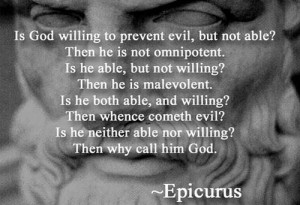
  2. Has any philosopher yet explained (except via verbal alchemy) how something can start out perfectly good and yet evil can come out of it? If God is defined as the perfectly good and only source of everything, then whence comes evil? Endless ages of verbal alchemy attached to this question explain nothing, the question remains.

    Note that if God is perfectly good and has freewill then a freewilled being can exist in a state of perfect goodness. But if God has freewill then wouldnʼt it be possible for God Himself to commit evil, or become evil? (Or do Christian apologists employ a different definition of “freewill” when it comes to “God?”) Conversely, if God does not have freewill then doesnʼt that imply that freewill is not necessarily of ultimate value and that humanity has something even God lacks?

  3. Is there something, ANYTHING, that a Christian apologist might consider to be “unjustifiable suffering?”

    For instance, what types of horrendous suffering (or chronic forms of soul-grinding suffering, or physically or psychologically crippling forms of suffering, even mentally maddening forms of suffering) have NOT happened to someone somewhere on this planet, or may not happen say, to someone throughout eternity? And is not ALL of that suffering “justifiable” according to Christian apologists? Judaism claims that even the righteous suffer like Job. While Christianity claims that an infinite eternal and guiltless Being (AKA Jesus-God) has “suffered” and even spent time in “hell,” though everyone still continues to suffer here on earth, including for the past two thousand years since that Being suffered. So there does not appear to be any form of suffering thatʼs not justifiable to the Christian apologist, is there, including Jews suffering in concentration camps simply for being Jewish in some way—and then they die in such a camp and may will awaken on judgment day to find their new bodies (and old souls) in eternal hell, right? (For centuries both devout Calvinists and Catholics even spoke about seeing the damned suffer for eternity and not only finding the eternal suffering of the damned something justifiable, but also something worth REJOICING over.) I ask again, is there any form of suffering that a Christian apologist might consider to be “unjustifiable suffering?”

    And why must people believe that the only way God can “accept” a person is if that person believes God has wrath (or a need to punish), and cannot simply forgive, nor punch a super pillow till His wrath abates, nor calmly instruct with minimal pain, and give people more than one chance, but instead God must take the sum total of His wrath out on the most unworthy recipient, a wholly guiltless individual, who also happens to be Himself? Why is such a belief necessary? And why do Christian creeds insist on the necessity of such a belief, when it obviously does not appeal to all, nor even make sense to all? All people donʼt even find the same stories (whether they involve “God” or not) as equally appealing or believable.

    At present about a third of the world is nominally speaking, “Christian.” No doubt the Bible is constantly being published and republished, even Uber-published if I may coin the phrase, and passed out round the world, making it the “worldʼs biggest best seller,” though a more truthful accolade might be the “worldʼs most handed out book,” or the “worldʼs most common gift book,” or the “most commonly suggested book that Christian men and women and pastors tell others that they should or must get a copy of and read.”

  4. I wonder whether Christian apologists have ever come to grips in a truly convincing fashion with the ways their God is portrayed (either in reality or metaphorically) in the book that they claim “reveals” the truth of their beliefs to humanity? For instance does the DEVIL threaten to cast people body and soul into hell? No. That type of imposed suffering is Godʼs design. Does the Devil get portrayed as wiping out every breathing thing on the planet except some ark survivors? Nope. Thatʼs God again. Does the Devil command the destruction of everything that breathes in certain cities? Does the Devil send plagues, famines, poisonous snakes, and opposing armies to teach people lessons like the God of the Bible is portrayed as doing? Does the Devil strike husband and wife both dead if they lie about giving all of their earthly possessions to the church?

Have Christian philosophers really dealt with questions like those above and below, or do they tend to flee them till they reach a nice quiet corner of huge generalizations resembling nothing so much as pious platitudes? But think for just a moment longer about this…

God is portrayed as acting thusly toward the “apple of His eye,” the “children of Israel”: The God of Israel tried to kill Moses (and failed); struck dead two sons of Aaron; commanded “brother to kill brother” leading to the deaths of 3,000 Israelites (right after He gave them the commandment, “Do not kill”); opened up the earth and buried alive “wives, sons and little children;” sent a fire that consumed 148 Levite princes; cursed his people to wander in the desert for forty years and eat 40,000 meals of quail and “manna” (talk about a monotonously torturous diet—and when they complained about it, God killed 3,000 Israelites with a plague); had a man put to death for picking up sticks on the Sabbath; denied Moses and Aaron entrance into the “promised land” because Moses struck a rock twice with his staff instead of talking to the rock; delivered to his people a “promised land” that was parched, bordered by desert, and a corridor for passing conquering armies; sent fiery serpents among Israel, killing many; wanted to kill every Israelite and start over with Moses and his family (but Moses talked God out of that plan); drove the first king of Israel to suicide; killed someone who tried to steady a teetering ark of the covenant; murdered king Davidʼs innocent child; sent plagues and famines upon his people that killed men, women and children; ordered the execution of 42 children of the king of Judah; “smote all Israel” killing half a million men of Israel in a civil war between Israel and Judah; “delivered into the hand of the king of Israel” 120,000 Judeans massacred in one day along with 200,000 Jewish women and children; gave Satan the power to kill Jobʼs children and servants (in order to win a bet); let the Babylonians conquer the holy city of Jerusalem, and then the Greek forces of Alexander the Great, followed by the Romans; and finally left the Jews homeless and persecuted by Christians and Moslems for nearly 2000 years. Furthermore, the large number of laws in the Hebrew Bible concerning the treatment of lepers and those with sores demonstrates that the Israelites were far from being blessed with unparalleled good health. And archeological evidence indicates that in ancient Israel the infant mortality rate was as high as fifty percent.

Edward T. Babinski [See the Bible for all of the cases mentioned above, except for the archeological evidence concerning ancient Israelʼs infant mortality rate. For the latter see, Drorah OʼDonnell Setel, “Abortion,” The Oxford Guide to Ideas & Issues of the Bible, ed. by Bruce Metzger and Michael D. Coogan (Oxford University Press, 2001)]

The Problem of Evil, Alvin Plantinga & Victor Reppert

by Edward T. Babinski

I saw through Plantingaʼs initial assumptions regarding his “solution” to the problem of evil twenty years ago while reading Plantingaʼs book that a Calvinist friend loaned me. I phoned Plantinga years later. He didnʼt answer my question.

Problem of Evil

Hereʼs my question…

A free-willed
All powerful
All knowing
All good
All perfect
All blissful God

creates something SOLELY out of His own will, power, knowledge, goodness, perfection, and bliss…so what room is there for anything less?

…but out of infinite perfection comes a cosmos where everything dies, where bliss is fleeting, where minds and hearts grow confused, damaged, sometimes even shattered via the process of struggling to earn a living and/or raise a family, or whittled down via repressive labor, or bored to death. Where human development is difficult and perilous, where communication is difficult, even perilous, for both people and nations, where ignorance (inherent in each culture, family and individual) and stubbornness about oneʼs ignorance is rife (the latter perhaps due to increasing inflexibility of the brain/mind once it has assumed a “system”—or been “assumed by” a system—because we not only “have beliefs,” but there is also evidence that “beliefs have us” as well). A cosmos where we cannot “see” whatʼs “behind it,” where “God” and “heaven” and the “afterlife” (or even the “before birth”) remains “hidden” to the vast majority of the earthʼs inhabitants throughout time. A cosmos where consciousness does not appear to pop out fully grown all at once, but has to develop just as the brain/mind develops in the womb and during the time of infancy, childhood, adolescent impulsiveness and finally adulthood. A cosmos where we continue to struggled against a world of nature that kills with cold, wind, fire, water, earth, desert heat, lava, predators, poisons, diseases, parasites. A cosmos where we strive to lessen the painful effects of, or eliminate, natureʼs dangers and pains that haunt not only us, but every other living organism on this planet. So we fighting the cold weather that kills to the desert heat that withers, and we strive to discern early warning signs of natural disasters and epidemics. A cosmos where we also strive to eliminate barriers of communication, or blow each other up trying.

Christian apologists like Plantinga ADD to the above mix of confusion and dangers their PRESUMPTION that this cosmos is all for the greater good, and PRESUME that besides all of the above confusion imperfection and dangers—from the death of everything we see—to insufferable boredom—to daily pains—passions—miscommunications—the ignorance inherent in each culture, family and individual—the inflexibility and inertia inherent in each brain/mind as it develops from youth—or degenerates with age—besides all that—Christian apologists insist everyone MUST believe in a particular holy book written by true believers (even in a particular INTERPRETATION of that holy book), or we will not only continue to suffer as on earth, but suffer relentlessly for eternity, without mercy.

And Plantinga presents it all like itʼs the most “rational” view possible.

Christian philosopher Victor Reppert at his blog, “C. S. Lewisʼs Dangerous Idea,” seems at least doubtful that Plantingaʼs view is the most rational and suggests that it might made a bit more sense if people received “another chance” after they had died to “convert.” I assume Vic believes that the ignorant limited brain/minds, and confused or debilitated characteristics of peopleʼs brain/minds from living in this imperfect cosmos will be healed following death (otherwise they might misperceive even the afterlife based on past limited experiences or imperfect brain/mind constitutions). So Vic suggests non-Christians will all be given another chance to “believe” after they have seen God and heaven and had time to investigate and ponder matters on the “other” side of this cosmos. But Vic also realizes I suppose that this is a rationalization on Vicʼs part. (What other of Vicʼs beliefs might not also be “rationalizations to believe” as he does, i.e., rather than “reasons to believe?”) At the very least Vic does not appear to think that Plantinga has “solved” all the problems regarding this cosmos and the Christian view of salvation, since Vic recognizes the need to try and go “further” than Plantinga via Vicʼs “second chance” scenario/rationalization.

Victor Reppert remains uncomfortable, has more questions than most orthodox Christian apologists on the internet. (Welcome to my mind/brain world, Vic, filled with more questions than answers.)

I have rational difficulties conceiving of a perfectly good and perfectly powerful being squeezing out a cosmos such as this. Furthermore, the experience of this cosmos in which all things die (and struggle not to) with such daily persistence is a shared experience of everyone on the planet.

I have even GREATER difficulty imagining that humanity (and every other organism on earth) have been placed in such a universally deadly situation in order that human beings might “hear the Word of the Christian God” and either choose to believe a book written by true believers, or die an everlasting death.

P.S., Since Iʼm agnostic, let me play around with a philosophical suggestion or two, a rationalization here, a guess there, concerning God. What if “God,” being a perfect eternal being, got omni-bored and tried to surprise Himself/Herself/They/Itself by playing “hide and seek” with Him/Her/They/Itself in a panentheistic fashion? Not that I even know what “panentheism” is, except to say that some say it refers to a view of “God” as the flame of all reality with everything else being flamelets proceedings from the one great flame, a lot like pantheism, but with each flamelet having a slightly greater degree of individuality. (I wonʼt argue whether such a conception of “degrees of individuality” is “true or not” in a philosophical sense, which will obviously get us no where, since how could one prove any of my assumptions above at all)? At any rate the “Hide and Seek” playing panentheistic God who gets omnibored and then tries to generate “Surprise,” might help explain a cosmos in which life arises yet everything dies, and it might help explain humanity as well, including the “hiddenness” of God. But again, I admit Iʼm only dealing with analogies from “fire,” or from basic human emotions such as “boredom” and “surprise,” and ways in which we understand such matters, and thus I am bending the wax nose of philosophical ideas and words in ways I cannot prove and that prove nothing. Though if someone wished to follow up on this little suggestion they could do worse than read Alan Wattsʼs BOOK OF THE TABOO (Against Knowing Who You Really Are); or his Christian version of the same view in an earlier work he wrote while still an Anglican priest, BEHOLD THE SPIRIT. I am not however suggesting one must read anything of the sort.

Another guess concerns the views of universalist Christians who believe that God and time are the best teachers, hence they donʼt fear what comes next for anyone, and merely seek to blow on the spark of eternal salvation already lying inside us all, to inspire and uplift.

Iʼm not saying any philosophical suggestion of mine, or Plantingaʼs, or Reppertʼs, is easy to maintain however, not if pains or diseases of body and/or mind grow excruciating. People suffering a “ringing in the ears” have been known to leap to their deaths because the ringing kept them up till they had gone nearly mad. Sleep deprivation, even just dream deprivation (waking up a person whenever they go into rapid eye movement (or REM) mode to prevent them from dreaming) can apparently kill a person faster than depriving them of food. During times of intense pain, disease, or deprivation neither philosophy nor theology seem to help the person who is being forced to suffer greatly. Even in the Bible, though Job didnʼt curse God, he sought answers. “WHY?” Even Jesus is portrayed as shouting out “WHY” in a despairing line from a psalm before his death, “My God, My God WHY have you forsaken me?” C.S.Lewis admitted a year before he died that he “dreaded most” the thought that he may have been “deceiving himself” concerning the kind of “God” who would give his wife cancer and then himself cancer. Or as in the case of a conversation Mother Teresa had (she didnʼt believe in pain killers) with a man suffering intense pain from cancer, “Jesus is kissing you,” to which the man replied, “Then I wish heʼd stop.” Thatʼs the problem of pain in a nutshell. The “dread” of C.S. Lewis. The “Whys” of Job and Jesus. Not to mention Victor Reppertʼs “second chance.”

The Da Vinci Code, Fiction and The Gospels

by Edward T. Babinski

Dan Brownʼs novel proves that FICTION can be highly engrossing, and obtain a wide readership—especially if the fiction begins with a fictional promise of unveiling truth (*smile*), and especially if the market is ripe for it. The same might also be said of the Gospels and why they became “bestsellers.”

Erasmus

British actor Ian McKellen who appeared in The Da Vinci Code, put it this way: “Iʼve often thought the Bible should have a disclaimer in the front saying this is fiction. I mean, walking on water, it takes an act of faith.”

Quite a few people — including many fans of Dan Brownʼs book — will probably be displeased with such sentiments, but itʼs difficult to argue that significant amounts of the Bible arenʼt fiction. Obviously some portions are historical to one degree or another, but any more historical than the true parts of Dan Brownʼs novel? [Austin Cline at http://atheism.about.com]

The Gospels were like a first-century “Da Vinci Code” novel, featuring wild pesher and midrashic interpretations of “riddles and clues” that God allegedly added to the ancient Hebrew books of the Bible, written centuries before Jesus was born, yet which “foretold” his arrival and even incidents of his deeds, death and resurrection. The earliest Gospel, “Mark,” also speaks mysteriously about Jesus being secretive about his true identity. Sounds similar to the unconvincing arguments found in Dan Brownʼs mystery novel! Especially since the alleged “prophecies about Jesus” which were lifted (sometimes a mere half verse at a time) from the O.T. were based on the most tenuous of alleged connections, or even possibly based on making some stories of Jesus up just to suit the verses! [Google Jeff Lowderʼs online article, “The Fabulous Prophecies of the Messiah;” and also google “Fiddler Zvi” and his online “Messiah and Tanakh” page. Also note that the earliest Gospel, of which 90% was reproduced in the two later ones, Matthew and Luke, is also the gospel featuring the idea that Jesusʼs messiahship was originally kept a secret, which is a bit different from the last written Gospel were Jesusʼs messiahship is out in the open from the start beginning with Nathaniel in chapter one and with Jesus speaking solely about himself every chance he got in public, “I am” this, “I am that,” with not a word spent talking in parables to the public.

Another point raised by the Da Vinci Code is the haughtiness and self-seeking hierarchies of the Catholic church and her theologians, a point that even Christians throughout history have raised in ways that might make Dan Brown smile in recognition:

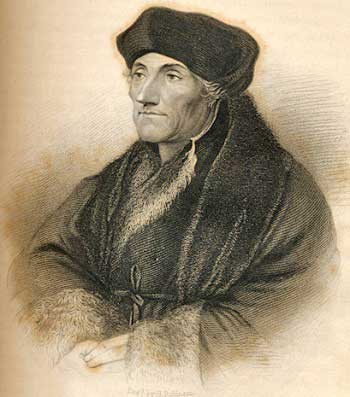
Take the words of the Catholic satirist, Erasmus, “As for the theologians, perhaps it would be better to pass them over in silence, not stirring up a hornetsʼ nest and not laying a finger on the stinkweed, since this race of men is incredibly arrogant and touchy. For they might rise up en masse and march in ranks against me with six hundred conclusions and force me to recant. And if I should refuse, they would immediately shout ‘heretic.’ For this is the thunderbolt they always keep ready at a moments notice to terrify anyone to whom they are not very favorably inclined” (Erasmus 57).

His commentary continues regarding the theologiansʼ ridiculous penchant for “endless and magisterial definitions, conclusions,” and “corollaries” (Erasmus 58).

“They [theologians] are so blessed by their self love as to be fully persuaded that they themselves dwell in the third heaven, looking down from high above on all other mortals as if they were earth-creeping vermin almost worthy of their pity…”

“Moreover, they explicate sacred mysteries just as arbitrarily as they please, explaining by what method the world was established and arranged, by what channels original sin is transmitted to Adamʼs posterity, by what means, by what proportion, in how short a period of time Christ was fully formed in the virginʼs womb… There are others which they think worthy of great and ‘illuminated’ [in the faith by the Holy Spirit] theologians, as they say. If they ever encounter these, they really perk up. Whether there is any instant in the generation of the divine persons? Whether there is more than one filial relationship in Christ? Whether the following proposition is possible: God the Father hates the Son. Whether God could have taken on the nature of a woman, of the devil, of an ass, of a cucumber, of a piece of flint? And then how the cucumber would have preached, performed miracles, and been nailed to the cross?…”

Dan Brown, in comparison with Erasmus, simply wondered whether Jesus could have had children and still “saved the world.”

Erasmus continued, “And then these most subtle subtleties are rendered even more subtle by the various ‘ways’ or types of scholastic theology, so that you could work your way out of a labyrinth sooner than out of the intricacies of the Realists, Nominalists, Thomists, Albertists, Occamists, Scotists—and I still havenʼt mentioned all the sects, but only the main ones.”

Erasmus does not spare the “religious” or the “monks” his berating wit either. Erasmus branded those who considered themselves “religious” or “monk” to be anything but that which such monikers signify. He, in fact, couldnʼt imagine “how anything could be more wretched than these men,” who were in reality “far removed from religion” and “encountered more frequently everywhere you go” (Erasmus 61).

Popes and priests are offered the same treatment. Popes are painted as the antithesis of the Christ example of poverty, labor, teaching, and sacrifice. It is the popes who have an abundance of luxuries, honor, and pomp. Popes have all of the advantages this life can afford. “How many advantages would these men be deprived of if they were ever assailed by wisdom” (Erasmus 66)? The priests, on the other hand, and when not fighting “for their right to [being given the] tithes [of parishioners], with sword, spears, and stone, with every imaginable sort of armed force,” are busy keeping a “sharp lookout to harvest their profits” (Erasmus 67-68).

SOURCE: Erasmus, Desiderius. In Praise of Folly. A Reformation Reader: Primary Texts with Introductions. Ed. Denis Janz. Minneapolis, MN: Fortress Press, 1999.

http://www.lofitribe.com/

So if Dan Brown satirized excesses within the Catholic Church, perhaps he was too light in doing so, especially when compared with what Erasmus (a reform-minded Catholic humanist) and Martin Luther (a former Catholic who became a Protestant Reformer) both wrote about it!

- Edward T. Babinski

Gospel of John in American Evangelicalism

Gospel of John

by Edward T. Babinski

A Christian seminarian (at a Southern Baptist seminary—a conservative inerrantist institution), named Chris Petersen, has composed an article titled, “The Triumph of the Gospel of John in American Evangelicalism”, that includes some questions I too struggled with before I left the fold.

The questions this student raises are not new. They arise whenever students and scholars of the Bible compare the three synoptic Gospels with the Gospel of John. For instance, professor James D. G. Dunn in his most recent monumental theological works on Jesus has acknowledged that the historical Jesus most probably didnʼt speak a word of what the Gospel of John portrays Jesus as having said.

Chris also has a five-part series on the discrepancy between the day of the week in which Jesus died according to the three Synoptic Gospels, compared with the day mentioned in the Gospel of John, titled, “The Date of Passover and the Pitfall of Inerrancy”.

(Perhaps J. P. Holding and Dave Armstrong might consider reading Chrisʼs pieces and offer to explain to the bright young lad why his questions, like Dr. Dunnʼs, arenʼt worth focusing any serious attention on.)

- Edward T. Babinski

Which “God” Should A Classical Theist Believe In?

Which God Should Classical Theist Believe In?

by Edward T. Babinski

According to a detailed survey performed by Baylor University researchers, the type of god people believe in can predict their political and moral attitudes more so than just looking at their religious tradition.

Researchers found that none of the “four gods” dominated among believers. The data showed:

  • 31.4 percent believe in an Authoritarian God, who is very judgmental and engaged
  • 25 percent believe in a Benevolent God, who is not judgmental but engaged
  • 23 percent believe in a Distant God, who is completely removed
  • 16 percent believe in a Critical God, who is judgmental but not engaged

Source: Baylor University

USA Today breaks down more information about those political and moral attitudes which are associated with each of the four types of God:

The Authoritarian God (31.4% of Americans overall, 43.3% in the South) is angry at humanityʼs sins and engaged in every creatureʼs life and world affairs. He is ready to throw the thunderbolt of judgment down on “the unfaithful or ungodly,” Bader says.

Those who envision God this way “are religiously and politically conservative people, more often black Protestants and white evangelicals,” Bader says. “(They) want an active, Christian-values-based government with federal funding for faith-based social services and prayer in the schools.”

Theyʼre also the most inclined to say God favors the USA in world affairs (32.1% vs. 18.6% overall).

The Benevolent God (23% overall, 28.7% in the Midwest) still sets absolute standards for mankind in the Bible. More than half (54.8%) want the government to advocate Christian values.

But this group, which draws more from mainline Protestants, Catholics and Jews, sees primarily a forgiving God, more like the father who embraces his repentant prodigal son in the Bible, Froese says. Theyʼre inclined (68.1%) to say caring for the sick and needy ranks highest on the list of what it means to be a good person.

The Distant God (24.4% overall, 30.3% in the West) is “no bearded old man in the sky raining down his opinions on us,” Bader says. Followers of this God see a cosmic force that launched the world, then left it spinning on its own.

This has strongest appeal for Catholics, mainline Protestants and Jews. Itʼs also strong among “moral relativists,” those least likely to say any moral choice is always wrong, and among those who donʼt attend church, Bader says. Only 3.8% of this group say embryonic stem cell research is always wrong, compared with 38.5% of those who see an authoritarian God, 22.7% for those who see God as benevolent and 13.2% who see God as critical but disengaged.

Edward T. Babinski and Victor Reppert

Philosophy
  • Philosophical Problems of Knowledge and Communication
    Flaws in philosophizing about the Big Questions. The ‘God’ knowledge appears relatively more ‘hidden’ than the knowledge about the cosmos we all live in together.

  • Which “God” Should A Classical Theist Believe In?
    Beliefs which are prevalent among believers in God.

  • Gospel of John in American Evangelicalism
    Questions raised are not new, and arise whenever students and scholars of the Bible compare the three synoptic Gospels with the Gospel of John.

  • The Da Vinci Code, Fiction and The Gospels
    A look at the Da Vinci code, the early gospels, and writings of Erasmus.

  • Question of Evil
    Hereʼs to personal hope there is more than just mortal life with its pains and then death, however one does not need to construct ‘philosophical proofs’ in order to entertain basic questions concerning ‘why’ the cosmos is the way it is.

  • Problem of Evil
    Questions like these which Christian philosophers have never really dealt with, and tend to flee them reaching a nice quiet corner of huge generalizations resembling pious platitudes.

  • The Problem of Evil
    Question of why a God of own will, power, knowledge, goodness, perfection and goodness creates a cosmos filled with pain and death.

  • Non-Exclusivism, Universalism, Evil, and, Philosophy As One Big “IF”
    Americaʼs leading Evangelical Christian philosophers are more attracted to ideas of ‘non-exclusivism’ than are Americaʼs leading Evangelical Christian theologians, the latter of whom spout relatively more exclusivistic views based on a stricter linguistic interpretation of the Scriptures.

Philosophical Problems of Knowledge and Communication

by Edward T. Babinski

Victor Reppert said…
OK Letʼs go back to kindergarten. The argument from evil is proffered as a proof of the nonexistence of an omnipotent, omniscient, and perfectly good being. The defender is trying to prove nothing except that the atheist has not proven atheism. A person can accept the argument from evil who does not accept the existence of an omnipotent, omniscient, and perfectly good being, even if they believe in some other being that might be in some sense a deity.

You can believe that the existence of the worldʼs evil is logically incompatible with theism, you can believe that it provides substantial and virtually overwhelming evidence against theism. You can believe that it provides some, but not overwhelming evidence against theism. or that it provides no evidence against theism. Which is it Ed? These options exhaust the alternatives, unless you actually think that evil provides evidence for theism. Where do you stand?

In the issue of the problem of evil, itʼs atheists like Loftus and Carr, and Flew and Mackie, and Rowe and Draper, who put the argument forward as a good or perhaps decisive reason to reject theism. Some of them go as far as to say that the argument from evil proves that all theists hold their beliefs irrationally. If they are right then a philosophical argument in a major topic in the philosophy of religion works, and works well. If you donʼt, then you accept the outcome of my project, which has always been to show that there is nothing overwhelming about the argument from evil.

You lose credibility every time you dodge this question and pour out pages and pages of anti-Christian diatribe while at the same time refusing to accept the idea that any argument in philosophy really works. Unless you make clear what conclusion you are driving at, I must conclude that your animadversions on these matters are “full of sound and fury, signifying nothing.” Or, to put it another way, BS.

Victor Reppert recently left me a comment at his blog that began with an invitation for me to return to kindergarten, and concluded that my replies were full of “sound and fury,” and my questions “signified nothing.” My reply appears below.

Philosophical Problems of Knowledge and Communication

Vic,
Since you wish to take me back to kindergarten, then letʼs do so. No evasions, letʼs begin from scratch.

Tell me all that you know about God, all that youʼve seen of God, touched of God, heard of God, tasted of God; and then tell me all that you know about the world you see and taste and touch and hear, the people you see everyday, and the cosmos where you see all things die.

The “God” knowledge appears relatively more “hidden” to me than the knowledge I have of the cosmos we all live in together.

I am not saying that the problem of evil has ceased being problematical any more than I am saying it is impossible for anything other than nature to exist. Iʼm simply telling you what I know with some degree of certainty compared with beliefs that I am less sure about.

I have also pointed out what I consider to be flaws in philosophizing about the Big Questions. Anyone may philosophize all they wish, and argue for whatever “God” or “force” they believe exists or doesnʼt.

However the more I read such arguments, the less convincing I find them. “Words” themselves do not appear to provide absolutely accurate descriptions of the realities they are supposed to parallel. “Words” are stuck having to describe things that can also be understood as lying along spectrums of change. Words and concepts appear to be distilled from experiences within this cosmos where words/concepts and their opposites co-exist, or intermingle along spectrums of change. Neither am I of the opinion that verbal analogies constitute proof. Poetry yes. Proof no. I suspect the human mind of also being flexible enough to come up with counter analogies and counter arguments aplenty concerning all the BIG questions.

So I have simply come to trust direct experience a bit more than idealized philosophical arguments purporting to explain the answers to all the Big Questions. I also have grown more patient, not less, with living life day to day, and with the experimental process on both a personal level and in terms of humanityʼs groping toward greater knowledge. I choose patience even to the point of admitting I will very probably grow old and die with the same questions we have discussed, being debated still among philosophers.

Let me put it this way, I donʼt even know nor can I prove in a strictly philosophical fashion whether or not death ends “me” permanently, or, whether I or bits of me might survive after I die in a “ghostly” fashion, or, whether bits of me might not merge or join with others or bits of others that have died to form something new that begins again in a cosmos like ours or continues in some another dimension, or, whether I or bits of me might not “come back” in a reincarnate fashion, or, whether bits of me might survive after death for a long time and THEN even those bits die eventually, or, whether I have an immortal individual “soul” that can never die, or, perhaps I will die and an exact duplicate of me will be CREATED with the exact same knowledge and memories I had right up to the instant of my death (I donʼt know whether or not such a thing could be done by beings of super-intelligence from the future or past or parallel cosmoses, or by a demi-god or infinite Being who kept a copy of me in their “memory” and so could recreate me in some other place time or cosmos even if the “me” that lives here “dies”). Christian philosophers of mind also canʼt agree on the later two options, an immortal soul, or recreation after death by God. Some of them even use the Bible to argue that human beings donʼt “have” souls, they “are” souls. So, they agree the mind could be a function of the brain and the summation of experiences and knowledge each brain takes in as it grows and develops and becomes enculturated. Purely philosophically speaking, any or all of the above options might be true. Itʼs even possible philosophically speaking to argue that what we call “consciousness” does not include our particular memories and knowledge and lives which might accrue and gather round “consciousness” and interact with it, so “consciousness” might be something that is more basic even to the cosmos itself, malleable and universal rather than individual. (Note, Iʼm not saying I view all options as equally appealing.)

There certainly are many weird things Iʼve read about when it comes to consciousness, including mystical experiences, and weird visions people claim to have experienced which vary depending on oneʼs culture. Though unfortunately, most people whose heart stop during surgery, or for long periods, and they are revived, recall nothing. And most sleep during the night is unconscious, dreamless. And thereʼs questions that result from split-brain experiments, and thereʼs cognitive science that is teaching us some of the many ways we each are influenced by items around us, or by others, unconsciously, and thereʼs pheromonal influences as well (scents we canʼt even consciously smell that affect us). Recently I read about how certain bacteria might be affecting peopleʼs brain/minds. Other experiment indicate that the brain/mind is an excuse generator, even a belief generator (as indicated in some-split brain experiments).

It also seems to me that humanity is young as an intellectual species. Heck weʼre still stuck on the cradle planet.

So tell me Vic, what do you really know? How much do you think you know about “God the universe and everything?” What percentage of that knowledge consists of philosophical conundrums that have remained unresolved for millennia? While just how much more do you interact with and know about the cosmos in which you live, move and have your being, and in which everything dies? I think youʼd have to agree with me that you know more about the latter than the former.

P.S., By the way, your recent post about the Deityʼs “right to choose” as a possible reply to “evil,” appears like youʼre thrashing blindly about for answers nearly as much as I am. I donʼt know how you can continue to believe you are building up “proofs” when you sink back in that post to relying on total mystery and faith in whatever “God does,” which is close to relying on the mystery of “whatever will be will be.” Are you honestly considering no longer even asking WHY “God” might “choose” the things “God” chooses, or what the definition of “good” is? Is it simply whatever God chooses? Whatever exists? Again, mystery. Didnʼt Aquinas and Barth also sink back into total mystery in the end and admit all of their philosophizing wasnʼt quite the point, or didnʼt provide the ultimate proofs theyʼd hoped to present?

I know youʼre not a fundamentalist Vic, and you DO admit uncertainties. I simply admit more than you do. By the way, thereʼs a book about kindergarten that I enjoyed reading once, titled, Everything I Need to Know I Learned in Kindergarten.

- Edward T. Babinski

Origins of Hospitals and Schools of Higher Learning

Many hospitals and universities too were indeed founded by churches, religious orders and individual Christians.
If youʼre making a distinction between founded on and founded by Iʼd be curious to see it. You can find hospitals founded by non-Christian institutions or individuals but a large number owe their existence to the aforementioned Christian associations and individuals. Itʼs a historic fact.
I read Edʼs article and donʼt see a contradiction between it and what I wrote. There are hospitals in other parts of the world and other cultures had their own means of healthcare. He contends that “hospitals as we know them were an innovation of Christianity.” The operative phrase being “as we know them.” Stephen is probably right but I expect heʼll weigh in himself on this. — Paul
Article in Dispute, History of Hospitals

Origins of Hospitals and Schools of Higher Learning

Ed: Paul, I would like to add something to what you wrote above concerning “the origin of universities,” since you have added that to the topic of the origin of hospitals. Please read the quotations below, from recognized scholars. The early Christian church under the Christianized Emperors let languish and helped destroy the greatest library known to the ancient world. It associated “Satanʼs influence” with great works of pagan genius. It threatened people with hell for reading “pagan” books, it closed the schools of the ancient pagan scientists and doctors and mathematicians (Ramsay McMullen, cited often below, is a well known and well respected professor of history concerning this particular time period and has written copiously about it):

[During the reign of Christian Emperor Theodosius] bands of wandering monks attacked synagogues, pagan temples, hereticsʼ meeting places, and the homes of wealthy non-believers in Mesopotamia, Syria, Egypt, Palestine, and North Africa. [Also during his reign] the bishop of Alexandria incited local vigilantes to destroy the Temple of Serapis [also known as the Serapeum], one of the largest and most beautiful builds in the ancient world that also housed a library donated by Cleopatra. Alexandrian Christians whipped up by Bishop Cyril rioted against the Jews in 415, and then murdered Hypatia, a wise and beloved Platonic philosopher.
- Richard E. Rubenstein, When Jesus Became God: The Epic Fight Over Christʼs Divinity in the Last Days of Rome, p.226-227


Art, philosophy, literature, the very psychology of Western man, all suffered by the victory of the [Christian] bishops.
- John Holland Smith, The Death of Classical Paganism


The Christian zealots for conversion took to the streets or criss-crossed the countryside, destroying no doubt more of the architectural and artistic treasure of their world than any passing barbarians thereafter.
- Ramsay MacMullen, Christianizing the Roman Empire


Examples of destroyed Temples: the Sanctuary of Aesculap in Aegaea, the Temple of Aphrodite in Golgatha, Aphaka in Lebanon, the Heliopolis. Christian priests such as Mark of Arethusa or Cyrill of Heliopolis were famous as “temple destroyers.”

In the early fourth century the philosopher Sopatros was executed on demand of Christian authorities.

In the sixth century pagans were declared void of all rights.

- K. Deschner, Abermals krähte der Hahn, (Stuttgart 1962), p. 466, 468


Pagans had not been clear or unanimous in their belief in an afterlife, but those who credited it looked to mystery cults for insurance in their future. Christians were much more positive. The Christians united ritual and philosophy and brought the certainty of God and history to questions whose answers eluded the pagan schools. Whereas pagan cults won adherents, Christianity aimed, and contrived, to win converts.

Paganism was reclassified as a demonic system. If Satan was the source of error and evil, false teaching and wrongdoing were not merely mistaken: they were diabolic. The division between a Christian “community of goodness” and an “outer world of evil” could easily become too pronounced. The idea of Satan magnified the difference between “true” and “false” Christians and between Christian sinners and saints.

Like Satan, the Last Judgment was a force that Christians exaggerated and then claimed to be able to defeat. This teaching was reinforced by an equally powerful ally, the Christian idea of sin. Sin was not just the sin of an action, or even an intention, but also the sin of a thought, even a passing interest in an appealing man or woman. This combination of rarefied sin and eternal punishment was supported, as we shall see, by books of vision and revelation that were probably more widely read than modern contempt for “pseudepigraphic” forgeries allows: acquaintance with the Apocalypse of “Peter” would make anyone think twice before leaving the Church (we happen to know that “Peterʼs vision of hell” was still read as a holy text in the churches in Palestine on Good Friday during the fifth century). If fears for Eternity brought converts to the faith, one suspects that they did even more to keep existing converts in it.
- Robin Lane Fox, Pagans and Christians (Alfred A. Knopf, Inc., New York, 1987), p. 326-327, 330-331, 412


Institutions of higher learning had been largely destroyed. The [Christian] emperorsʼ attacks had centered on the chief of them, Athens and Alexandria, in the late fourth century and were turned against them again toward the end of the fifth and in 529 [the year that the School of Athens was closed by the decree of the Christian Roman Emperor Justinian.
— E.T.B.].

As to the initiators of the persecution, the [Christian] emperors themselves, a steady decline in their level of cultivation has been noticed. Thus books and philosophy were bound to fade from sight.

After Constantine there existed an empire-wide instrument of education: the church. What bishops, even emperors, made plain, and what could be heard in broader terms from every pulpit, was an agreed upon teaching. Every witness, every listener should know the great danger to his soul in Platoʼs books, in Aristotleʼs, in any of the philosophical corpus handed down from the past. The same danger threatened anyone using his mind according to their manner, with analytical intent, ranging widely for the materials of understanding, and independent of divine imparted teachings.

Another factor that arose specifically out of the ongoing conversion of the empire was the doctrine of demonic causation. The belief in the operation of maleficent forces on a large scale had to await Christianity; and it was of course Christianity that was to form the medieval and Byzantine world.

Satanic agents were to be seen as the cause not only of wars and rebellions, persecution and heresy, storms at sea and earthquakes on land, but of a host of minor or major personal afflictions. So, in consequence, Christians were forever crossing themselves, whatever new action they set about, and painted crosses on their foreheads too, responding to their leadersʼ urging them to do so. It would protect them against all evil.
- Ramsay MacMullen, Christianity and Paganism in the Fourth to Eighth Centuries


[Lucky thing that the Moslems preserved such a huge library of classical books stored in Seville, Spain, that helped reignite the European Christian world of learning. It was that Moslem library at Seville that helped revive learning more than all the books the Irish monks were busy “illuminating.” (I learned that from the famed CONNECTIONS television series). - E.T.B.]

The Origin Of Universities

As for Christian universities they were inspired by revived Greek and Roman learning during the Renaissance. Calvin attended such a “humanistic” institution of learning before becoming a Reformer. Luther was certainly in close contact with such “humanist” scholars like Erasmus and others. Such institutions were inspired by the Renaissanceʼs revival of ancient pagan knowledge and ideals of scholarship. So the Christians took their studies from the Greeks and Romans. Aquinas built his system on that of Aristotleʼs philosophy (and added eternal hell and the joy of seeing the damned rot there). See the following quotations:


Because of the emphasis on authority and the all-pervasive influence of the church, the medieval atmosphere was not conductive to free scientific investigation. Those who studied science were churchmen, and their findings were supposed to illuminate rather than contradict the dogmas of the theologians. When Greek and Arabic works were translated in the twelfth century, the West inherited a magnificent legacy of mathematical and scientific knowledge. Algebra, trigonometry, and Euclidʼs Geometry became available, and Arabic numerals and the symbol for zero made possible the decimal system of computation…

Scholasticism reached its zenith with Thomas Aquinas (1225?-1274). In his Summa Theologica, this brilliant Italian Dominican dealt exhaustively with the great problems of theology, philosophy, politics, and economics. Thomasʼ major concern was to reconcile Aristotle and church dogmain other words, the truths of natural reason and the truths of faith. There can be no real contradiction, he argued, since all truth comes from God. In case of an unresolved contradiction, however, faith won out.

Origin Of Universities

The rebirth of learning in the twelfth century, with especially its revival of classical learning, its unprecedented number of students flocking to the schools, and its development of professional studies in law, medicine, and theology, led to the rise of organized centers of learning - the universities, which soon eclipsed monastic and cathedral schools. Originally the word university meant a group of persons possessing a common purpose. In this case it referred to a guild of learners, both teachers and students, similar to the craft guilds with their masters and apprentices. In the thirteenth century the universities had no campuses and little property or money, and the masters taught in hired rooms or religious houses. If the university was dissatisfied with its treatment by the townspeople, it could migrate elsewhere. The earliest universities - Bologna, Paris, and Oxford - were not officially founded or created, but in time the popes and kings granted them and other universities charters of self-government. The charters gave legal status to the universities and rights to the students, such as freedom from the jurisdiction of town officials.
Source: ragz-international.com


Since we [the nation of India] inherited the present system of university education from the British, one may be tempted to believe that university education had its origins in the West. The truth of the matter is very different. India and Sri Lanka had their own systems of university education, their origins going back to the pre-Christian era. Jawaharlal Nehru, the first Prime Minister of India, describing the structure of the village republics of ancient India, in his ‘Glimpses of World History’ describes the origin of universities in very simple terms: “Many learned men used to retire into the forests, near the towns and villages, in order to lead simple lives, or to study and work in quiet. Pupils gathered round them, and gradually fresh settlements grew up for these teachers and their students. We can consider these settlements as universities. There were not many fine buildings there, but those who sought knowledge came from long distances to these places of leaning” (P.25).

When large towns and cities grew up, the universities also grew up into large complexes. “And in these centers of learning” continues Nehru, “every kind of subject that was then known was taught. The Brahmans even taught the science of war” (P.26). Prof. A. L. Basham, the author of the famous book, ‘The Wonder That was India’ tells us more about these Indian universities.

“Certain cities became renowned for their learned teachers, and achieved a reputation comparable to that of the university cities of medieval Europe. Chief among these were Varanasi and Taksasila, which were already famous in the time of the Buddha; later, around the beginning of the Christian era; Kanci acquired a similar reputation in the South. Varanasi, then usually called Kasi, was particularly renowned for its religious teachers, but Taksasila, in the far North-West, laid more emphasis on secular studies.”

Taksasila, which is now in Pakistan, had become so famous as a university that even the Buddhist Jataka tales make reference to it. Says Prof. Basham: “The Buddhist Jataka tales show that young men from all over the civilized part of India sought education in this city, through which a trickle of Iranian and Mesopotamian influence found its way to India.

Among the famous learned men connected with Taksasila were Panini, the grammarian of the 4th century BC, Kautilya, the Brahman Minister of Chandragupta Maurya, and traditionally the chief master of science of statecraft and Caraka, one of the two great masters of Indian medical science.” (P.165) Indian Buddhists get the credit of establishing monasteries that developed into universities. The Buddhist monastery of Nalanda, in Bihar, founded during the Gupta Age was one such university. According to Hsuan Tsang, the Chinese pilgrim who visited Nalanda in the 7th century, Nalanda was a hive of intellectual activity. As Prof. Basham notes “Under its aged and saintly abbot Silabhadra, Nalanda did not confine itself to training Buddhist novices, but also taught the Vedas, Hindu philosophy, logic, grammar and medicine. It would seem that the student population was not confined to the Buddhist order, but that candidates of other faiths who succeeded in passing a strict oral examination were admitted” (P. 166). [Here this website adds, “To be continued”]

Hypatia of Alexandria

Hypatia (370?-415 A.D.), Greek philosopher, born in Alexandria, daughter of the mathematician Theon (q.v.). She assisted her father in his writings, and succeeded him as lecturer on mathematics and Greek philosophy. Her intellectual gifts and her beauty attracted students from foreign countries; and her judgment was so respected that the city magistrates of Alexandria consulted her on important cases. In about 400 A.D. she was the undisputed leader of the Neoplatonic school of philosophy at Alexandria (see Neoplatonism). She was the author of commentaries on ancient astronomical and mathematical works. Because of her association with Orestes, the pagan prefect of Alexandria who opposed the persecution of the Jews and other non-Christians initiated by Bishop Cyril (see Cyril, Saint), Hypatia was murdered by a mob of Christians and her body was burned. She is the heroine of the historical romance Hypatia (1853) by the English novelist Charles Kingsley.

Source:Funk and Wagnalls Encyclopedia 1950 and 1951
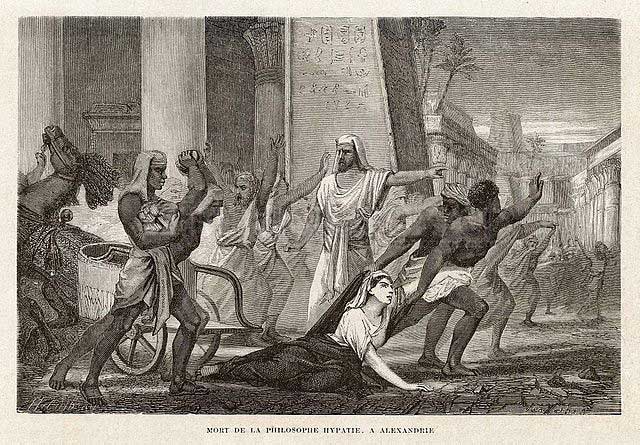

Hypatia of Alexandria

III.-The Policy Of Succeeding Emperors Toward Heathenism.

The discretion of the emperor who followed Julian saved Christian rule, for the time being, from an unfavorable contrast with heathen rule, as respects tolerance.

Jovian earned the hearty encomiums of representative heathens, such as Themistius, by granting full liberty for the exercise of their religion, those obnoxious rites alone excepted for which no one expected a governmental sanction. Valentinian, Emperor of the West from 364 to 375, adhered in general to the same principles; a superstitious zeal in prosecuting those suspected of practicing magic being his most serious exhibition of intolerance. Valens (364-378), Emperor of the East, by the grace of his brother Valentinian, acknowledged the same laws in relation to heathenism, and sanctioned a similar severity against all supposed to be guilty of magic and divination. The reputation for intolerance attached to Valens is due rather to the rigor with which, as an Arian, he treated the orthodox party, than to any violent attack upon heathenism, It was during the joint reign of these emperors that the word paganism was first employed officially as a designation of a religion. l
1 codex Theodus., Lib XVI., Tit. ii. 18.
Gratian, who followed Valentinian in the rule of the West, while he issued no sweeping prohibition against the practice of heathenism, dealt it a destructive blow by ordering that the revenues of the temples, and the public support which had been given to priests and vestals, should be withdrawn, He also commanded the statue and altar of Victory to be removed from the Senate. A strong effort was made by heathen partisans to have these measures repealed; but the diligence and energy of Ambrose, who was highly influential both with Gratian and his successor, Valentinian II., defeated the attempt.

In 379 Theodosius came to the throne of the East, and in 394 his success in overthrowing the usurper Eugenius gave him also the rule over the West. Reversing the policy of Valens in relation to the doctrinal controversies of the age, he assisted the orthodox party to a final victory. As regards heathenism, his decrees and his practice indicated for a considerable time a wavering between toleration and proscription; but in 891 he entered decidedly upon a policy of total repression, that is, of heathen rites. The mere belief, or even its advocacy, he did not think of touching, and numbered professed heathen among his friends and officers. By a law of 392, the offering of idolatrous sacrifices was declared a crimen majestatis, and as such might be capitally punished. This penalty, however, had its place in the statute-book, rather than in actual execution. “The ready obedience of the pagans,” says Gibbon, “protected them from the pains and the penalties of the Theodosian code.” l
1 Chap xxviii
But if their persons were spared, their temples in many instances were not. No general edict was issued by Theodosius for their destruction; but the passions of the populace, and the fanatical zeal of the monks, urged on, in various districts, the work of spoliation and ruin. In some cases retaliation was provoked from the heathen. We read of Christian churches being burned in Palestine and Phoenicia. In Alexandria the heathen requited what they deemed an insult to their faith (namely, an ostentatious parading of the indecent symbols found in a temple which had been devoted to the worship of Bacchus) with violence and bloodshed; and, indeed, they so far committed themselves by their sedition, that they finally counted it good fortune that they were allowed to escape with their lives, though obliged to witness the destruction of the magnificent temple of Serapis, as well as of less noted edifices.

A similar course, attended with similar incidents, was pursued by the sons of Theodosius, Arcadius, and Honorius, and by their immediate successors. The episode most disgraceful to the Christian side was the murder at Alexandria, in 415, of the beautiful and talented female philosopher Hypatia. It is to be observed, however, that, while professed Christians were the agents in this brutal and unchristian deed, it was not altogether in the name of religion that it was accomplished. Political motives were prominent. The deed, moreover, was that of a mob, -a mob drawn from a populace noted for its turbulence and ferocity. “The Alexandrians,” says Socrates, who was in middle life at the time of the tragedy, “are more delighted with tumult than any other people; and if they can find a pretext they will break forth into most intolerable excesses.” The same historian speaks in the highest terms of the character and ability of Hypatia, representing her as gaining universal admiration by her dignified modesty of deportment, as drawing students from a great distance to hear her exposition of the Neo-Platonic philosophy, and as surpassing all the philosophers of her time through her attainments in literature and science, “Yet even she fell a victim,” he continues, “to the political jealousy which at that time prevailed. For as she had frequent interviews with Orestes [the prefect], it was calumniously reported among the Christian populace that it was by her influence he was prevented from being reconciled to Cyril. Some of them, therefore, whose ringleader was a reader named Peter, hurried sway by fierce and bigoted zeal, entered into a conspiracy against her; and observing her as she returned home in her carriage, they dragged her from it, and carried her to a church called Caesareum, where they completely stripped her, and murdered her with shells. After tearing her body in pieces, they took her mangled limbs to a place called Cinaron, and there burned them. An act so inhuman could not fail to bring the greatest opprobrium, not only upon Cyril, but also upon the whole Alexandrian Church.” The judgment which the Christian historian passes upon the deed, it may fairly be presumed, was the judgment of intelligent and sober-minded Christians the Empire over.

As heathenism had very little to contend for, it gradually succumbed. Only a remnant of it was left in the East by the time of Justinian (527-565), and to this the despotic emperor endeavored to give a finishing blow. Heathen worship was declared by him a capital offence, and its last source of intellectual prestige was quenched by the abolition of the philosophical school of Athens. In the West, the incursions of the barbarians left little chance for the exercise of any central and decisive authority on the subject. But as the Barbarians themselves had no favor for the old classic heathenism, it found no refuge, save in the hearts of occasional devotees in the cities, and in the rites which might safely be practiced in the unfrequented districts.

History of the Christian Church; Vol. 1 “The Early Church” pages 362-366
By Henry C. Sheldon, New York, 1895


A speech given before the Independent Religious Society at the Majestic Theater in Chicago

The Martyrdom of Hypatia (or The Death of the Classical World)
by Mangasar Magurditch Mangasarian
Mangasar Mugurditch Mangasarian 1859-1943,
Mangasarianʼs lectures Chicago : s.n., 1912-1919 (v. ; 22 cm)
Series: Rationalist (Independent Religious Society of Chicago), v. 1-4

Mangasar Mugurditch Mangasarian 1859-1943,
“The martyrdom of Hypatia, or, The death of the classical world.”,
The Rationalist, May 1915

Our subject this morning takes us to the city of Alexandria, one of the greatest intellectual centers in the days when Athens and Rome still ruled the world. The capital of Egypt received its name from the man who conceived and executed its design — Alexander the Great. Under the Ptolemies, a line of Greek kings, Alexandria soon sprang into eminence, and, accumulating culture and wealth, became the most powerful metropolis of the Orient. Serving as the port of Europe, it attracted the lucrative trade of India and Arabia. Its markets were enriched with the gorgeous silks and fabrics from the bazaars of the Orient. Wealth brought leisure, and it, in turn, the arts. It became, in time, the home of a wonderful library and schools of philosophy, representing all the phases and the most delicate shades of thought. At one time it was the general belief that the mantle of Athens had fallen upon the shoulders of Alexandria.

But there was a stubborn and superstitious Oriental constituency in the city which would not blend with the foreign element — namely, the Greeks and the Romans. This antagonism between the Egyptian born and the children of Hellas and Rome, who were Alexandrians only by adoption, was frequently the occasion of street riots, feuds, massacres, and civil wars.

In or about the year 400 A.D., Alexandria, which is today a third-rate Mohammedan town, enjoyed a population of 600,000 inhabitants. The city proper comprehended a circumference of fifteen miles. It enjoyed the distinction of being quite free from the curse of poverty. No beggars could be seen loitering in its streets. No one was idle, and work brought good wages. Such was the demand for labor that even the lame and the blind found suitable occupation. The Alexandrians understood the manufacture of papyrus, a kind of vegetable paper used extensively by the authors, and they knew how to blow glass and weave linen.
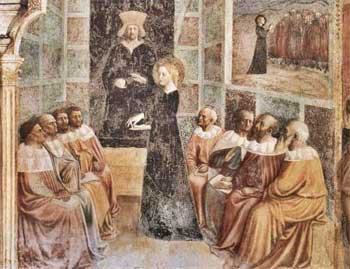
Hypatia of Alexandria

After its magnificent library, whose shelves supported a freight more precious than beaten gold, perhaps the most stupendous edifice in the town was the temple of Serapis. It is said that the builders of the famous temple of Eddessa boasted that they had succeeded in creating something which future generations would compare with the temple of Serapis in Alexandria. This ought to suggest an idea of the vastness and beauty of the Alexandrian Serapis, and the high esteem in which it was held. Historians and connoisseurs claim it was one of the grandest monuments of Pagan civilization, second only to the temple of Jupiter in Rome, and the inimitable Parthenon in Athens, which latter is certainly the best gem earth ever wore upon her zone.

The Serapis temple was built upon an artificial hill, the ascent to which was by a hundred steps. It was not one building, but a vast body of buildings, all grouped about a central one of vaster dimensions, rising on pillars of huge magnitude and graceful proportions. Some critics have advanced the idea that the builders of this masterpiece intended to make it a composite structure, combining the diverse elements of Egyptian and Greek art into a harmonious whole. The Serapion was regarded by the ancients as marking the reconciliation between the architects of the pyramids and the creators of the Athenian Acropolis. It represented to their minds the blending of the massive in Egyptian art with the grace and the loveliness of the Hellenic.

But the greatest attraction of this temple was the god Serapis himself, within the vaulted building. It is difficult for us to form an idea of his enormous proportions. He filled the house with his presence. He stretched his arms and took hold of the two walls, the one on his right and the other on his left. The artist had conceived, also, the idea of making the body of the god as all-embracing as his arms. He fused together all the then known metals — gold, silver, copper, iron, tin, lead — to create a substance fit to represent a god. He inlaid this multifarious composition with the rarest gems — the most costly stones which the markets of the world offered. He polished them all until the colossal statue shone like a huge sapphire. Its exquisite tints and shades are said to have provoked the jealousy of the azure skies. For a crown, the god wore on his head a bushel, symbol of plentiful harvests. At his side, in silence, stood a three-headed animal with the forepart of a lion, a wolf, and a dog. The lion was meant to represent the present; the rapacious wolf symbolized the past — the devoured past; while the dog, the faithful, friendly animal, stood for the future. Wound around the body of the god was a mammoth serpent, which, after its many turns and twists, returned to rest his head on the hand of the god. The sinuous serpent was meant to personate Time, whose mysterious birthplace, or birthday, has yet to be discovered.

Serapis, whose statue adorned the temple, was once the most popular god in the Orient. He was believed to be the source of the Nile, whose breasts he swelled until they poured their wealth upon the surrounding soil. As long as his eye remained open, the sun would shine, and the land would produce, and women would give birth. But if he should close his eye, life would became as a sere and sapless leaf. But Serapis was a stranger in Egypt. He was not an African by birth, but was imported from Sinope, on the Euxine. When he first made his appearance in the land of the Nile, the people — the Alexandrians, especially — rose up en masse and protested vehemently against the introduction of a foreign deity. Did they not have Osiris, the great god of their ancestors, and Isis, his consort — the divine woman with her infant, Horus, sitting upon her knees? Why, then should a strange god be admitted to the throne or to the bed of Osiris and Isis? Did they not have their holy trinity, Osiris, Isis, and Horus — father, mother, and child — the best trinity ever conceived? But Ptolemy was king, and his will prevailed. He told them that Osiris had, in a dream, commanded him to accept Serapis as a new and well-beloved god, and he did not wish to do anything contrary to his dream.

In all this do we not see a similarity to the story about Jesus, and how his friends compelled solitary Jehovah to accept him as his son, and share with him the honors of divinity? We know how the people objected at first to Jesus, precisely as the Alexandrians did to Serapis, and how, finally, through dreams and miracles, Jesus, the new God, grew to be even more popular than the old one.
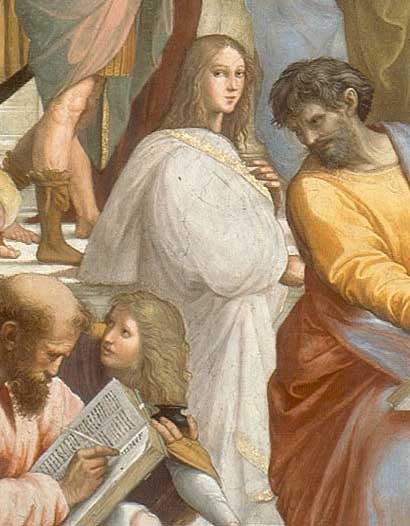
Hypatia of Alexandria

When Christianity gained the upper hand in Alexandria, it set its mind from the start upon destroying two of the principal monuments of its powerful rival, Paganism — the library and the temple of Serapis. Let me at this juncture remind you that Alexandria, at a very early period, became one of the foremost strongholds of the Christian religion. Of the five capitols of the new faith — Jerusalem, Constantinople, Carthage, Alexandria, Rome — Alexandria at one time led Constantinople, and was not second even to Rome. What was said about Christianity being essentially an Asiatic philosophy is confirmed, it seems to me, by this additional fact; that out of five of its greatest centers four were in the Orient. It felt more at home in Asia and Africa than in Europe. A still stronger confirmation of the affinity between Asia and Christianity is the fact that as soon as the Roman Empire became Christian it shifted its capital from Europe to Asia, from Rome to Constantinople. The first Christian emperor, Constantine, impelled, as it were, by the logic of his new religion, left Rome to take up his residence on the Bosphorus, which washed the shores of the continent that had cradled Christianity. For a ruler who coveted absolute power, who feared democracy, who hated liberty and who preferred stagnation of thought to the movement of ideas, who desired slaves for subjects, Asia was the more suitable place. Without wishing to offend anyone, I must say that Christianity was more Asiatic than Paganism, and the Orient was better fitted to be the home of political and religious absolutism than the occident. Christianity, as the religion of meekness and obedience, had irresistible attractions for Constantine. He not only embraced it, but he went to dwell as close to where its cradle had swung as he could.

It is not the fault of Christianity that the Asiatic is servile, but the fault of the Asiatic that Christianity is so supple and submissive. It is not so much religion that makes the character of a people, as it is the people who determine the character of their religion. Religion is only the resume of the national ideas, thoughts, and character. Religion is nothing but an expression. It is not, for instance, the word or the language which creates the idea, but the idea which provokes the word into existence. In the same way religion is only the expression of a peopleʼs mentality. And yet a manʼs religion or philosophy, while it is but the product of his own mind, exerts a reflex influence upon his character. The child influences the parent, of whom it is the offspring; language affects thought, of which, originally, it was but the tool. So it is with religion. The Christian religion, as soon as it got into power, turned the world about. It struck at the Roman Empire, and grabbing everything it could lay its hands on — the scepter, the sword, the imperial diadem, the throne — it walked away with them to Asia. We could never ask for a more eloquent defense of the position that Christianity is Asiatic than is found in this historic transfer of the seat of power from Europe to Asia, from Rome to Constantinople.

Now, naturally enough, a religion which combats the culture and traditions of European life in Europe, will not tolerate them in Asia. Do we understand this point? If it seeks to down European thought in Europe, how much more will it seek to expel it from Asia? If it persecutes Socrates, Plato, Cicero, and Seneca in Europe, it cannot, of course, tolerate them in Asia. Christianity tried to destroy all the monuments of Paganism in Rome, in free and proud Rome; could it, then, leave them standing in Alexandria, in Constantinople, or in Antioch? On the contrary, in Asia, which is her proper home, the seat of her power, and with the Emperor transferred to Constantinople, Christianity became more aggressive against Paganism and civilization than even in Europe. Religion, like everything else, is consistent as long as it is young and virile, and Christianity in the early centuries was both young and virile, and therefore logical. Changing slightly the great words of Shakespeare, we might say:
There is a logic which shapes our ends
Rough hew them as we may.

We wonder sometimes that a Japanese gentleman or an Arab, or a Siamese, who has never mingled with Europeans or Americans, should think as we do, or exhibit the polite manners of occidental races. There are those who refuse to believe that a Pagan, living three thousand years ago, could possess the very virtues which we prize today. The sectarian who believes that only people of the size and caliber of his creed can be good, is at a loss to explain the universality of culture and virtue. This is explained by his inability to perceive that there is a logic in the development of the human being which brings about the same results the world over — before Christ, and after. Let us appreciate this truth. How can a Moslem or a Jew or a Pagan be as good as a Christian? By a law of nature and evolution the ripened human fruit is the same the world over. If only Mohammedanism or Christianity or Judaism possessed the power to make men good, then there would be no morality outside these religions. But history contradicts so sweeping a conclusion. There is a logic, we repeat, in the culture of the mind which makes a Trajan, who was a Pagan, as sweet and sane as a Washington, who was born in a Christian era, or the Chinese Confucius, as noble and independent as the French Voltaire. I say there is a universality in the evolution of man, before which all sectarian pretenses and conceits are like chaff for the wind to sport with. And we cannot be really large-minded, nor can we read history and philosophy aright, until we appreciate the power of the logic which shapes our ends “rough hew them as we may.”

The transference of the capital of the world and the seat of authority from Europe to Asia was not an accident. It was a logical step. Christianity, to be consistent, had to break up housekeeping in Europe and move its menage from Rome to Constantinople. She was homesick for the climate, the atmosphere, the peoples, the traditions, the spirit, the institutions — the milieu in which she was born. Unable to assimilate western ideas, she pined for Asia. By the same logic, she wished to wipe out in Asia every trace of European thought and culture. When, therefore, we read of the destruction of Pagan schools, libraries, and monuments, let us not look upon such acts as accidents in the history of Christianity, but as the logical unfolding of its genius. Why, you may ask, does it no longer pursue the policy of extermination? For the best of reasons; it is no longer virile enough to be logical. It has stumbled into the ways of inconsistency by reason of old age. Fifteen hundred years ago, in Alexandria, when our religion was both young and lusty, it attempted to, and succeeded in, destroying everything that reminded the world of the glory and liberty of ancient Rome and Greece.

Theodosius was at the time, of which we will now speak, the Christian ruler of the Empire. In reply to a request by the Archbishop of Alexandria, he sent a sentence of destruction against the ancient religion of Egypt. Both the Pagans and the Christians had assembled in the public square to hear the reading of the Emperorʼs letter, and when the Christians learned that they may destroy the gods of the Pagans, a wild shout of joy rent the air. The disappointed Pagans, on the other hand, realizing the danger of their position, silently slipped into their homes through dark alleys and hidden passage-ways. Yet they did not stand aside and see the temples of their gods razed to the ground without first offering a desperate resistance. Under the leadership of a zealot, Olympus, the Pagans fell upon the Christians, maddened with the cry in their ears of their leader, “Let us die with our gods!” Then came the turn of the Christians. Theophilius, the Archbishop of Alexandria, with a cross in his hand, and followed by his monks, marched upon the temple of Serapis, and proceeded to pull its pillars down. When they came to strike at the colossal statue of the god, for centuries worshiped as a deity, even the Christians turned pale with superstitious awe, and held their breath. A soldier armed with a heavy axe, was hesitating to strike the first blow. Will the god tolerate the insult? Will he not crash the roof upon the heads of the sacrilegious vandals? But the soldier struck the thundering blow right in the cheeks of Serapis, who offered no remonstrance whatever. The sun shone as usual, and the laws of nature maintained their even pace. Encouraged by this indifference of the god to defend himself, the Christian rabble rushed upon the statue, and pulling Serapis off his seat, dragged him in pieces through the streets of Alexandria that the Pagans might behold the disgrace into which their great god had fallen. Thousands of Pagans, seeing how helpless their gods were to avenge this insult, deserted Paganism and joined the Christians. As soon as the ground of the temple was sufficiently cleared, a church was erected on the ancient site. The Alexandrian library was the next point of attack. Its shelves were soon cleared, and you and I, and twenty centuries, were most lamentably deprived of the intellectual treasures which our Greek and Roman forefathers had bequeathed unto us.

When the archbishop under whose influence the monuments and libraries of Pagan civilization were pillaged and pulled down died, he was succeeded by his nephew, St. Cyril, who was even more Asiatic in his sympathies and more hostile to European thought than his uncle, Theophilius. The new archbishop directed his efforts against the living monuments of Paganism — the scholars, the poets, the philosophers — the men and women who still cherished a passionate regard for the culture and civilization of the Pagan world. The most illustrious representative of Greco-Roman culture in Alexandria about this time was Hypatia, the gifted daughter of Theon, a mathematician and a philosopher of considerable renown. It is said that Theon would have come down to us as a great man had not his daughterʼs fame eclipsed his.

Hypatia was a remarkably gifted woman. Her example demonstrates how all difficulties yield to a strong will. Being a girl, and excluded by the conventions of the time from intellectual pursuits, she could have given many reasons why she should leave philosophy to stronger and freer minds. But she had an all-compelling passion for the life of the mind, which overcame every obstacle that interfered with her purpose. The example of a young woman conquering tremendous difficulties, and becoming the undisputed queen of an intellectual empire, ought to be a great inspiration to us faint hearts. She won the prize which was denied her sex, and became “the glory of her age and the wonder of ours.”

To pursue her studies, she persuaded her father to send her to Athens, where her earnest work, her devotion to philosophy, the readiness with which she sacrificed all her other interests to the cultivation of her mind, earned for herself the laurel wreath which the university of Athens conferred only upon the foremost of its pupils. Hypatia wore this wreath whenever she appeared in public, as her best ornament. Upon her return to Alexandria, she was elected president of the Academy, which at this period was the rendezvous of the leading minds of the East and West. In fact, it was in this academy that the effort of the advanced thinkers to bring about a pacification between the culture of Europe and that of Asia originated. They wished to make Alexandria, situated midway between the occident and the orient, the point of confluence of the two streams of civilization. They wished to celebrate the marriage of the East as bride to the West as bridegroom. It was their plan to make Alexandria a sort of intellectual distillery, refining and fusing the two civilizations into one. But this amalgamation — this assimilation — Christianity, alas, helped to prevent by bringing into still bolder relief the Asiatic habits of mind, and by refusing to concede an inch to the larger spirit of the West. Christianity is responsible for the miscarriage which has ever since left Asia a widow, or, to change the simile, a withered branch upon the tree of civilization. Christianity broke the link which scholarship and humanity were trying to forge between Europe and Asia. The world has never since been one as it came near being under the Roman Empire.

Cyril, the Archbishop of Alexandria, persuaded himself that Hypatiaʼs good name and talents were giving the cause of Paganism a dangerous prestige, and thereby preventing the progress of the new faith. Hypatia was indeed a great power in Alexandria. She was the most popular personage in the city. When she appeared in her chariot on the streets people threw flowers at her, applauded her gifts, and cried, “Long live the daughter of Theon.” Poets called her the “Virgin of Heaven,” “the spotless star,” “of highest speech the flower.” Judging by the chronicles of the times, it appears that her beauty, which would have made even a Cleopatra jealous, was as great as her modesty, and both were matched by her eloquence, and all three surpassed by her learning.
Her beauty did astonish the survey of eyes,
Her words all ears took captive.

Her renown as a lecturer on philosophy brought students from Rome and Athens, and all the great cities of the empire, to Alexandria. It was one of the great events of each day to flock to the hall in the academy where Hypatia explained Plato and Aristotle. Cyril, the Asiatic archbishop, passing frequently the house of Hypatia, and seeing the long train of horses, litters, and chariots which had brought a host of admirers to the female philosopherʼs shrine, conceived a terrible hatred for this Pagan girl. He did not relish her popularity. Her learning was rubbish to him. Her charms, temptations for the ruin of man. He hated her because she, a frail woman, dared to be free and to think for herself. He argued in his mind that she was competing with Christianity, taking away from Christ the homage which belonged to him. With Hypatia out of the way the people would turn to God, and give him the love and honor which they were wasting upon her. She was robbing God of his rights, and she must fall; for He is a jealous God. Such was the reasoning of Cyril, whom the Church has canonized.

Moreover, Orestes, the Prefect of Alexandria, respected Hypatia, and was a constant attendant at her lectures. Cyril believed that she influenced the Prefect and tainted him with her Paganism. With Hypatia crushed, Orestes would be more responsive to Christian influences. Ah, it is a cruel story which I am about to unfold. Generally speaking, if a man is jealous and small, no religion can make him sweet; and if he is generous and pure-minded, no superstition can altogether poison the springs of his love. Religion is strong, but nature is stronger. Unfortunately Cyril was a barbarian, and the doctrines of his religion only sharpened his claws and whipped his passion into a rage.

If we were living in those days we would have witnessed at the close of each day, when both sea and sky blush with the departing kiss of the sun, Hypatia mounting her chariot to ride to the academy, where she is announced to speak on some philosophical subject. She is followed by many enthusiastic and devoted admirers impatient to catch her eye. She is nodding to her friends on her right and on her left. She, who refused lovers that she may love philosophy, is not insensible to the appreciation of her pupils. Approaching the academy, she dismounts, ascends the white marble steps and enters by the door, on either side of which sit two silent sphinxes. As we follow her into the hall, we see that it is lighted by numerous swinging lamps filled with perfumed oil; the rotunda of the ceiling has been embellished by a Greek artist, with figures of Jupiter and his divine companions, who appear to be rapt in the words which fall from his lips. The walls have been decorated by Egyptian artists, with pictures of the sacred animals, the crocodile, the cat, the cow, and the dog; and with sacred vegetables, the onion, the lotus, and the laurel. Besides these there is a scene on the walls representing the marriage of Osiris and Isis. On an elevated platform is a divan in purple velvet, and upon a little table is placed the silver statue of Minerva, goddess of wisdom and patron of Hypatia. Behind the table sits the philosophic young woman dressed in a robe of white, fastened about her throat and waist by a band of pearls, and carrying upon her brow the laurel crown which Athens had decreed to her. A musical murmur sweeps over the audience as she rises to her feet. But in a moment all is silent again save the throbbing and trembling of Hypatiaʼs silvery voice. She speaks in Greek, the language of thought and beauty, of the ancient world. Alas! this is her last appearance at the academy. Tomorrow that hall will be a tomb. Tomorrow Minerva will be childless. When Hypatiaʼs listeners bade her farewell on that evening they did not know that within a few hours they would all become orphans.
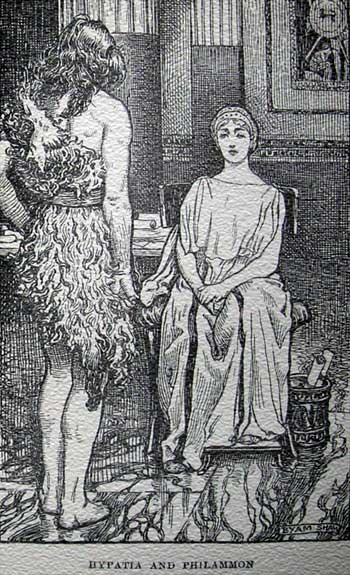
Hypatia of Alexandria Depiction

The next morning, when Hypatia appeared in her chariot in front of her residence, suddenly five hundred men, all dressed in black and cowled, five hundred half-starved monks from the sands of the Egyptian desert — five hundred monks, soldiers of the cross — like a black hurricane, swooped down the street, boarded her chariot, and, pulling her off her seat, dragged her by the hair of her head into a — how shall I say the word? — into a church! Some historians intimate that the monks asked her to kiss the cross, to become a Christian and join the nunnery, if she wished her life spared. At any rate, these monks, under the leadership of St. Cyrilʼs right-hand man, Peter the Reader, shamefully stripped her naked, and there, close to the alter and the cross, scraped her quivering flesh from her bones with oyster shells. The marble floor of the church was sprinkled with her warm blood. The alter, the cross, too, were bespattered, owing to the violence with which her limbs were torn, while the hands of the monks presented a sight too revolting to describe. The mutilated body, upon which the murderers feasted their fanatic hate, was then flung into the flames.

Oh! is there a blacker deed in human annals? When has another man or woman been so inhumanly murdered? Has politics, has commerce, has cannibalism even committed a more cruel crime? The cannibal pleads hunger to cover his cruelty — what excuse had Hypatiaʼs murderers? Even Joan of Arc was more fortunate in her death than this daughter of Paganism! Beautiful woman! murdered by men who were not worthy to touch the hem of thy garment! And to think that this happened in a church — a Christian church!

I have seen the frost bite the flower; I have watched the spider trap the fly; I have seen the serpent spring upon the bird! And yet I love nature! But I will never enter a church nor profess a religion which can commit such a deed against so lovable a woman. No, not even if I were offered as a bribe eternal life! If, O priests and preachers! instead of one hell, there were a thousand, and each hell more infernal than your creeds describe, yet I would sooner they would all swallow me up, and feast their insatiable lust upon my poor bones for ever and ever, than lend countenance or support to an institution upon which history has fastened the indelible stigma of Hypatiaʼs murder!

I wish I could live a thousand years to admire the noble spirit and delight in the courage and beauty of this brave martyr of Philosophy, Hypatia! O that my voice were strong enough to reach the ends of the world! I would then summon all independent minds to join with me in a hymn of praise to that incomparable woman, who has joined the choir invisible and Whose music is the gladness of the world.

Honor and love to beautiful Hypatia! Pity to the monks who killed her! A delicious feeling of satisfaction, like a warm sunshine on a wintry day, spreads over me as I contemplate the privilege I am enjoying of vindicating her memory against her assassins. Fortune has smiled upon me in selecting me as one of her defenders. I congratulate myself on having both the heart and the head to weep over her sad fate. And I tremble and shrink, as from a paralyzing nightmare, when I think that, under different circumstances, I might still have a minister of the Church whose hands are, after fifteen hundred years, still unwashed of her innocent blood. The thought overpowers me; I labor for breath. But I am free. O joy, O rapture! I am free to speak the truth about Hypatia. Let the clergy praise Peter and Paul, St. Cyril and St. Theophilius. I give my heart to thee, thou glorious victim of superstition!

If we, of this present generation, are responsible for Adamʼs sin, and deserve the penalties of his disobedience, as the clergy say we do, then the Church of today is responsible for Hypatiaʼs fate. How will they take this practical application of their own dogma? It will not do for them to say: “We wash our hands clean of St. Cyrilʼs sin”; for if Adam can, by his remote act, expose us all to damnation, so shall Bishop Cyrilʼs dark deed cleave for ever unto the religion which his followers profess. Yet, let the Church people apologize, and we shall forgive them; but no apology short of discarding this Asiatic slave-creed, which in the Old Testament stoned the free thinker to death, and in the New pronounces him a “heathen and a publican,” will satisfy the ends of justice.
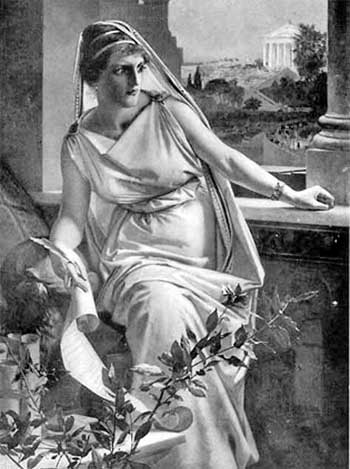
Depiction of Hypatia of Alexandria

I have intimated, by the wording of my subject, that it was a classic world which was murdered in the person of one of its last and noblest representatives, Hypatia. Hypatia embodied in her life and teaching, the proud spirit, the beauty, the culture, and the sanity of Greece. With her, fell Greece; fell the intellectual world from her eminence.

Then followed the nearly ten centuries of Egyptian darkness, which settling over Europe, paralyzed all initiative. During the thousand years in which the spirit of St. Cyril and his Church managed, with undisputed sway, the affairs of religion and the State, night folded to its sterile bosom our orphaned humanity, and the chains of slavery were upon every mind. A cloud of dust rising heaven-high choked the flow and dried up the fountains which had, in the days of Pericles and Antoninus, poured forth a world of living waters. The barren and lumbering theology of the Church crowded out the Muses from their earthly walks, and the world became a prison after having been the home of man. One by one the great lights went out; Athens was no more, Rome was dead. The bloom had vanished from the face of the earth, and in its place there fell upon it the awful shadow of a future hell.

Symonds, in his “The Greek Poets,” says that while Cyrilʼs mobs were dismembering Hypatia, the Greek authors went on creating, “Musaeus sang the lamentable death of Leander, and Nonnus was perfecting a new and more polished form of the hexameter.” These authors, ignorant that the Asiatic superstition had destroyed their world, or that they had themselves been stabbed to death — like one who has been shot, but whose wound is still warm, and who does not know that he has but a few more breaths to draw — kept on singing their song. But their song was, indeed, the “very swanʼs notes” of the classical world. “With the story of Hero and Leander, that immortal love poem, the Muse,” says the same author, “took her final farewell of her beloved Hellas.”

After a thousand years of night, when the world awoke from her sleep, the first song it sang was the last long of the dying Pagan world. This is wonderfully strange. In the year 1493, when the Renaissance ushered in a new era, the first book brought out in Europe was the last book written in Alexandria by a Pagan. It was the poem of Hero and Leander. The new world resumed the golden thread where the old world had lost it. The severed streams of thought and beauty met again into one current, and began to sing and shine as it rushed forth once more, as in the days of old. A Greek poem was the last product of the Pagan world; the same Greek poem was the first product of the new and renascent world.

Between the dying and reviving Pagan world was the Christian Church — that is to say, ten dark centuries.
If Greece and Rome made art, poetry, philosophy, sculpture, the drama, oratory, beauty, (and) liberty classical, (then) Christianity the Syrian, Asiatic cult made for nearly fifteen hundred years persecution, religious wars, massacres, theological feuds and bloodshed, heresy huntings and heretic burnings, prisons, dungeons, anathemas, curses, opposition to science, hatred of liberty, spiritual bondage, the life without love or laughter, a classic!
But the dawn is in the sky, and it is daybreak everywhere!

We are reasonably confident that never again will this religion, born and bred in Asia, command sufficient influence over the minds of modern men to burn or murder the intellectual aristocrats, the daily beauty of whose lives makes the ugliness of superstition so very noticeable. What a difference there would have been in our attitude toward the Christian Church, if, instead of fearing the thinker and the inquirer, and persecuting him with a hatred too awful to contemplate, it had opened both its arms to welcome him with affection and gratitude! But the “divine” is always jealous of the human. Hypatia eclipsed the glory of God. She was murdered because only “the poor in spirit” — the intellectual babes, are the elect of Heaven.

It is good news, however, that while the Church may still exclude the mental giants from the world to come, it can no longer exclude them from the world that now is!

“All formal dogmatic religions are fallacious and must never be accepted by self-respecting persons as final. Reserve your right to think, for even to think wrongly is better than not to think at all. To teach superstitions as truth is a most terrible thing.”
- Theon to Hypatia of Alexandria

Murder of Hypatia and the burning of the Great Library at Alexandria
Mathematicians: Hypatia of Alexandria

The persecution and murder of Hypatia was a transformative event. After Hypatia, the stature of women, which had been enhanced via involvement in Pagan systems of worship, was significantly diminished. In the end:“They dragged her along till they brought her to the great church, named Caesarion. Now this was in the days of the fast. And they tore off her clothing and dragged her through the streets of the city till she died. And they carried her to a place named Cinaron, and they burned her body with fire…”