Showing posts with label roman empire. Show all posts

Christianity being proved ‘true’ by the persecution of Christians

“This makes me think that Christianity is even more true as persecution is expected for Christians and this is yet more evidence as verifying its truth.”
Christianity being proved 'true' by the persecution of Christians

Human beings have “suffered” at each otherʼs hands for as long as human beings have had hands. “Suffering” for almost any conceivable reason, including “suffering for the Gospel,” is therefore not unique. Throughout history and in fields of human endeavor as diverse as religion, politics, science, art, and education, great minds have suffered at the hands of little minds; great hearts and souls have suffered at the hands of the heartless and the soulless; obstinate hearts, minds and souls have suffered at the hands of equally obstinate hearts, minds and souls. Those inflicting the suffering often thought they were “right” to do so. And those experiencing it took succor in believing that their faith, or ideas, or actions, were “right.”

Speaking of non-Christians who have suffered: Jews have suffered for over a thousand years at the hands of Babylonians,Greeks, Romans, Catholics, Protestants, Eastern Orthodox Christians, Moslems, and Germans. Which reminds me of the Jewish story of a rabbi facing the Inquisition, who was asked to deny his faith. He asked for time to think it over. The next morning he said, “I will not become a Catholic, but I have a last request - before Iʼm burnt at the stake my tongue should be cut out for not replying at once. To such a question ‘No!’ was the only answer.”

Christian antisemitism has been the cause of much Jewish suffering over the past 1900 years. And, like the modern day disavowal of the importance of pro-slavery Biblical passages, most of todayʼs Christians disavow the importance of anti-Jewish New Testament passages, which is certainly an improvement over the past. Still, neither the antisemitic passages, nor the pro-slavery passages, have been erased from the Bible, and some people continue to find such passages “divinely inspired.” According to the author of Antisemitism in the New Testament, “Nearly every book in the New Testament expresses slander and contempt for Jews. Most Christians have maintained that the New Testament is not anti-Jewish but that antisemitism arose as a result of the misunderstanding of it. Examination of the contents of the New Testament does not support this claim.”

And what about the religion known as “Bahaism?” It began when the Persian holy man, Ali Muhammad (1819-1850) set out to reform Islam and bring people back to the worship of a purely spiritual God (not unlike how Jesus set out to reform the Judaism of his day). His movement caused much religious ferment. This led to his execution in 1850 by order of the Shahʼs chief minister and at the instigation of Muslim clerics who saw his movement as a threat to orthodox Islam. Besides Ali Muhammad, 20,000 of his followers were martyred for their beliefs. Yet the “Bahai” religion survived, and it has communities in 205 countries.”

The early Mormons were persecuted by the “orthodox” Christian majority, and the founder of Mormonism was killed by a mob. Yet that religion continues to do quite well.

And what about agnostics, atheists, “heretical” Christians and “heretical” Muslims, all of whom have suffered at the hands of “orthodox” Christians and “orthodox” Muslims for daring to speak and publish their “blasphemous” or “heretical” ideas? Christians and Muslims have publicly burnt the books of their critics, so that even today, the words of Christianityʼs earliest critics only survive in the form of excerpts in the works of their Christian opponents. In colonial America, there were laws that made “blasphemy” a crime punishable by death. Even up till the early 1900s, the authors of “blasphemous” literature in Great Britain and America could be put on trial, fined, and/or imprisoned for their “crime.” Some Muslims still view “blasphemy and heresy” as crimes deserving the death penalty.

As I said above, human beings have “suffered” at each otherʼs hands for as long as human beings have had hands. “Suffering” for almost any conceivable reason and belief is therefore not unique.

Moreover, the blood of the martyrs did nothing to keep Islam from taking over North Africa, a major Christian stronghold in Africa, out of which Augustine and Ambrose and Origin and other church fathers, bishops, and leaders dominated.

Nor did those Christians martyred in Japan keep the Buddhist religion from remaining dominant. You see, the blood of martyrs is not always the seed of the church. Rival religions and political systems can overpower Christianity. In fact, Islamʼs rise was swifter than Christianityʼs. And so was communismʼs. And after the fall of communism as a political system, it has still left behind billions of agnostics and atheists.

Persecution and Religious Bigotry

Kevin: Ed, The quotes of Jesus you cited do not establish that Jesus told his followers to persecute anyone. They show that Jesus himself made judgments about certain people.

Persecution and Religious Bigotry

Ed: You originally said that Jesus was just judging their “teaching” (sic), but now you admit he was judging the people themselves. Well, thatʼs a step toward reality.

Now consider why the words of the Bible have led to so much persecution over so long a period of time, and why Christianity (just as equally if not more-so than all other other religious or political movements with absolutistic teachings) has waded in blood, slavery and bigotry for two thousand years. (Compare the far fewer wars that Buddhists have fought over their religion. In fact, there as a wise Buddhist king who reigned in India and brought peace to rival religious sects, but making laws of sane tolerance, during the same time when Europeans were suffering the Inquisition, Calvinʼs insufferable laws and persecutions in Geneva, Lutherʼs anti-Jewish venom and anti-Catholic venom and anti-peasant venom, and anti-anyone-who-disagreed-with-the-Apostleʼs-Creed venom—since Luther signed a paper demanding the death penalty for anyone who did not accede to the Apostleʼs Creed, and when Catholic and Protestant Christian nations were engaged in a Thirty Years War)

Indeed, there is no evidence that Christianity today would Be a “world religion” unless it HAD taken control of the reigns of government and (one sect of Christians, the Catholic one) instituted itself as the supreme religion by means of force (outlawing paganism and all rival Christian sects), accommodation (to pagan festivals and ideas), and bribery (the first Christian Roman Emperor spent lots of money, offering a gold coin and a robe to “converts” or at least to get pagans to outwardly acknowledge Christianity). [See the historian William Ramsayʼs book Christianity And Paganism In The Fourth To Eighth Centuries]

Furthermore, it is because of the absolutistic demands made in the Bible, linked with hellish fear for society as a whole, and fear for the souls of Christian kids (if “non-Biblical beliefs” ever “got loose”) that drives people and societies over the edge. Absolutistic fears drive the engines of bigotry and persecution. And thereʼs also the Bibleʼs judgmentalism. For all that Jesus SAYS about “not judging,” he does a helluva lot of it himself, and weʼre supposed to be like Jesus, (especially when the “Holy Spirit” moves us).

One might also consider the words of the Bible in which God commands the destruction of the worship places of rival religions (which the first Christian Emperor made into a command to destroy non-Christian temples, art and literature), or biblical commands to execute those who believed differently or who blasphemed the God of the Bible. Even in the N.T., God strikes Anais and Saphiris dead because they held back some money from the common church fund. (By the way, that story was one that C. S. Lewis found unbelievably reprehensible, along with the alleged city-wide slaughters and treacheries of Joshua, neither of which Lewis believed to be true history nor attributable to a moral Beingʼs just commands.)


Kevin: I concede that if we assume that Jesus is not God, then this seems inconsistent. But if he is, then it is entirely within his prerogative to do things himself that are not the prerogative of his followers.

Ed: Like telling Christians to “love their enemies,” while God gets to Damn his for all eternity. But my point is not what individual Christians do or how they shall act. Letʼs assume that on an individual basis they act like saints (they do Not all act like saints of course, far from it, as history shows, but rather many have acted more like devils). Still the question remains how should a Society act? What laws should IT make? Do you think society would work better if all thieves and murderers went free? Forgive and love all your enemies? Every last one in all cases? All they have to do is repent? (And how do you know their act of repentance is genuine or not?) Is that your proposed answer to the question of what laws society should institute? Well Luther and Calvin proposed that the answer was this…

It was the duty of individual Christians to love their neighbors and enemies in so far as the case may be non-religious personal affronts, but when the neighbors become blasphemers and affronted God or his holy Book, then it is the duty of each Christian to serve God rather than man, and not accept such blasphemy, and it is likewise the duty of civil magistrates to do their duty and follow Godʼs laws in the O.T. when it comes to blasphemy, in order to preserve society, and keep it from being judged by God for being too lax. This is also the view of Missouri Synod Lutherans and Conservative Reformed Churches, and the Reconstructionist Christian movement. Go argue with THEM is you want, or read chapter two of Leaving The Fold, and learn the exact Scripture verses that Luther and Calvin used and what argument they made, based on the Bible. If you think Luther and Calvin were wrong, argue with THEM and with fellow living Christians. Iʼm not making this stuff up. God to the Chalcedon Report webpage, argue with those Reconstructionists. Tell them how wrong they are. Go ahead, and get their Scriptural replies in return. If you can make some converts out of them, I for one will bless you. Reconstructionism is even being funded by some Christian millionaires who are trying to elect Reconstructionists to American government posts, like in California. I have an article on that I can send you.


Ed: Not to forget the parable about cutting off oneʼs offending hand lest you go to hell with both hands, which has inspired some to fear hell so much that they cut off their own hand

Kevin: I suspect that Jesus was speaking in hyperbole here, or else he would have, for example, told John to cut out his own tongue for speaking overly harshly about some people.

Ed: Of course he was speaking in hyperbole. The point is that it is such strong hyperbole it has inspired people “cutting things off” (like hands and penises in the case of Origin, and Skoptsie Russian Christians and in various isolated cases since then), and “cutting off” relatives and friends, etc. Itʼs the fear of eternal hell that this hyperbole is emphasizing, and fear as I said drives people crazy. Fear is the mind killer as the author of Dune once put it. If God inspired the Bible then he must have known the power of hyperbole and its effects, and foreseen the disasters that lay in wait after composing such a fear-based verse. Of course, such talk was common in the apocalyptic days of first century Palestine. Just compare the books of Enoch (which even the author of Revelation copied from), or passages in the Dead Sea Scrolls (another apocalyptic group awaiting the end of the world). The soon end of the world was the Reason why you had to save your own soul and avoid hell at all costs by acting so completely nice to even your enemies, and turning the other cheek, because otherwise you would be cast into the fire after the Son of Manʼs soon arrival. In other words, Jesusʼ perfectionistic teachings are based on the premise that the world was soon going to be judged, and we shouldnʼt judge but wait for God to soon do so, and we should keep ourselves as pure as possible because the final judgment was near.


Ed: as well as figuratively cutting off their own relatives from their family, all because they Jesus said so. Not to mention Jesusʼ teachings that he has come to bring fire to the earth and how he wished it was already kindled, along with the teaching that every branch that does not bring forth fruit shall be cast into the flames, and his teachings about families hating one another and coming to set a father against his own children, and vice versa.

Kevin: I think these types of things can be a result of families being divided over Jesus; not that this is Godʼs preference.

Ed: Of course families were divided over “Jesus.” Jesus is portrayed in the synoptic Gospels as an apocalyptic prophet expecting to initiate what is called “the tribulation” in his lifetime. As in verses in which Jesus said, “I have come to set father against son, mother against daughter, etc.” and, “I have come to cast fire on the earth.”

“Think not that I am come to send peace; I came not to send peace but a sword.” “He that hath no sword, let him sell his garment and buy one.”

“But those mine enemies, which would not that I should reign over them, bring hither, and slay them before me.” (spoken in a parable in Lk.) “If a man abide not in me, he is cast forth…and men gather them into the fire, and they are burned.” (a verse in John cited by the Inquisition) Jesus looked at the Pharisees “with anger” Mk. 3:5, called them blind fools and sons of vipers and sons of the devil, and called his generation an evil and adulterous one (as all of todayʼs apocalyptic prophets call our own generation), and said that certain towns of his day deserved and would receive greater judgment than Sodom. And in one spectacular curse, Jesus says, “Depart from me ye accursed into the hellfire prepared for the devil and his angels.”

Need I discuss the self-fulfilling nature of how the divisive apocalyptic categorizations that Jesus employed also created centuries of human strife?


Ed: And Jesusʼ teaching found only in the Gospel of John in which Jesus speaks condemnations on the whole Jewish people rather than just the clergy, declaring numerous times “the Jews” this, and “the Jews” that.

Kevin: Letʼs have a little context though. The apostles were all Jews. This leads me to think that Jesus was talking about a group in general, not about each and every member of the group, else the Twelve should have packed it in right then. I think he was saying that a personʼs identity as Jew would not cut it; this idea is hardly unique to John.

Ed: This idea of blackening a whole “peopleʼs identity” (as you admit) happens to be the very essence of bigotry.


Ed: Of course, one may argue about the “analyses” of these and other verses. But if you think Jesusʼ message was simply one of “love, love, love,” then you havenʼt read everything Jesus said and did, including his using a whip of cords in his Temple tantrum.

Kevin: I dodnʼt say that Jesusʼ message was “love love love” and nothing else. Clearly he spoke of judgment too. Just because the idea is distasteful it doesnʼt mean itʼs untrue.

Ed: “Distasteful?” No, itʼs reprehensible, especially in the fearful effects it has produced in the human psyche. It was C.S. Lewis who once admitted in a letter (written near the end of Lewisʼ life) to his universalistic friend, Dom Bede Griffiths (who hosted a Christian-Hindu ashram in India): “Even more disturbing as you say, is the ghastly record of Christian persecution. It had begun in Our Lordʼs time - ‘Ye know not what spirit ye are of” (John of all people!) I think we must fully face the fact that when Christianity does not make a man very much better, it makes him very much worse…Conversion may make of one who was, if no better, no worse than an animal, something like a devil.”


Ed: Neither have you considered the dilemmas faced once Christianity became a nationwide power instead of merely a minority of individual Christians. Once “Christian” governors and governments arose, they had to decide what laws to make, and they had to use their own “analytical” judgment to formulate laws based on “the Bible.”

Kevin: I too would place the word “Christian” in quotes in this context. Indeed, how could people who profess to follow the one who said “My kingdom is not of this world; if it were then my servants would fight” proceed to rule tyrannical regimes? Only with a great deal of rationalization.

Ed: The fact that you canʼt imagine “how they could” strikes me as the most naive answer imaginable. You havenʼt considered the psychological effects that all the apocalyptic preaching and raving in the N.T., and pictures of a “jealous” God as portrayed by jealous men in the O.T., has had on humanity? Page after page the Bible depicts God as a mass murderer, and in the N.T. as inventing an eternal hell and judging everyone and “casting” them out, and you say, “Gee, how could anyone ever get the idea that the Bible is about maintaining the reign of a tyrannical king, kingship, or government?”


Ed: Well, you canʼt make laws out of the N.T. because it doesnʼt deal with them. Only the O.T. contains inspired laws for a “nation,” such as killing blasphemers and stoning anyone who threatens the life of your child (how much more a threat is it to teach heresies that threaten the Eternal Life of a personʼs child?) Hence, Christians made laws condemning and Persecuting And Punishing/Executing non-Christians. Read Luther and Calvin for the Scriptural justifications of such laws, or read chapter two of Leaving The Fold in which I cite Luther and Calvinʼs Scriptural justifications for such laws.

Kevin: These laws were given to a specific people in specific circumstances, and misappropriated by an imperialistic church trying to legitimize the acquisition of wealth and power. Contrast this with, say, the Celtic church, whose humility, detachment from wealth and power, and self-sacrifice to scholarship and missionary activity shamed the “servant of the servants of God” enthroned in Rome, whose worldview was adopted by some of the reformers later on (specifically, re: church and state).

Ed: So, instead of whining about how the Bibleʼs been “misappropriated” (sic), why not tell me exactly HOW do you set up laws for a kingdom in THIS world based on the Bible? Which laws do you make and enforce, and WHY those and not others? Huh?

Glad to hear you align yourself with Celtic Christianity rather than some megalomaniac Catholic church hierarchy. At least your heart is in the right place, though I believe the heart of a person like ou would also be in the right place even if you werenʼt a Christian, but a devout Buddhist or Taoist or Confucian, or even charitable atheist.

Of course, since you praised Celtic Christianity so highly, I can almost hear you adding that the Irish “saved” civilization, like the claim made in the book of the same title. But of course, one has to wonder how civilization got into such trouble that it needed “saving” after Christians have been ruling it for a thousand years prior to the Irish having to “save” it. For instance, the rise of Christendom a thousand years earlier, in the Roman world, led to the burning of the central pagan portion of the library of Alexandria (with the bishopʼs approval), and led to the library falling into a state of disrepair and disuse until some Moslems came around and burned down what little was left, and how Christians burned the books of Greek and Roman Christian critics, killed pagan philosophers and mathematicians like Hypatia in the street, and replaced the pursuit of pagan learning and scholarship and mathematics and politics with vast treatises on the dangers of religious heresy, the dangers of not maintaining oneʼs virginity, and signs of Jesusʼ soon coming, and warnings of Satanʼs snares (he was everywhere!). You can read Augustineʼs works for yourself, they are on the web, and see which of them is not concerned with Satan, virginity, and rooting out Christian heresies of one sort or another. No wonder the Roman Empire fell. Problems were not dealt with as they should, but were instead preached to the people in churches across the empire as being either signs of Jesusʼ soon return, or of Godʼs or Satanʼs wrath. Again, you should consult the recent book by William Ramsay I mentioned above.

As for the rebirth of civilization in Europe, I watched the series Connections on PBS (and read the book) and learned that the revival of learning in Europe (after Christianityʼs thousand year blight of diseased minds that hunted cats because they were “emissaries of Satan,” which led to the abundance of rats and fleas on the rats that spread the great plagues),as I was saying, the revival of learning in Europe coincided with some Christian crusaders taking the city of Seville from the Moslems, a city which contained the largest collection of classical literature that had been preserved since the Fall of the Roman Empire, by Moslem scholars, not Irish priests. This windfall soon reignited scholarship in Europe, Praise The Romans And Greeks who originally wrote such books, and praise those Moslems who preserved such literature essential to getting civilization back on track after a thousand years of Biblical darkness.


Kevin: As to the perceived universality of the Mosaic law, consider that Moses himself appears to have been the offspring of a union later proscribed by the Mosaic law. This alone, apart from the NT, should be sufficient clue that the Mosaic law was intended to be limited in scope.

Ed: If itʼs so “limited in scope” then I suppose Luther and Calvin were idiots to point out that Jesus said, “Not one jot or tittle of the law will pass away until all things have been fulfilled,” and, “whomever teaches this little one to disregard even the least of the law, it would be better for him if a millstone were placed around his neck.” And Paul who wrote, “Do we by this, obviate the law of Moses? No!”

Instead of hemming and hawing about the O.T. only being “limited in scope” please tell me Exactly How Limited. And tell me why youʼre at it how Christian people could NOT read the O.T. and understand that a society Needed to make and obey specific laws to please God and avoid Godʼs wrath or Satanʼs ruin? The question remains WHICH laws can a society of concerned Bible readers ignore, and which should it enforce? Christians have NEVER agreed on that, nor does the Bible (nor the inspiration of the Holy Spirit which “leads us into all truth”) seem capable of leading to any ultimate agreement on such matters, yet laws must be made. Laws against killing for instance. Thatʼs not “limited in scope” is it? What about “killing someoneʼs immortal soul” by the spread of “false doctrine” that “kills souls?” All the original American colonies and nations of Europe at that time had laws against non-Christian words and publications, not just non-Christian acts. Those laws go back as for a thousand years to Constantineʼs edicts against paganism and all Christian sects other than the Catholic church. During those thousand years the Catholic and Protestant churches of Europe grew powerful and wealthy. There was NO religious competition. It had been outlawed for a thousand years. Since the advent of the Age of Reason and democracies (democracies/republics being post “kingship” and hence, post Biblical, mentalities), the Christian churches had not had the power to outlaw rival sects nor rival religions, and so in a mere hundred years, the previous two thousand is being undone, quite quickly, I might add. It took earliest Christianity three hundred years before it gained the clout to outlaw paganism and rival Christian sects. Even then, it took another four hundred to complete the near obliteration (and accommodation) with paganism, and Christianity was rent with further schisms after that time. But in a mere two hundred years, since Deists in Europe first began questioning the Bible, and opened the way for historical scholarship and examination of the Bibleʼs documents, the Christian world is having to react to more different religions and challenges than can be counted. In four hundred more years, If Laws For Religious Tolerance Remain In Place, Christianity today (the phenomenon, not the magazine), will cease to exist, and have been replaced by perhaps 100,000 or more different sects (in the past five years the number of Christian sects have grown, according to the last two printings of Oxfordʼs Christian Encyclopedia, from 20,000 to 30,000!), and a wide variety of alternative religions and non-religions.

On the Justinian Code

Dear Ed,
I read your article on Calvin and Geneva. I think I understand your intent, but as a “historian”, you failed to relay to your visitors that both religious and secular states in 16th century had a very underdeveloped division of church and state. If I recall, the ancient Rome of Augustus was also not a model of a modern democratic state. I guess that suggests Roman culture and the later code of eastern Justitian, the basis for many modern European law codes, is to be despised. Also, the jurisprudence of Blackstone, the father of British common law-and American jurisprudence- being influenced by the Bible - must be despised in kind too. Thanks for your even handed “enlightenment” on the subject. Take a historiography course.

Ted Smith


On the Justinian Code

Ted,

The only thing I “despise” are religionʼs undemocratic tendencies as evidenced in history and the religious addiction to “infallibility.” Itʼs not a mere coincidence that democracy arose only after religion had been “defanged” and increasingly separated from the political sphere, i.e., after the Thirty Yearsʼ War of Protestants and Catholics in Europe proved that one religion could not conquer all the rest, which was soon followed by the Enlightenment and the diminution of witchcraft trials, heresy hunts, and slavery (the last being something that “Biblical” Christians continued to support for quite some time especially in the Southern U.S.), followed by the incessant splintering of “Christianities,” and the blossoming of Deism and the Bill of Rights in America that raised the First Amendment (“Freedom of religion”) above the First Commandment (“Thou shalt have no other gods before me”). (I have a multitude of quotations from Christian historians that I am currently editing into a long article that discuss exactly what I have said above.)

The Justinian Code (that you misspelled in your email) was formulated by Christians (who shared something analogous to todayʼs “fundamentalist mindset”). The Justinian Code incorporated the earlier Theodosian Code from the century before that legalized and institutionalized intolerance of Thought for centuries, something even the Romans had never done (they restricted their intolerance to rituals, not thought). Calvin and Luther and the Catholics all cited the Theodosian (and subsequent Justinian which incorporated the Theodosian) code of laws regarding religious differences in thought, to justify their own intolerant excesses in the realm of religious belief, like executing people, most prominently, the Anabaptists and members of smaller Christian sects that were neither Calvinist nor Lutheran. As for the other laws of both of those Christian codes, the basic laws that regulate interpersonal relations, they were already in use by the Romans, and many of them resembled common sense laws and restrictions from other civilizations on earth in the past and present.

I have learned by historiography, by all means learn yours and Read some of the Justian Code too. Here is how it begins…

The Code Of Our Lord The Most Sacred Emperor Justinian. Second Edition. Book 1. Title 1. Concerning The Most Exalted Trinity And The Catholic Faith And Providing That No One Shall Dare To Publicly Oppose Them.

  1. The Emperors Gratian, Valentinian, and Theodosius to the people of the City of Constantinople.
    We desire that all peoples subject to Our benign Empire shall live under the same religion that the Divine Peter, the Apostle, gave to the Romans, and which the said religion declares was introduced by himself, and which it is well known that the Pontiff Damascus, and Peter, Bishop of Alexandria, a man of apostolic sanctity, embraced; that is to say, in accordance with the rules of apostolic discipline and the evangelical doctrine, we should believe that the Father, Son, and Holy Spirit constitute a single Deity, endowed with equal majesty, and united in the Holy Trinity.

    1. We order all those who follow this law to assume the name of Catholic Christians, and considering others as demented and insane, We order that they shall bear the infamy of heresy; and when the Divine vengeance which they merit has been appeased, they shall afterwards be punished in accordance with Our resentment, which we have acquired from the judgment of Heaven. Dated at Thessalonica, on the third of the Kalends of March, during the Consulate of Gratian, Consul for the fifth time, and Theodosius.

  2. The Same Emperors to Eutropius, Praetorian Prefect. Let no place be afforded to heretics for the conduct of their ceremonies, and let no occasion be offered for them to display the insanity of their obstinate minds. Let all persons know that if any privilege has been fraudulently obtained by means of any rescript whatsoever, by persons of this kind, it will not be valid. Let all bodies of heretics be prevented from holding unlawful assemblies, and let the name of the only and the greatest God be celebrated everywhere, and let the observance of the Nicene Creed, recently transmitted to Our ancestors, and firmly established by the testimony and practice of Divine Religion, always remain secure.

    1. Moreover, he who is an adherent of the Nicene Faith, and a true believer in the Catholic religion, should be understood to be one [pg. 10] who believes that Almighty God and Christ, the son of God, are one person, God of God, Light of Light; and let no one, by rejection, dishonor the Holy Spirit, whom we expect, and have received from the Supreme Parent of all things, in whom the sentiment of a pure and undefiled faith flourishes, as well as the belief in the undivided substance of a Holy Trinity, which true believers indicate by the Greek word These things, indeed do not require further proof, and should be respected.

    2. Let those who do not accept those doctrines cease to apply the name of true religion to their fraudulent belief; and let them be branded with their open crimes, and, having been removed from the threshold of all churches, be utterly excluded from them, as We forbid all heretics to hold unlawful assemblies within cities. If, however, any seditious outbreak should be attempted, We order them to be driven outside the the walls of the City, with relentless violence, and We direct that all Catholic Churches, throughout the entire world, shall be placed under the control of the orthodox bishops who have embraced the Nicene Creed.
      Given at Constantinople, on the fourth of the ides of January, under the Consulate of Flavius Eucharius and Flavius Syagrius. Source: Corpus Juris Civilis (The Civil Law, the Code of Justinian), by S.P. Scott, A.M., published by the Central Trust Company, Cincinnati, copyright 1932, Volume 12 [of 17], pages 9-12, 125.

The Theodosian Code And Paganism (By Noted Christian Historian Peter Brown)

In 436, the lawyers of Theodosius II (408-450), the grandson of Theodosius I, met in Constantinople to bring together the edicts of his Christian predecessors in a single book. The subsequent Theodosian Code appears in 438.

When early medieval Christians looked back to Rome, what they saw, first and foremost, was not the “Golden Age” of classical Rome (as we would tend to do). The pagan empire did not impress them. It was the Theodosian Code that held their attention and esteem. It was the official voice of the Roman Empire at its greatest, that is, when it was the Roman empire as God always intended it to be — a Christian empire. The Code ended with a book On Religion. This book, in itself, signaled the arrival of a new attitude to religion. Religious belief as such was not treated as a subject for legislation. As we have seen, Roman had always been concerned with the correct performance of religions, with the maintenance of traditional rites. But this attitude had been replaced by the new definition of “religion” which, was we saw, had emerged in the course of the third century A.D. Now it was “thought-crime” itself — wrong view on religion in general, and not simply failure to practice traditional rites in the traditional manner — which was disciplined. In the Theodosian Code, extracts from the laws issued from the reign of Constantine to that of Theodosius II were arranged in chronological order. They communicated a rising sense of governmental certainty. There was to be little place, in the new Roman order, for heresy, schism, or Judaism, and no place at all for “the error of stupid paganism.”
- Peter Brown, The Rise of Western Christendom, 2nd Ed., (Malden, MA: Blackwell Publishing, 2003), p. 75

More Information On The Christian Emperor Justinian And His Code-Making Predecessor, Theodosius

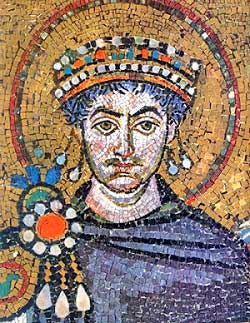
The School of Athens was closed by the decree of the Christian Roman Emperor Justinian.

The Emperor Justinian enacted measures to win back the Egyptians to Christian orthodoxy. But that only infuriated them more, and, when the Arabs invaded Egypt the Egyptians received them as deliverers, and fell in fury on their Greek defenders, and drove them into the sea. One Egyptian Christian said to Amrou, the Saracen general, “With the Greeks I desire no communion, either in this world or the next, and I adjure forever the Byzantine tyrant, and his Christian synod of Chalcedon.”

Justinianʼs precursor was the Emperor Theodosius, and under Theodosius was formulated the first great Christian Code of Laws, the Theodosian Code, that was a model for the Justinian Code. The Justian Code was written about a century after the Theodosian Code and incorporated the latter into it.

The Emperor Theodosius of Theodosian Code fame, banned Arianism and officially declared Christianity the religion of the Roman Empire. In his edict of 378, Theodosius issued an order compelling all people under his rule to embrace the Catholic faith. (Codex Theodosianus XVI, I, 2) Any doctrines deviating from the Churchʼs teachings were declared criminal, those responsible for such doctrines deserving punishment.
- Gustav Mensching, Tolerance and Truth in Religion, trans., Hans-J. Klimkeit (Alabama: The University of Alabama Press, 1971), p. 44.

And in 380 A.D. a decree from Theodosius read: “We shall believe in the Holy Trinity. We command that those persons who follow this rule shall embrace the name of Catholic Christians. The rest, however, whom We adjudge demented and insane, shall sustain the infamy of heretical dogmas, their meeting places shall not receive the name of churches, and they shall be smitten first by divine vengeance and secondly by the retribution of Our own initiative, which We shall assume in accordance with the divine judgment.”
- J. N. Hillgarth, The Conversion of Western Europe] That decree from Theodosius was written into the Justian Code, as you can see if you scoll upward to the extract from the Justinian Code.

The Christian Emperor, Theodosius, even had children executed, because they had been playing with remains of pagan statues.
- K. Deschner, Abermals krähte der Hahn, (Stuttgart 1962), p. 466, 468-469

Theodosius I (379-395) progressively forbade public [pagan] sacrifices, closed temples, and colluded in frequent acts of local violence by Christians against major cult sites — of which the destruction of the gigantic Serapeum of Alexandria, in around 392, was only the most spectacular.
- Peter Brown, The Rise of Western Christendom, 2nd Ed., (Malden, MA: Blackwell Publishing, 2003), p. 73-74

[During the reign of Christian Emperor Theodosius] bands of wandering monks attacked synagogues, pagan temples, hereticsʼ meeting places, and the homes of wealthy non-believers in Mesopotamia, Syria, Egypt, Palestine, and North Africa. The bishop of Alexandria incited local vigilantes to destroy the Temple of Serapis [also known as the Serapeum], one of the largest and most beautiful buildings in the ancient world that also housed a library donated by Cleopatra. Alexandrian Christians whipped up by Bishop Cyril rioted against the Jews in 415, and then murdered Hypatia, a wise and beloved Platonic philosopher.
- Richard E. Rubenstein, When Jesus Became God: The Epic Fight over Christʼs Divinity in the Last Days of Rome, p.226-227

In 430 Honorius passed the death sentence on Donatists for their “criminal audacity in meeting in public.” [Donatist were orthodox Christian believers who wanted to start their own “free” churches and baptize adult believers into them instead of having babies all baptized into the one state church of Catholicism.] In 413 he and Theodosius: “Anyone who baptizes someone the second time [as the Donatists were doing, baptizing people into the Donatist Christian church], he together with him who induced him to do this shall be condemned to death.” (Samuel Scott, trans. and ed. The Civil Code [Cincinnati: Central Trust, 1932], XII, 72.)

Finally in 514 Honorius threatened with death all those who dared celebrate the Donatist religious rites. (William K. Boyd, The Ecclesiastical Edicts of the Theodosian Code [“Studies in History, Economics, and Public Law,” edited by the political science faculty of Columbia University, Vol. XXIV, Nr. 2 (New York, 1905)], p. 55.)

In one day the Christians murdered more of their brethren than the pagans can be positively proved to have martyred in three centuries, and the total number of the slain during the fight for the papal chair (in which the supporters of Pope Damasus literally cut his way, with swords and axes, to the papal chair through the supporters of the rival candidate Ursicinus) is probably as great as the total number of actual martyrs. If we add to these the number of the slain in the fights of the Arians and Trinitarians in the east and the fights of Catholics and Donatists in Africa, we get a sum of “martyrs” many times as large as the genuine victims of Roman law; and we should still have to add the massacre by Theodosius at Thessalonica, the massacre of a regiment of Arian soldiers, the lives sacrificed under Constantius, Valentinian, etc.

This frightful and sordid temper of the new Christendom is luridly exhibited in the murder of Hypatia of Alexandria in 415. Under the “great” Father of the Church, Cyril of Alexandria, a Christian mob, led by a minor cleric of the church, stripped Hypatia naked and gashed her with oyster shells until she died [though I have read that she was clubbed to death before her flesh was stripped off her bones — E.T.B.]. She was a teacher of mathematics and philosophy, a person of the highest ideals and character. This barbaric fury raged from Rome to Alexandria and Antioch, and degraded the cities with spectacles that paganism had never witnessed.

Salvianus, a priest of Marseilles of the fifth century, deplores the vanished virtue of the pagan world and declares that “The whole body of Christians is a sink of iniquity.” “Very few,” he says, “avoid evil.” He challenges his readers: “How many in the Church will you find that are not drunkards or adulterers, or fornicators, or gamblers, or robbers, or murderers — or all together?” (De Gubernatione Dei, III, 9) Gregory of Tours, in the next century, gives, incredible as it may seem, an even darker picture of the Christian world, over part of which he presides. You cannot read these truths, unless you can read bad Latin, because they are never translated. It is the flowers, the rare examples of virtue, the untruths of Eusebius and the Martyrologies, that are translated. It is the legends of St. Agnes and St. Catherine, the heroic fictions of St. Lawrence and St. Sebastian that you read. But there were ten vices for every virtue, ten lies for every truth, a hundred murders for every genuine martyrdom.
- Joseph McCabe, How Christianity Triumphed

Pagans had not been clear or unanimous in their belief in an afterlife, but those who credited it looked to mystery cults for insurance in their future. Christians were much more positive. The Christians united ritual and philosophy and brought the certainty of God and history to questions whose answers eluded the pagan schools. Whereas pagan cults won adherents, Christianity aimed, and contrived, to win converts.

Paganism was reclassified as a demonic system. If Satan was the source of error and evil, false teaching and wrongdoing were not merely mistaken: they were diabolic. The division between a Christian “community of goodness” and an “outer world of evil” could easily become too pronounced. The idea of Satan magnified the difference between “true” and “false” Christians and between Christian sinners and saints.

Like Satan, the Last Judgment was a force that Christians exaggerated and then claimed to be able to defeat. This teaching was reinforced by an equally powerful ally, the Christian idea of sin. Sin was not just the sin of an action, or even an intention, but also the sin of a thought, even a passing interest in an appealing man or woman. This combination of rarefied sin and eternal punishment was supported, as we shall see, by books of vision and revelation that were probably more widely read than modern contempt for “pseudepigraphic” forgeries allows: acquaintance with the Apocalypse of “Peter” would make anyone think twice before leaving the Church (we happen to know that “Peterʼs vision of hell” was still read as a holy text in the churches in Palestine on Good Friday during the fifth century). If fears for Eternity brought converts to the faith, one suspects that they did even more to keep existing converts in it.
- Robin Lane Fox, Pagans and Christians (Alfred A. Knopf, Inc., New York, 1987), p. 326-327, 330-331, 412


Institutions of higher learning had been largely destroyed. The [Christian] emperorsʼ attacks had centered on the chief of them, Athens and Alexandria, in the late fourth century and were turned against them again toward the end of the fifth and in 529 [the year that the School of Athens was closed by the decree of the Christian Roman Emperor Justinian.
— E.T.B.

As to the initiators of the persecution, the [Christian] emperors themselves, a steady decline in their level of cultivation has been noticed. Thus books and philosophy were bound to fade from sight.

After Constantine there existed an empire-wide instrument of education: the church. What bishops, even emperors, made plain, and what could be heard in broader terms from every pulpit, was an agreed upon teaching. Every witness, every listener should know the great danger to his soul in Platoʼs books, in Aristotleʼs, in any of the philosophical corpus handed down from the past. The same danger threatened anyone using his mind according to their manner, with analytical intent, ranging widely for the materials of understanding, and independent of divine imparted teachings.

Another factor that arose specifically out of the ongoing conversion of the empire was the doctrine of demonic causation. The belief in the operation of maleficent forces on a large scale had to await Christianity; and it was of course Christianity that was to form the medieval and Byzantine world.

Satanic agents were to be seen as the cause not only of wars and rebellions, persecution and heresy, storms at sea and earthquakes on land, but of a host of minor or major personal afflictions. So, in consequence, Christians were forever crossing themselves, whatever new action they set about, and painted crosses on their foreheads too, responding to their leadersʼ urging them to do so. It would protect them against all evil.
- Ramsay MacMullen, Christianity and Paganism in the Fourth to Eighth Centuries



Art, philosophy, literature, the very psychology of Western man, all suffered by the victory of the bishops.
- John Holland Smith, The Death of Classical Paganism

Why Did Christianity Succeed?

Bob [of Tekton Apologetics]:
See my reply

Brian: For an evisceration of your response, and The “No Unique Advantages” Faith.


Final Thought On Christianityʼs “Success”

Before you can even ask “Why Did Christianity Succeed?” you have to answer the prior question of whether it did in fact “succeed” or whether it was doomed from the start to merely evolve into zillions of competing “Christianities” and semi-Christian offshoots, the major “orthodox” sect being the one that won the political, not the religious struggle.
- E.T.B.


From: Edward T. Babinski
To: fineyoungsocialist@yahoo.com
Sent: Thursday, March 04, 2004 12:17 AM
Subject: Ted! Ed here.

Ted: Sir,You lose yourself in detail…

The merit of the Justinian code was the attempt to synthesize previous CIVIL laws into a meaningfully system. That process was complimented by the much later Napoleonic Codes, which borrowing the Justinian premise, “guilty until proven innocent”, is a basis of many modern European (and still democratic) legal systems. In contrast, Blackstoneʼs common law and the notion of “innocent until proven guilty” contributes to modern notions of American jurisprudence. Both systems borrow from Christian, and to some extent Roman traditions.

I restate by premise, for you evade the point: You do not tell your readers that 16th century states had undeveloped notions of division of church and state. The brutality of a fifth century Christian state is not the point and thus moot.

Ed: Ted, I have “lost” nothing in setting forth the details, neither have I “evaded” anything. The brutality is in the Bible, a book that preceded the Christianized Roman Empire and preceded 16th century European Christian nations. Check out the Mosaic Code that Luther, Calvin and the Popes cited, as well as early Christian Emperors. The Bible contains brutal laws, it also advocates kingships, it is undemocratic and uncivil, as were many law codes of its day and age. In those respects it reflected its day and age. The First Commandment says, “Thou shalt have no other gods before me,” and the penalty is death. The very First Article in the Justinian Code stated likewise, “believe or die” (my paraphrase). But the First Amendment by Americaʼs founders says, “Freedom of Religion.” Yes, we have advanced Ted. Study the bloody religious wars of Europe sometime, leading up to the biggest of them all, the Thirty Yearsʼ War — that period ALSO saw the greatest persecution of “witches” and “heretics” that Europe has ever seen before or since, thus peaked the great Ages Of Faith. Deism and doubt soon followed, along with our American Constitution.

Also read about that other republic that preceded Americaʼs, the one in the Netherlands, the first republic in Europe that really worked (Poland had an extremely short-lived Republic before the Netherlands), and that practiced religious freedom, and gave the peasants more rights than in any other country in Europe. The Netherlands also became a publishing capital, publishing the books by the Jewish philosopher of religion and politics, Spinoza, along with Hobbesʼ Leviathan. The Netherlandsʼ republic arose prior to the American republic, but Calvinists squashed it. Read about THAT history in chapter two of Leaving The Fold: Testimonies Of Former Fundamentalists, avail. at Amazon. America was inspired by that first successful experiment in a republican form of government. Americaʼs founders were also well aware of Europeʼs religious wars. Hence, the American First Amendment, “Freedom of Religion.” And the founders of America also Deliberately chose to NOT invoke “God” in the constitution of their new nation. The preachers of that day and age in America were scandalized that no invocation of “God” had been made in Americaʼs Constitution. But the decision was Deliberate on the part of Americaʼs founders. In fact, even when Franklin rose and suggested public prayers at Americaʼs Constitutional Convention, the notion was Voted On And Rejected. The men at Americaʼs Constitutional Convention were not atheists, they trusted God, but knew full and well that all the nations before them had “invoked God” and got embroiled in conflicts regarding “whose God,” and tore each othersʼ Christian nations to bits. (Oh, and later, when the Southern pro-slavery states seceded from the U.S. and formed their own confederacy and drew up their Own Constitution, one of the first things they included at its beginning was an invocation to “God,” and you know how that story ended.)

By the way, have you seen the liquor bill of the attendees of Americaʼs Constitutional Convention? Those guys could really put away the beer and wine.

Meanwhile, Americaʼs Puritans and their close knit little witch-hanging towns simply became defunct, absorbed into the general Colonial milieu. (They became Presbyterians.) Harvard was founded as a conservative seminary, but due to its growing “theological excesses,” Yale was founded by reactionary conservatives. Today, Yale is as liberal as Harvard. Even in Calvinʼs Academy in Geneva, though it began with highly conservative teachings, two hundred years later it had professors who doubted the Trinity, and even doubted Satan. Yes, the wars of religion and witch hunts of the previous two centuries had disillusioned many concerning the “benefits of Christian orthodoxy.”


Ted: Or conversely, your litany of facts makes my point:

Your historiography suggest ancient political models are relevant to (most. if not all?) Christians active in todayʼs politics. Thus your tedious survey of 5th century brutalities argues implicitly for the “threat” of the modern Christian who is active in todayʼs political arena. Accordingly, you seem to despise modern democratic notions of pluralism, where by various interests (in this case, contemporary American citizens, who are Christians) compete with opposing groups for influence in our political system.

Ed: Ted, your presumptions above are your own. People can work together, people of all religions and also the non-religious. I am also aware of differences between Christians, even between individual Christians of the same denomination.


Ted: In that sense, your historiography (philosophy of historical interpretation) seems woefully underdeveloped, or simply intolerant. I again suggest you enroll in a freshman level historiography course. By the way, I am humbled by your correction of my spelling of the word “Justinian”, which seems to imply you love detail (but perhaps misunderstand context, perhaps historical context, in this case?)

Ed: *Laughs* at “you love detail.” Well, I certainly did not correct your spelling because I “hate” detail. I admit I misspell words as often as the next parson. Just do me a favor if you wish to continue writing me and lighten up on the adverbs. One lesson in dialoguing that I recall reading about was how adding derogatory adverbs (one of those words that ends in “ly”) only pours fuel on the fire of misunderstandings. Like the way you wrote, “woefully underdeveloped,” instead of just “underdeveloped.” Or like the way you wrote, “simply intolerant,” instead of just “intolerant.” I am neither, however. Think of me as if I was you. Iʼm sure you see yourself as a fair minded person with a good sense of humor who loves their fellow human beings — but we just have different thoughts about some things.

Ted Smith
“Personal Conviction, Pluralism, and Unity.”


From: citizenFine
To: Edward T. Babinski
Subject: Re: Ted! Ed here.
Date: Wed, 3 Mar 2004 22:08:03 -0800 (PST)

Well enough sir,
I hope you post my responce and your reply on your site
Ted Smith

Origins of Hospitals

“A Christian” writes: Hospitals as we know them were an innovation of Christianity (hence the universal healing symbol of a cross to represent hospitals).
Origins of Hospitals

Ed: Hospitals existed in antiquity, in Egypt and in India. And after Christianity became the state religion of the Roman Empire hospitals were built in Christian nations, and, after Islam arose, in Moslem countries as well. Regardless of questions of their origin, hospitals and the practice of modern medicine have continued to evolve. People of all faiths and non-faiths may today study medicine and work in hospitals and in worldwide relief organizations.

Take the Red Cross (now known as the “Red Cross and Red Crescent”), which is perhaps the largest international relief organization in the world. (See my earlier article on Christianity, Florence Nightingale, And The Red Cross for in-depth information.)

Aside from the cross (and the crescent) as its symbol, it treats people of all creeds and is supported by people of all faiths internationally.

Or take the MSF which stands for Médecins Sans [without] Frontières (English = “Doctors Without Borders”) which delivers emergency aid to victims of armed conflict, epidemics, and natural and man-made disasters, and to others who lack health care due to social or geographical isolation.

The only thing that Doctors Without Borders refuses to “tolerate” is indifference!

“We are by nature an organization that is unable to tolerate indifference.

We hope that by arousing awareness and a desire to understand, we will also stir up indignation and stimulate action.”

— Rony Brauman, MD, Former President, MSF

Their website explains that MSF was founded in 1971 by a small group of French doctors who believed that all people have the right to medical care regardless of race,religion, creed or political affiliation, and that the needs of these people supersede respect for national borders. It was the first non-governmental organization to both provide emergency medical assistance and publicly bear witness to the plight of the populations they served.

A private, nonprofit organization, MSF is at the forefront of emergency health care as well as care for populations suffering from endemic diseases and neglect. MSF provides primary health care, performs surgery, rehabilitates hospitals and clinics, runs nutrition and sanitation programs, trains local medical personnel, and provides mental health care.

Through longer-term programs, MSF treats chronic diseases such as tuberculosis, malaria, sleeping sickness, and AIDS; assists with the medical and psychological problems of marginalized populations including street children and ethnic minorities; and brings health care to remote, isolated areas where resources and training are limited. MSF unites direct medical care with a commitment to bearing witness and speaking out against the underlying causes of suffering. Its volunteers protest violations of humanitarian law on behalf of populations who have no voice, and bring the concerns of their patients to public forums, such as the United Nations, governments (in both home and project countries), and the media. In a wide range of circumstances, MSF volunteers have spoken out about forgotten conflicts and under-reported atrocities they have witnessed-from Chechnya to Angola, and from Kosovo to Sri Lanka. MSF is an international network with sections in 18 countries. Each year, more than 2,500 volunteer doctors, nurses, other medical professionals, logistics experts, water/sanitation engineers, and administrators join 15,000 locally hired staff to provide medical aid in more than 80 countries.

Source: www.doctorswithoutborders.org


History of Hospitals (from Encyc Britannica online)

As early as 4000 BC religions identified certain of their deities with healing. The temples of Saturn, and later of Asclepius in Asia Minor, were recognized as healing centers. Brahmanic hospitals were established in Sri Lanka as early as 431 BC, and King Asoka established a chain of hospitals in Hindustan about 230 BC. Around 100 BC the Romans established hospitals (valetudinaria) for the treatment of their sick and injured soldiers; their care was important because it was upon the integrity of the legions that the power of Rome was based.

It can be said, however, that the modern concept of a hospital dates from AD 331 when Constantine , having been converted to Christianity, abolished all pagan hospitals and thus created the opportunity for a new start. Until that time disease had isolated the sufferer from the community. The Christian tradition emphasized the close relationship of the sufferer to his fellow man, upon whom rested the obligation for care. Illness thus became a matter for the Christian church.

Around AD 370 St. Basil of Caesarea established a religious foundation in Cappadocia that included a hospital, an isolation unit for those suffering from leprosy, and buildings to house the poor, the elderly, and the sick. Following this example similar hospitals were later built in the eastern part of the Roman Empire. Another notable foundation was that of St. Benedict at Monte Cassino, founded early in the 6th century, where the care of the sick was placed above and before every other Christian duty. It was from this beginning that one of the first medical schools in Europe ultimately grew at Salerno and was of high repute by the 11th century. This example led to the establishment of similar monastic infirmaries in the western part of the empire.

The Hôtel-Dieu of Lyon was opened in 542 and the Hôtel-Dieu of Paris in 660. In these hospitals more attention was given to the well-being of the patientʼs soul than to curing bodily ailments. The manner in which monks cared for their own sick became a model for the laity. The monasteries had an infirmitorium, a place to which their sick were taken for treatment. The monasteries had a pharmacy and frequently a garden with medicinal plants. In addition to caring for sick monks, the monasteries opened their doors to pilgrims and to other travelers.

Religion continued to be the dominant influence in the establishment of hospitals during the Middle Ages . The growth of hospitals accelerated during the Crusades, which began at the end of the 11th century. Pestilence and disease were more potent enemies than the Saracens in defeating the crusaders. Military hospitals came into being along the traveled routes; the Knights Hospitalers of the Order of St. John in 1099 established in the Holy Land a hospital that could care for some 2,000 patients. It is said to have been especially concerned with eye disease, and may have been the first of the specialized hospitals. This order has survived through the centuries as the St. Johnʼs Ambulance Corps.

Throughout the Middle Ages, but notably in the 12th century, the number of hospitals grew rapidly in Europe. The Arabs established hospitals in Baghdad and Damascus and in Córdoba in Spain. Arab hospitals were notable for the fact that they admitted patients regardless of religious belief, race, or social order. The Hospital of the Holy Ghost, founded in 1145 at Montpelier in France, established a high reputation and later became one of the most important centers in Europe for the training of doctors. By far the greater number of hospitals established during the Middle Ages, however, were monastic institutions under the Benedictines, who are credited with having founded more than 2,000.

The Middle Ages also saw the beginnings of support for hospital-like institutions by secular authorities. Toward the end of the 15th century many cities and towns supported some kind of institutional health care: it has been said that in England there were no less than 200 such establishments that met a growing social need. This gradual transfer of responsibility for institutional health care from the church to civil authorities continued in Europe after the dissolution of the monasteries in 1540 by Henry VIII, which put an end to hospital building in England for some 200 years.

The loss of monastic hospitals in England caused the secular authorities to provide for the sick, the injured, and the handicapped, thus laying the foundation for the voluntary hospital movement. The first voluntary hospital in England was probably established in 1718 by Huguenots from France and was closely followed by the foundation of such London hospitals as the Westminster Hospital in 1719, Guyʼs Hospital in 1724, and the London Hospital in 1740. Between 1736 and 1787 hospitals were established outside London in at least 18 cities. The initiative spread to Scotland where the first voluntary hospital, the Little Hospital, was opened in Edinburgh in 1729.

The first hospital in North America was built in Mexico City in 1524 by Cortés; the structure still stands. The French established a hospital in Canada in 1639 at Quebec city, the Hôtel-Dieu du Précieux Sang, which is still in operation although not at its original location. In 1644 Jeanne Mance, a French noblewoman, built a hospital of ax-hewn logs on the island of Montreal; this was the beginning of the Hôtel-Dieu de St. Joseph, out of which grew the order of the Sisters of St. Joseph, now considered to be the oldest nursing group organized in North America. The first hospital in the territory of the present-day United States is said to have been a hospital for soldiers on Manhattan Island, established in 1663. The early hospitals were primarily almshouses, one of the first of which was established by William Penn in Philadelphia in 1713. The first incorporated hospital in America was the Pennsylvania Hospital, in Philadelphia, which obtained a charter from the crown in 1751.

The Introduction Of Hospitals

Late antiquity witnessed one revolution in the medical scene: the birth of the hospital. Literary sources occasionally mention hospitals, but only documents from Egypt reveal how widespread they were. These testimonial from Egypt record a multitude of hospitals founded by private individuals and independent of ecclesiastical institutions. The origin of the hospital as an independent institution for the care and treatment of the sick can be dated to the third quarter of the fourth century CE. The hospital resolved major tensions in the medical, ecclesiastical and religious scenes of late antiquity.

The 1911 Edition Encyclopedia

The Origin of Hospitals.- In spite of contrary opinions the germ of the hospital system may be seen in pre-Christian times (see ‘Charity And Charities’)

Pinel goes so far as to declare that there were asylums distinctly set apart for the insaneʼ in the temples of Saturn in ancient Egypt. But this is probably an exaggeration, the real historical facts pointing to the existence of medical schools in connexion with the temples generally, to the knowledge that the priests possessed what medical science existed, and finally to the rite of “Incubation,” which involved the visit of sick persons to the temple, in the shade of which they slept, that the god might inform them by dreams of the treatment they ought to follow. The temples of Saturn are know to have existed some 4000 years before Christ; and that those temples were medical schools in their earliest form is beyond question. The reason why no records of these temples have survived is due to the fact that they were destroyed in a religious revolution which swept away the very name of Saturn from the monuments in the country. Professor Georg Ebers of Leipzig, whose possession of that important handbook of Egyptian medicine called the Papyrus Ebers constitutes him an authority, says the Heliopolis certainly had a clinic united to the temple. The temples of Dendera, Thebes and Memphis, are other examples. Those early medical works, the Books of Hernies, were preserved in the shrines. Patients coming to them paid contributions to the priests. The most famous temples in Greece for the cure of disease were those of Aesculapius at Cos and Trikka, while others at Rhodes, Cnidus, Pergamum and Epidaurus were less known but frequented. Thus it is clear that both in Egypt and in Greece the custom of laying the sick in the precincts of the temples was a national practice.

Alexandria again was a famous medical center. Before describing the European growth of the hospital system in modern times, to which its development in the Roman Empire is the natural introduction, it will be well to dispose very briefly of the facts relating to the hospital system in the East. Harun al-Rashid (A.D. 763-809) attached a college to every mosque, and to that again a hospital. He placed at Baghdad an asylum for the insane open to all believers; and there was a large number of public infirmaries for the sick without payment in that city. Benjamin, the Jewish traveler, notes an efficient scheme for the reception of the sick in A.D. 1173,which had long been in existence.

The Buddhists no less than the Mahommedans had their hospitals, and as early as 260 B.c. the emperor Asoka founded the many hospitals of which Hindustan could then boast. The one at Surat, made famous by travelers, and considered to have been built under the emperorʼs second edict, is still in existence. These hospitals contained provision so extensive as to be quite comparable to modern institutions. In China the only records that remain are those of books of very early date dealing with the theory of medicine. To return to India, the hospitals of the Buddhist Emperor, Asoka, were swept away by a revival of Brahmanism, ‘and a practical hiatus exists between the hospitals he introduced and those that were refounded by the’ British ascendancy.

Hadrianʼs reign contains the first notice of a military hospital in Rome. At the beginning of the Christian era we hear of the existence of open surgeries (of various price and reputation), the specialization of the medical profession, and the presence of women practitioners, often as obstetricians. latria, or tabcrnae-medicae, are described by Galen and Placetus: many towns built them at their own cost. These iatria attended almost entirely to out-patients, and the system of medicine fostered by them continued without much development down to the middle of the 18th century. It is to be noted that these out-patients paid reasonable fees.

In Christian days no establishments were founded for the relief of the sick till the time of Constantine. A law of Justinian referring to various institutions connected with the church mentions among them the Nosocomia, which correspond to our idea of hospitals. In A.D. 370 Basil had one built for lepers at Caesarea. St Chrysostom founded a hospital at Constantinople. At Alexandria an order of 600 Parabolani attended to the sick, being chosen for the purpose for their experience by the prelate of the city (A.D. 416). Fabiola, a rich Roman lady, founded the first hospital at Rome possessed of a convalescent home in the country. She even became a nurse herself. St Augustine founded one at his see of Hippo.

These Nosocomia fell indeed almost entirely into the hands of the church, which supported them by its revenues when necessary and controlled their administration. Salerno became famous as a school of medicine; its rosiest days were between A.D. 1000 and 1050. Frederick II. prescribed the course for students there, and founded a rival school at Naples. At this period the connexion between monasteries and hospitals becomes a marked one. The crusaders also created another bond between the church and hospital development, as the route they traversed was marked by such foundations. Lepers were some of the earliest patients for whom a specialized treatment was recognized.

Threatening Others In the Name of God

Threatening Others in God's Name

The history of “Christianity” appears to be, among other things, the history of conflicts too numerous to mention:

Even during the persecutions of the Romans against the Christians, churches were cleft by rivalry and schism.

- Samuel Laeuchli, The Serpent and the Dove: Five Essays on Early Christianity

[Christians and their churches were cleft by rivalries and schisms even before the persecutions if you read Acts and the Letters in the New Testament. - E.T.B.]


Constantine [the first Roman Emperor to embrace Christianity] united the whole Roman Empire under his rule and reigned for twenty-five years. He brought up his sons to be pious Christians, and the last of them reigned for another twenty-five years, having ultimately reunited the empire under his rule. During that half-century the Church had enjoyed imperial protection and paganism had been viewed with disfavor. Christians had been promoted and pagans frowned upon. With only two short-lived exceptions no pagan was to reign as Emperor after Constantine.
- A. H. M. Jones, Constantine and the Conversion of Europe


A spirit of scornful tolerance breathes through not a few of his [Constantineʼs] edicts. As the years passed, toleration of paganism gave place to active repression; the emperor felt that he was strong enough to advance to a frontal attack upon paganism. The important fact to realize, however, is that this alteration in policy entailed no change of spirit, only a change of method. What Constantine would have recommended in 323 he later felt free to proclaim as the imperial will.
- Norman H. Baynes, Constantine the Great and the Christian Church


Constantine…banned the construction of new pagan temples, the consulting of oracles, and animal sacrifices. That these decrees were enforced sporadically did not detract from their symbolic value. With the old faith in decline, new converts poured into the Christian churches.
- Richard E. Rubenstein, When Jesus Became God: The Epic Fight over Christʼs Divinity in the Last Days of Rome


Constantineʼs allegiance to his God was backed by massive patronage. Emperors had always honored their favored gods with benefactions and buildings. Constantineʼs patronage was so lavish that he had to strip resources from pagan temples to fund it. One of his early foundations in Rome was the church of St. John Lateran, whose apse was to be coated in gold. Around 500 pounds of it was needed...Another 3,700 lbs was required for light fittings and another 400 pounds of gold for fifty gold vessels.
- Charles Freeman, “The Emperorʼs State of Grace,” History Today, January 2001


Edward Gibbon On Constantine And The Church

The grateful applause of the clergy has consecrated the memory of a prince, who indulged their passions and promoted their interest. Constantine gave them security, wealth, honors, and revenge; and the support of the orthodox faith was considered as the most sacred and important duty of the civil magistrate. The edict of Milan, the great charter of toleration, had confirmed to each individual of the Roman world the privilege of choosing and professing his own religion.
  But this inestimable privilege was soon violated: with the knowledge of truth the emperor imbibed the maxims of persecution; and the sects which dissented from the catholic church were afflicted and oppressed by the triumph of Christianity. Constantine easily believed that the heretics, who presumed to dispute his opinions or to oppose his commands, were guilty of the most absurd and criminal obstinacy; and that a seasonable application of moderate severities might save those unhappy men from the danger of an everlasting condemnation.
- Edward Gibbon, The Decline and Fall of the Roman Empire, Chapter 21


The privileges that have been granted in consideration of religion must benefit only the adherents of the Catholic faith. It is Our will moreover, that heretics and schismatics shall not only be alien from these privileges but shall also be bound and subjected to various compulsory public services.
- Letter of Constantine to his Vicar of the Praetorian Prefect, 326 A.D.; as cited in A New Eusebius: Documents Illustrating the History of the Church to AD 337, Ed., J. Stevenson, newly revised by W. H. C. Frend


The First Ecumenical Church Council At Nicea And The Arian Controversy

From the very first the Church was faced with the task of establishing dogmas. For Christianity abounds in problems more hinted at than answered in the New Testament...The first ecumenical church council, the Council of Nicea, assembled in the year 325 in the imperial palace of the first Christian emperor, Constantine. Once the discussions started the participants threw their Episcopal dignity to the wind and shouted wildly at each other. They were concerned primarily with improving their positions of power. Diplomacy was wielded as a weapon, and intrigues often replaced intelligence. There were so many ignorant bishops that one participant bluntly called the council “a synod of nothing but blockheads.” Constantine, who treated religious questions from a political point of view, assured unanimity by banishing all the bishops who would not sign the new profession of faith hammered out at the council. In this way unity was achieved.

[The Christians at Nicea displayed their shrewd theological insight by condemning and forbidding kneeling at prayer on Sundays and also between Easter and Whitsunday. - E.T.B.] The council also pronounced a Christian theologian named “Arius” to be a heretic. People who owned his writings were ordered to deliver them up on pain of punishment. Arius was banished.
- Walter Nigg, The Heretics


If any treatise composed by Arius should be discovered, let it be consigned to the flames, in order that no memorial of him may be by any means left. This therefore I [Constantine] decree, that if any one shall be detected in concealing a book compiled by Arius, and shall not instantly bring it forward and burn it, the penalty for this offence shall be death; for immediately after conviction the criminal shall suffer capital punishment.
- Letter of Constantine To the Bishops and People, c. 333 A.D. in which he proscribed the works of Arius [a Christian] and in which he also proscribed the works of the pagan scholar Porphyry [who had written numerous works that questioned Christianity, all of which were destroyed]; as cited in A New Eusebius: Documents Illustrating the History of the Church to AD 337, Ed., J. Stevenson, newly revised by W. H. C. Frend


Probably more Christians were slaughtered by Christians in two years [A.D. 342-343, during the Arian controversy] than by all the persecutions of Christians under the Romans during the previous three hundred years.
- Will Durant, The Story of Civilization, Vol. 4, The Age of Faith


In the century opened by the Peace of the Church [after the first Christian Roman Emperor began his rule], more Christians died for their faith at the hands of fellow Christians than had died before in all the persecutions.
- Ramsay MacMullen, Christianity and Paganism in the Fourth to Eighth Centuries


Arianism, which orthodox Christians now consider the archetypal heresy, was once at least as popular as the doctrine that Jesus is God…Ordinary tradespeople and workers felt perfectly competent - perhaps even driven - to debate abstract theological issues and to arrive at their own conclusions…Disputes among Christians, specifically arguments about the relationship of Jesus Christ the Son to God the Father, had become…intense. [p.7]

The anti-Arians…demanded that Christianity be “updated” by blurring or even obliterating the long-accepted distinction between the Father and the Son. From the perspective of our time it may seem strange to think of Arian “heretics” as conservatives, but emphasizing Jesusʼs humanity and Godʼs transcendent otherness had never seemed heretical in the [Eastern half of the Roman Empire]. [p.74]

The Great Council of Nicaea…was the largest gathering of Christian leaders, up to that time with 250 bishops in attendance, almost all of them from the Eastern Empire…To some extent, this Eastern predominance can be attributed to the westernerʼs lack of interest in the Arian controversy, which still seemed to them an obscure “Greek” matter.

The Council of Nicaea, then, was not universal…Several later gatherings would be more representative of the entire Church; one of them, the joint council of Rumini-Seluicie (359), was attended by more than five hundred bishops from both the East and West. If any meeting deserves the title “ecumenical,” that one seems to qualify, but its results - the adoption of an Arian creed - was later repudiated by the Church. Councils whose products were later deemed unorthodox not only lost the “ecumenical” label but virtually disappeared from official Church history. [p.74]

[After the Council of Nicaea, Constantine exiled Arian theologians.] But within three years, Arius, Eusebius, and their fellow exiles would be forgiven by Constantine and welcomed back to the Church. Eusebius would become Constantineʼs closest advisor, and would insist that Athanasius, now bishop of Alexandria, readmit Arius to communion in that city as well. A decade after that, Bishop Athanasius himself was exiled, and Arianism was well on its way to becoming the dominant theology of the Eastern Empire. [p.84]

The Council of Nicaea was the last point at which Christians with strongly opposed theological views acted civilly toward each other. When the controversy began, Arius and his opponents were inclined to treat each other as fellow Christians with mistaken ideas. Constantine hoped that his Great and Holy Council would bring the opposing sides together on the basis of a mutual recognition and correction of erroneous ideas. When these hopes were shattered and the conflict continued to spread, the adversaries were drawn to attack each other not as colleagues in error but as unrepentant sinners: corrupt, malicious, even satanic individuals. [p. 84-85]

Athanasiusʼs ambition was endless; and he was very much at home in the “real” world of power relations and political skullduggery…Athanasius would soon be recognized as the anti-Ariansʼ champion. But first, he had to become bishop of Alexandria. [p. 104-105]

Athanasius sent gangs of thuggish supporters into the Melitian Christian district, where they beat and wounded supporters of the Melitian leader, John Arcaph, and, according to Arcaph, burned churches, destroyed church property, imprisoned and even murdered dissident priests. [p. 106]

Constantine ordered a council of bishops to meet in Tyre [concerning charges leveled against Athanasius]…Athanasius reacted with desperation…He had his agents terrorize those who might have provided evidence against him and prevented them from leaving the country…The pro-Athanasius bishops who attended the council at Tyre behaved so disruptively that the council later cited their activities as proof of Athanasiusʼs unfitness for office…The debate at the council was stormy, with many witnesses contradicting each otherʼs stories, and much name calling…After weeks of squabbling the bishops decided to send a commission to the region to interview witnesses there and the decide the truth of various accusations…The investigative commission left for Egypt…accompanied by a company of imperial troops…For the next two months Egypt was in an uproar. The Athanasians charged that the commission was obtaining evidence by means of threats and torture. The commissioners charged that Athanasiusʼs supporters were intimidating and kidnapping witnesses. By the end of the investigation it was clear that the commissionʼs report would indict Athanasius, who fled the city by night…The Bishops in Tyre condemned Athanasius for specific acts of violence and disobedience. [p.123-125]

When Constantine convened the Great Council of Nicaea, he could not have imagined that the bishops would be meeting almost every year to rule on charges of criminal activity and heresy. Partisan control of these gatherings virtually guaranteed that condemned churchmen would attempt to rehabilitate themselves and punish their enemies by denying the authority of “illegitimate” councils and convening new ones. The emperor probably considered this a temporary problem.
  Surely, after blatant troublemakers and fanatics like Bishops Athanasius and Marcellus were removed from office, reasonable churchmen could learn to live together despite occasional differences of opinion! But this was to repeat the original mistake made at Nicaea. It was to assume that doctrinal differences among Christians were not that important, that they did not reflect serious divisions of class, culture, and moral values within the community, and that they could be resolved by discovering the correct form of words. [p.133]

[The former exile, Arius, on the eve of being readmitted to membership in the church at Alexandria, was found dead on the floor beside a toilet. Poisoning is one possibility to account for the timing and manner of his passing. However, Athanasius used Ariusʼs death as a public relations opportunity.] He announced that Alexandriaʼs prayers had been answered and “condemned the Arian heresy, showing it to be unworthy of communion with the Church.” Most telling is the language Athanasius uses in describing the manner of Ariusʼs death: “Arius…urged by the necessities of nature withdrew, and suddenly in the language of Scripture, ‘falling headlong, he burst asunder in the midst,’ and immediately expired as he lay, and was deprived of both communion and of his life together.’” [The biblical reference is to Acts 1:18 - the manner of death of Judas, the apostle who betrayed Jesus.] [p. 137]

[But even after Ariusʼs death, Arianism remained, for there remained other more influential Christian leaders who dominated the movement.] Moreover, another death was of greater consequence than Ariusʼs. The death in question was Emperor Constantineʼs…Eusebius [an Arian Bishop] heard the Emperorʼs confession, and administered the last rites…Following Constantineʼs death a decree was made that permitted all exiled bishops to return to their sees…

Athanasius [who was in exile at that time] returned to Alexandria after making a political tour of several provinces. Everywhere he rallied the anti-Arian forces and helped return exiles to power, organized opposition to “heretical” bishops, and intervened actively in local disputes. Violence dogged his steps, since both sides had organized popular support and were quite ready to use angry mobs to expel churchmen they despised or defend friendly incumbents. The result in a number of key cities was something close to civil war…Finally, Athanasius returned to Alexandria where, according to his enemies, ‘he seized the churches…by force, by murder, by war.’” [p.141-142]

Soon afterwards a large council of bishops met in Antioch [in 338] to declare that Athanasius had committed new atrocities…The leaders of the church met again in Antioch in the winter of 338-339. With the new Emperor, Constantineʼs son, Constantius in attendance, they convicted Athanasius of violence and mayhem, and ordered him deposed…Warned by his agents, Athanasius fled, and rioting and arson (which had also accompanied his return) erupted across the city…The Church of Dionysius was burned, a number of people on both sides were injured and killed, and fighting even broke out on Easter Sunday in the Church of Quirinius. Several weeks later, the mobs supporting Athanasius had been suppressed, at least for the time being.

What really happened in Alexandria during this stormy month? Athanasius in a letter charged that “Arian madmen” incited pagans, Jews, and “disorderly persons” to attack the faithful, set churches on fire, strip and rape holy virgins, murder monks, desecrate holy places, and plunder the churchesʼ treasures. He presents pictures designed to horrify and madden his readers: Jews, for example, are presented as cavorting naked in the churchesʼ baptismal waters. And, of course, he says nothing about any violence that his own supporters may have offered in his defense or in opposition to the installation of the new bishop.

Athanasius had always had a following in Alexandria, but Arius was also an Alexandrian with his share of supporters…The truth seems to be that in Alexandria and many other cities large groups of militant fighters could be mobilized by both sides, and that both sides made frequent use of them in the confused period following Constantineʼs death…What is most striking is the closeness and bitterness of the conflict in important cities like Constantinople, Antioch, Ancyra, Caesarea, Tyre, and Gaza. [p. 143-144]

But what caused this deep division?…The split between Nicene and Arian Christians seems to reflect a rough division between those more in need of a powerful, just ruler and those more in need of a loving advocate and friend. Neither side in the controversy could afford to turn its back entirely on either image: the Athanasians therefore called Jesus “God from God.” And the Arians called him “a paradigm and an example.” Each side put its primary emphasis on one image while paying lip service to the other, and each side was prey to fears that the other side was aiming to obliterate “its” Jesus. While Athanasians denounced the Arians for lowering Christ to the point that his majesty and saving power would be lost, the Arians accused Athanasius and Marcellus of raising him to the point that his love (and Godʼs majesty) would be lost…

The violence in the Eastern cities ended for the time being with the forcible eviction of major anti-Arian bishops and their exile to the Western half of the Roman Empire. Many were arriving in Rome, where Athanasius had already fled. But the uncalculated efforts of these deportations would be to make the Roman pontiff [the pope] a major participant in the controversy, to embroil the Western bishops, and, finally, to dive a wedge between the Christian churches of the Greek East and the Latin West. [p. 146-147]

[It was at this time that the Emperor Julian “the Apostate,” though raised a Christian, came to power and declared himself a pagan.] He reflected the common peopleʼs distaste for the scandalous disunity of the Church. Christianity had conspicuously failed to bring the empire together or to secure it from enemy attack. As the contemporary historian Ammianus said, “no wild beasts are such enemies to mankind as are most Christians in their deadly hatred of one another.” He deprived the Christian clergy of the special privileges [and tax exemptions] bestowed on them by his predecessors, and also took steps to re-inflame the Arian controversy by permitting Athanasius and other anti-Arians to return from exile. Violence between competing Christian groups broke out almost immediately…Bishop George of the city of Alexandria [and several of his fellows]…were killed by a mixed mob of pagans and anti-Arian Christians, his body paraded through the streets on the back of a camel and burned. [p. 195]

In the second century, Christians in the city of Alexandria, inspired by anti-Semitic preaching, had launched one of the earliest riots against the cityʼs Jewish community. Two hundred years later those who called Jesus “Lord” were battling each other in the streets…and lynching bishops. By the time bishop George of Alexandria met his grisly death, religious riots had become commonplace throughout the region. [p.6]

[Julian “the Apostate” was killed in battle which led to a string of more Christian Roman Emperors, one of the most intolerant of whom was Theodosius] Theodosius banned Arianism and officially declared Christianity the religion of the Roman Empire…[p.226]

- Richard E. Rubenstein, When Jesus Became God: The Epic Fight over Christʼs Divinity in the Last Days of Rome


Theodosius passed a decree in 380 A.D. that read: “We shall believe in the Holy Trinity. We command that those persons who follow this rule shall embrace the name of Catholic Christians. The rest, however, whom We adjudge demented and insane, shall sustain the infamy of heretical dogmas, their meeting places shall not receive the name of churches, and they shall be smitten first by divine vengeance and secondly by the retribution of Our own initiative, which We shall assume in accordance with the divine judgment.”
- J. N. Hillgarth, The Conversion of Western Europe


[During the reign of Theodosius] bands of wandering monks attacked synagogues, pagan temples, hereticsʼ meeting places, and the homes of wealthy unbelievers in Mesopotamia, Syria, Egypt, Palestine, and North Africa. [Also during his reign] the bishop of Alexandria incited local vigilantes to destroy the Temple of Serapis [also known as the Serapeum], one of the largest and most beautiful builds in the ancient world that also housed a library donated by Cleopatra. Alexandrian Christians whipped up by Bishop Cyril rioted against the Jews in 415, and then murdered Hypatia, a wise and beloved Platonic philosopher. Since Arianism was now identified with the “barbarians” who were its main advocates, the remaining Arians within the empire, now split into small, powerless sects, were also fair game for Christian avengers. And the struggle to uproot paganism, conducted sporadically ever since the days of Constantine the Great, now resumed in earnest.

Was the Arian controversy resolved?…Unresolved issues, appearing in changed form, continued to produce serious religious conflicts…which ended in the Great Schism separating the Roman Catholic and Orthodox churches. [p.226-227]

In the Greek-speaking lands, the end of the Arian controversy triggered more than two centuries of intense conflict [over the question of the relationship between Jesusʼs human and divine natures]. Once again, bishops met in councils to proclaim the orthodoxy of their views and to excommunicate their opponents. Once more the East knew depositions and exiles, riots and assassinations. Each side accused the other of Arianism. The Second Council of Ephesus (449) condemned the school of Antioch; the Great Council of Chalcedon (541) condemned the Alexandrians; numerous emperors intervened on one side or the other; and the controversy did not end until the one-nature “Monophysites” were driven from their own churches, many of which exist to this day.

- Richard E. Rubenstein, When Jesus Became God: The Epic Fight over Christʼs Divinity in the Last Days of Rome


The Donatist Controversy

[After the persecution of Christians by pagan Emperors ended, Christians in North Africa debated whether or not priests that had recanted their faith under threat of persecution should still be recognized as valid members of the priesthood.] This issue [among others] led to a schism between Donatist Christians and mainstream Christians of North Africa. Saint Augustine advocated violent suppression of the Donatists, justifying massacres in the name of Christian unity. Armed groups, called the Circumcellions, formed to defend the “pure” [Donatist] churches, and perpetrated acts of terrorism in their name, and some committed mass suicide rather than yield to the forces they identified as Antichrist. The virtual civil war among North African Christians would not end until the fifth century, when invading Vandals suppressed all the churches, Donatist and orthodox alike. [p.39]
- Richard E. Rubenstein, When Jesus Became God: The Epic Fight over Christʼs Divinity in the Last Days of Rome


At the church council held at Ephesus in 449 the discussion became so inflamed that the delegates went at one another with clubs, until one party held the field and could enforce the decree it desired. Fanatical bands of monks terrorized the assembly of Church notables. Envoys from the church at Rome were set upon and soundly thumped. Leo the Great called it “The Robber Council,” nor was this the only one of its kind. There were other councils at which the Church Fathers became so incensed that they hurled the Bible at each otherʼs heads.
- Walter Nigg, The Heretics


After one “election meeting” in a church, in October 366, the “ushers” picked up from the floor one hundred and sixty Christian corpses! It is sheer affectation of modern Roman Catholic writers to question this, as we learn it from a report to the emperor of two priests of the time. The riots of the Christians that filled the streets of Rome with blood for a week, are, in fact, ironically recorded by the contemporary Roman writer, Ammianus Marcellinus.

In one day the Christians murdered more of their brethren than the pagans can be positively proved to have martyred in three centuries, and the total number of the slain during the fight for the papal chair (in which the supporters of Pope Damasus literally cut his way, with swords and axes, to the papal chair through the supporters of the rival candidate Ursicinus) is probably as great as the total number of actual martyrs. If we add to these the number of the slain in the fights of the Arians and Trinitarians in the east and the fights of Catholics and Donatists in Africa, we get a sum of “martyrs” many times as large as the genuine victims of Roman law; and we should still have to add the massacre by Theodosius at Thessalonica, the massacre of a regiment of Arian soldiers, the lives sacrificed under Constantius, Valentinian, etc.

This frightful and sordid temper of the new Christendom is luridly exhibited in the murder of Hypatia of Alexandria in 415. Under the “great” Father of the Church, Cyril of Alexandria, a Christian mob, led by a minor cleric of the church, stripped Hypatia naked and gashed her with oyster shells until she died [though I have read that she was clubbed to death before her flesh was stripped off her bones - E.T.B.]. She was a teacher of mathematics and philosophy, a person of the highest ideals and character. This barbaric fury raged from Rome to Alexandria and Antioch, and degraded the cities with spectacles that paganism had never witnessed.

Salvianus, a priest of Marseilles of the fifth century, deplores the vanished virtue of the pagan world and declares that “The whole body of Christians is a sink of iniquity.” “Very few,” he says, “avoid evil.” He challenges his readers: “How many in the Church will you find that are not drunkards or adulterers, or fornicators, or gamblers, or robbers, or murderers - or all together?” (De Gubernatione Dei, III, 9) Gregory of Tours, in the next century, gives, incredible as it may seem, an even darker picture of the Christian world, over part of which he presides. You cannot read these truths, unless you can read bad Latin, because they are never translated. It is the flowers, the rare examples of virtue, the untruths of Eusebius and the Martyrologies, that are translated. It is the legends of St. Agnes and St. Catherine, the heroic fictions of St. Lawrence and St. Sebastian that you read. But there were ten vices for every virtue, ten lies for every truth, a hundred murders for every genuine martyrdom.
- Joseph McCabe, How Christianity Triumphed


Art, philosophy, literature, the very psychology of Western man, all suffered by the victory of the bishops.
- John Holland Smith, The Death of Classical Paganism


The Christian zealots for conversion took to the streets or criss-crossed the countryside, destroying no doubt more of the architectural and artistic treasure of their world than any passing barbarians thereafter.
- Ramsay MacMullen, Christianizing the Roman Empire


Institutions of higher learning had been largely destroyed. The [Christian] emperorsʼ attacks had centered on the chief of them, Athens and Alexandria, in the late fourth century and were turned against them again toward the end of the fifth and in 529 [the year that the School of Athens was closed by the decree of the Christian Roman Emperor Justinian. - E.T.B.].

As to the initiators of the persecution, the [Christian] emperors themselves, a steady decline in their level of cultivation has been noticed. Thus books and philosophy were bound to fade from sight.

After Constantine there existed an empire-wide instrument of education: the church. What bishops, even emperors, made plain, and what could be heard in broader terms from every pulpit, was an agreed upon teaching. Every witness, every listener should know the great danger to his soul in Platoʼs books, in Aristotleʼs, in any of the philosophical corpus handed down from the past. The same danger threatened anyone using his mind according to their manner, with analytical intent, ranging widely for the materials of understanding, and independent of divine imparted teachings.

Another factor that arose specifically out of the ongoing conversion of the empire was the doctrine of demonic causation. The belief in the operation of maleficent forces on a large scale had to await Christianity; and it was of course Christianity that was to form the medieval and Byzantine world.

Satanic agents were to be seen as the cause not only of wars and rebellions, persecution and heresy, storms at sea and earthquakes on land, but of a host of minor or major personal afflictions. So, in consequence, Christians were forever crossing themselves, whatever new action they set about, and painted crosses on their foreheads too, responding to their leadersʼ urging them to do so. It would protect them against all evil.
- Ramsay MacMullen, Christianity and Paganism in the Fourth to Eighth Centuries